



Construction and demolition waste makes up half of the waste generated in Aotearoa New Zealand. The greenhouse gas (GHG) emissions from all waste contribute about 4% of the country’s total emissions. Cutting down on waste is one of the government’s top priorities.
Buildings contribute up to 15% of Aotearoa’s total GHG emissions. Approximately half of these come from making and disposing of building products – collectively known as embodied carbon. Operating buildings accounts for the other half.
While the total amount of construction and demolition waste is significant, much of it is inert and does not release GHG emissions. This means that most of the embodied carbon in buildings comes from manufacturing construction products rather than disposing of them.
What is the circular economy?
The circular economy aims at keeping products and materials in use at their highest value to eliminate waste and pollution. Rather than focusing on what happens to a product at the end of its life – such as recycling – a circular economy tries to prevent waste and pollution from being created in the first place.
This can happen through smarter design and manufacturing methods, improved business models and increasing the lifespan of products and materials.
Moving to a low-carbon circular economy
The circular economy is often seen as a potential solution to reduce both waste and the carbon footprint. However, some types of products have a low carbon footprint but do not contribute to the circular economy.
Others can be highly circular but have a high carbon footprint. There are many lightweight products that are difficult to reuse or recycle – plastic film, for example.
The other category comprises heavy products with a higher carbon footprint to manufacture and that may have a significant carbon footprint when recovered or reprocessed. The challenge for policy-makers is to achieve both a low-carbon and a circular economy. Minimising construction waste can tick both boxes.
Study found 4.2% of project materials wasted
thinkstep-anz used a bottom-up approach to calculate material flows and GHG emissions based on a small set of archetypal buildings. The study then scaled this data to the national level using building consents for 2021.
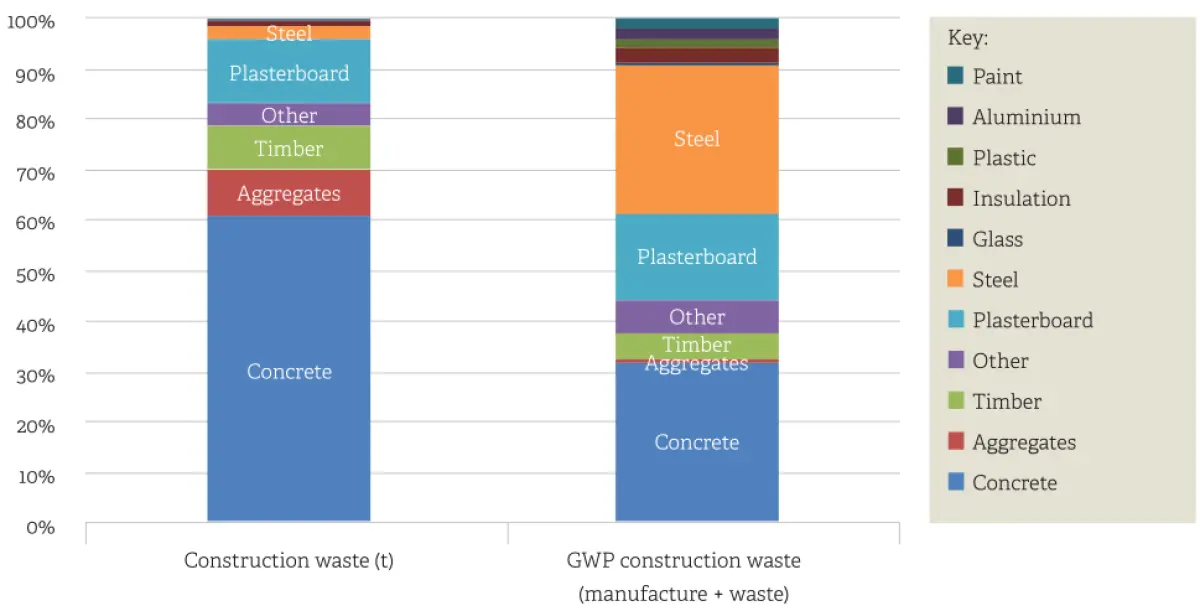
It was found that, by weight, 4.2% of materials were wasted across all buildings. Similarly, the embodied emissions of these materials were responsible for 4.2% of total whole-of-life embodied GHG emissions (see Figure 1).
Most of these emissions come from manufacturing building products (85%) rather than their disposal (15%).
The leading contributors
Concrete was the biggest contributor to construction waste by mass and GHG emissions. This waste is often unseen, as a significant portion returns to concrete batching plants in agitator trucks as unused wet concrete.
Other significant contributors to the emissions from construction waste were steel, plasterboard and timber. Both steel and plasterboard contribute a higher share to GHG emissions than they contribute by mass of construction waste.
For steel, this is due to its relatively high carbon footprint per kilogram when compared with bulk materials like concrete and aggregates. For plasterboard, this is due to a combination of the emissions of manufacturing and the emissions of disposal in a landfill.
Advantages of reducing waste
While saving materials from landfill has the potential to reduce GHG emissions, the emissions generated when products are made are often overlooked.
In the construction industry, emissions generated during the manufacture of products tend to be significantly larger than the emissions generated at the end of the product’s life.
While increasing recycling rates is important, the most effective way to achieve a low-carbon circular economy is to cut down on waste in the first place. Reducing construction waste:
- contributes to a circular economy
- reduces the carbon footprint at the building level by avoiding the GHG emissions associated with manufacturing and disposing of wasted materials
- may reduce the cost of construction by avoiding paying for excess wasted materials when they are disposed of.
How one company cut down on waste
Winstone Wallboards (WWB), manufacturer of gypsum plasterboard under the GIB brand, set a challenge to reduce plasterboard waste in construction across Aotearoa by 30%.
Identifying life-cycle carbon hotspots
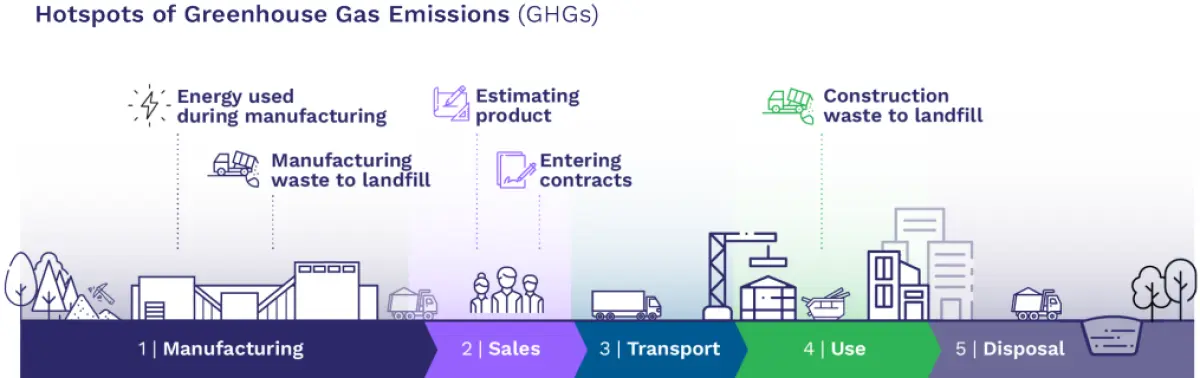
WWB’s designing out waste programme looked at how the business designs its products and transports them to its customer and how the customers use and dispose of products on site (see Figure 2).
WWB identified five hotspots of GHG emissions for construction waste during manufacture, when sold and when used and disposed of:
- Manufacturing – making the plasterboard, disposing of manufacturing waste.
- Sales – specifiers estimating the amount of plasterboard needed for a build, customers signing contracts to build.
- Transport, use and disposals – customers using the plasterboard and disposing of construction waste to landfill. These activities’ emissions are examples of embodied carbon in building products.
They include emissions from sourcing materials, making and distributing products, and using and disposing of them. One factor links these five carbon hotspots – waste.
Tackling waste with custom-sized boards
Much plasterboard waste is created when builders cut down sheets of plasterboard. Even when things go to plan, this results in waste – off-cuts typically can’t be used. Add in mistakes such as cutting a board to the wrong size or damaging it during storage and the waste ratchets up fast.
To reduce this waste, WWB now offers a range of plasterboard lengths and widths. Customers can order custom sizes if they buy 100 boards or more so they can use a size that is most efficient for their project and reduce or eliminate off-cuts.
WWB is pushing for changes across the industry, including:
- clauses in construction contracts to focus project teams on minimising waste
- encouraging modular design based on material sizes
- supporting materials logistics plans so builders receive the right amount of materials at the right time. This reduces the risk of mislaying product, overordering and damaging plasterboard stored on site.
The result has been fewer plasterboard off-cuts, fewer mistakes, less damage and less construction waste going to landfill. There have also been fewer GHG emissions. While the gypsum in plasterboard is inert in landfill – it does not release greenhouse gases – paper and starch do.