




Cross-sectional details for valley gutters are given in both Acceptable Solution E2/AS1 and the NZ Metal Roof and Wall Cladding Code of Practice. However, neither document shows what happens at the fascia board/valley gutter intersection.
Current practice
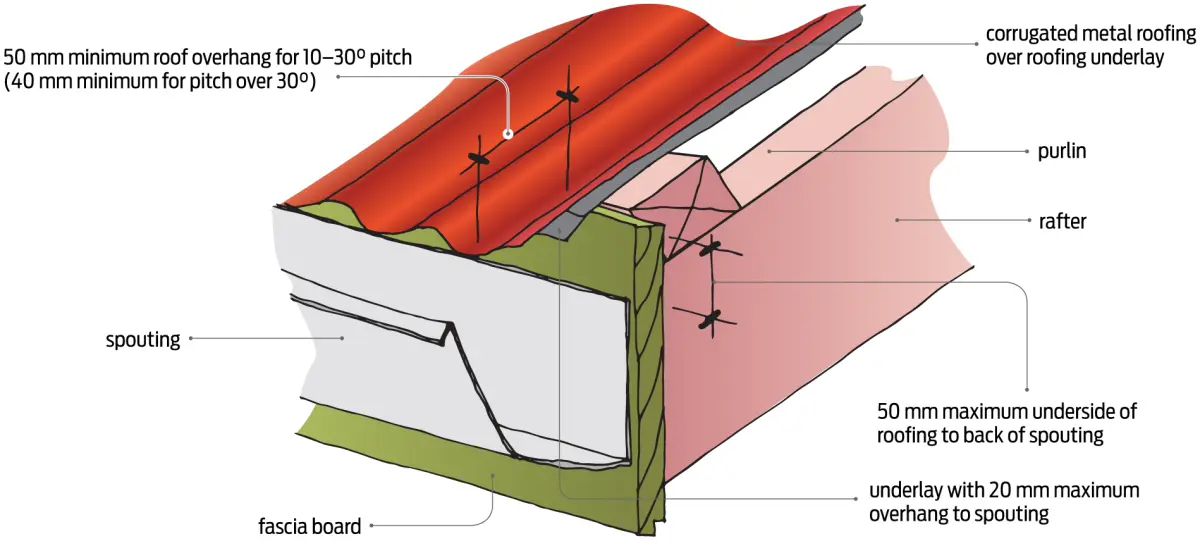
Roof cladding is generally installed over purlins or battens, the top faces of which are generally aligned with the top of the fascia board (see Figure 1). This means that the roof cladding can be carried over the top of the fascia board to overhang and discharge into the spouting fixed to the fascia board.
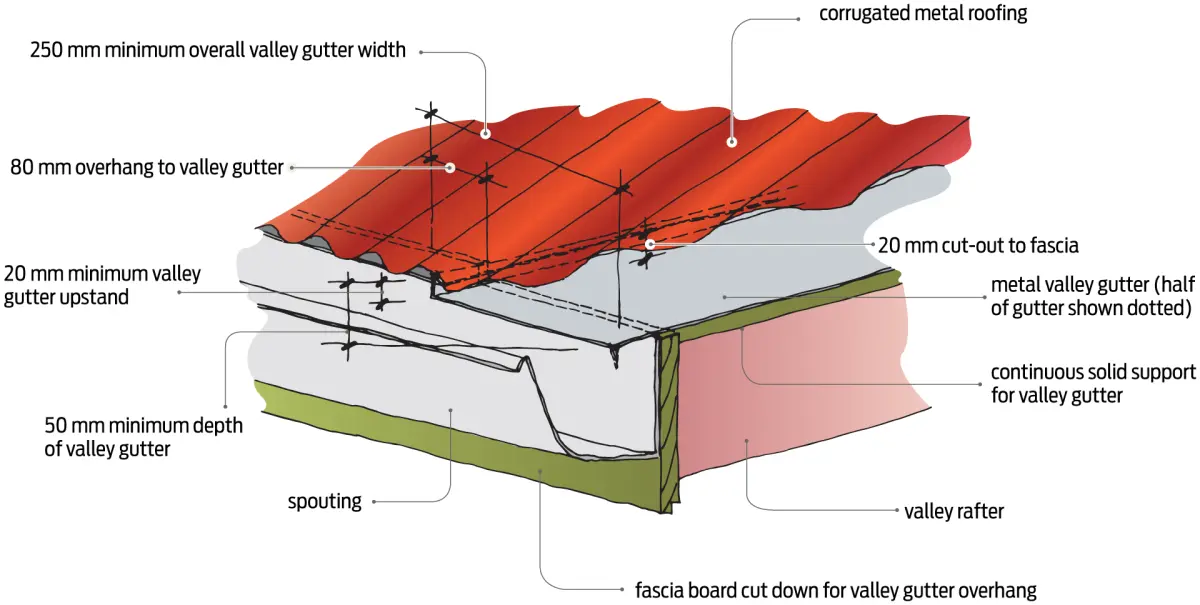
The valley gutter, however, is at a lower level than the roofing and therefore also at a lower level than the top of the fascia board. The usual way of dealing with this situation is to cut down the fascia board where the valley gutter intersects with it (see Figure 2), but the eaves spouting must not be cut down as this will compromise its capacity.
Requirements for valley gutters
Valley gutter requirements are set out in E2/AS1:
- They may only be installed where the roof pitch is greater than 8°.
- They must have a minimum depth at the centre of 50 mm.
- They must be a minimum of 250 mm wide if receiving run-off from a spreader.
Maximum catchment area
Maximum catchment areas for valley gutters are given in Table 8 of E2/AS1 for minimum roof pitch and gutter widths.
Where the roof pitch is between 8–12.5°, the:
- catchment area must be no more than 25 m2
- gutter must be at least 250 mm wide.
Where the roof pitch is 12.5° or greater, the:
- gutter catchment area must be no more than 16 m2
- gutter may be a minimum of 160 mm wide.
Minimum roof overhangs
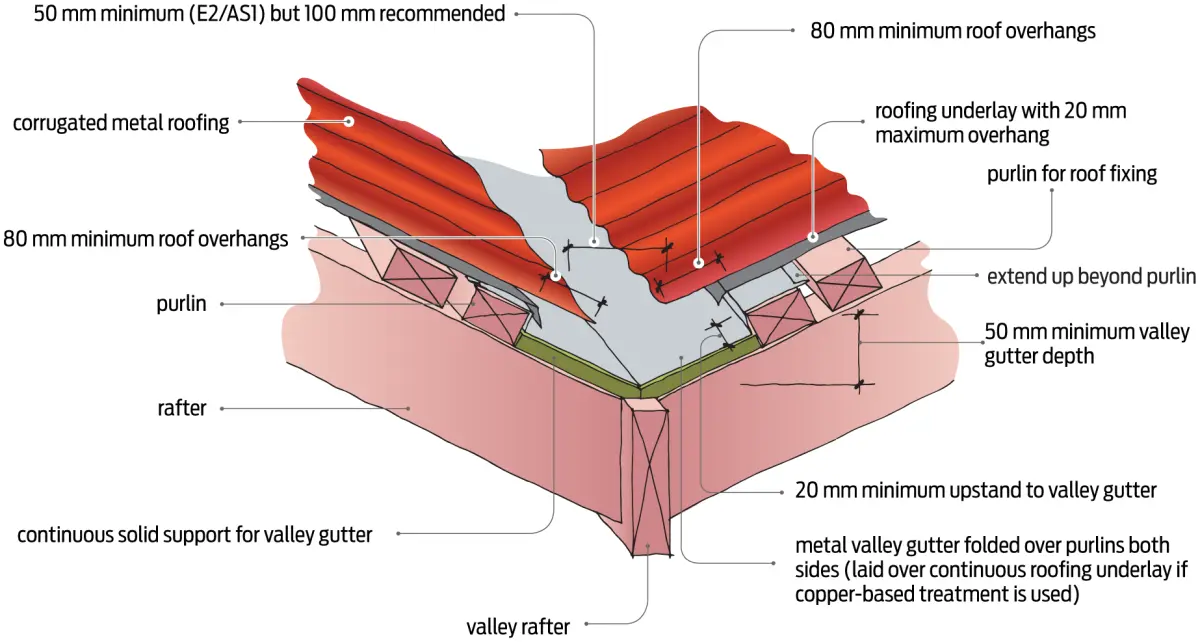
The roof overhangs to valley gutters vary according to the type of roof cladding (see Table 1), but E2/AS1 requires a minimum clearance of 50 mm between the overhangs to be maintained.
| TYPE OF ROOF CLADDING | MINIMUM ROOF OVERHANG TO VALLEY GUTTER |
|---|---|
| Profiled metal roofing | 80 mm |
| Masonry tile roofing | 100 mm |
| Pressed metal roofing | 50 mm |
Where a valley gutter is less than 250 mm wide, for profiled metal and masonry tile roofing, E2/AS1 allows the roof overhangs to be reduced to 60 mm to give a 40 mm clearance between overhangs.
However, a valley gutter with a minimum clearance of 100 mm allows the gutter to be accessed more easily for cleaning (see Figure 3).
The NZ Metal Roof and Wall Cladding Code of Practice also recommends increasing the minimum depth of the valley gutter to 75 mm where the roof pitch is between 8–12°.
Downpipe for catchment over 50 m2
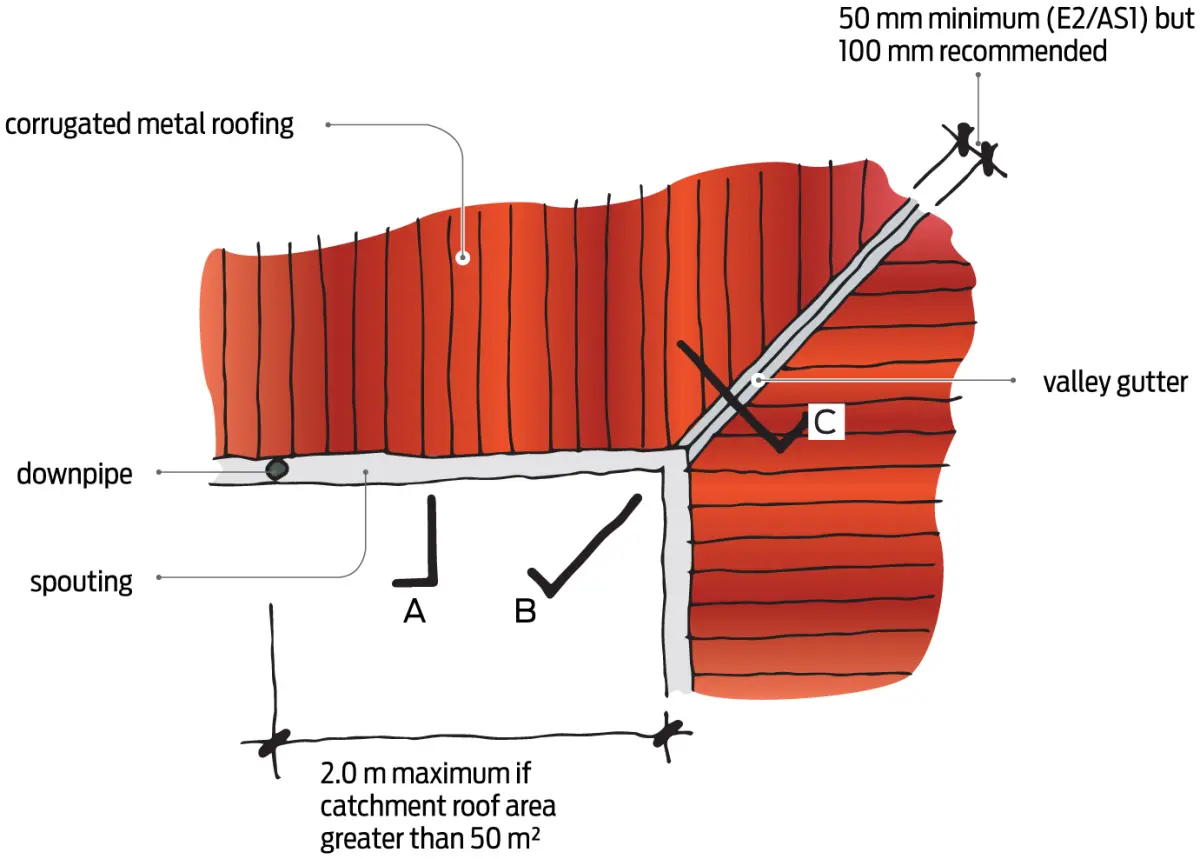
Where a valley gutter discharges into an eaves spouting that has a total catchment area greater than 50 m2, a downpipe must be installed within 2 m of the valley (see Figure 4).
Gutters and upstands
Valley gutters should be fully supported and fixed at the upper end only to allow for thermal expansion and contraction.
Upstands should be on both sides of the valley gutter and extend full height to the underside of the roofing (see Figure 2). The upstands should be terminated with a hook and must not be fixed under the roofing.
Spreaders
Spreaders may not discharge directly into valley gutters.
Where a valley gutter receives run-off from a spreader, the gutter must be at least 250 mm wide.