

New Zealand Building Code clause E2 External moisture deals with the weathertightness of the building envelope for buildings within the scope of NZS 3604:2011 Timber-framed buildings. These are described as up to 3 storeys or no greater than 10 m in height, with a floor plan limited by seismic and structural control joints and with vertical walls and roofs with a pitch of 60° or less.
Acceptable Solution E2/AS1 provides one means of compliance with clause E2 so buildings that are designed in accordance with E2/AS1 must be accepted by the building consent authority (BCA).
E2/AS1 risk matrix
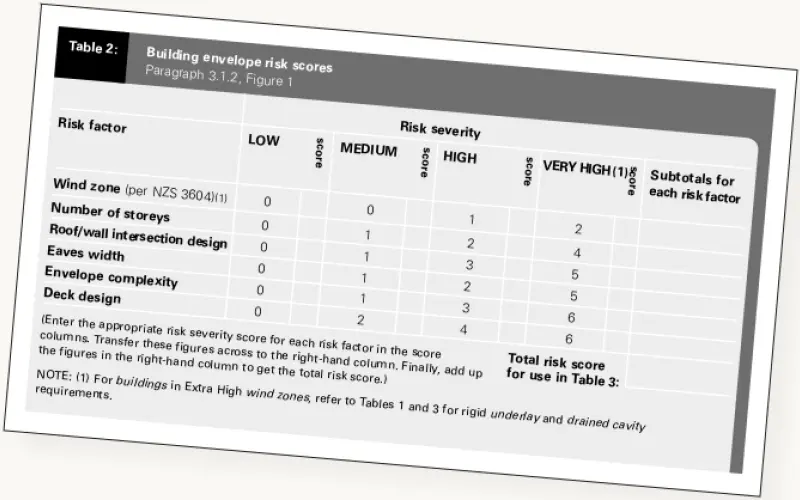
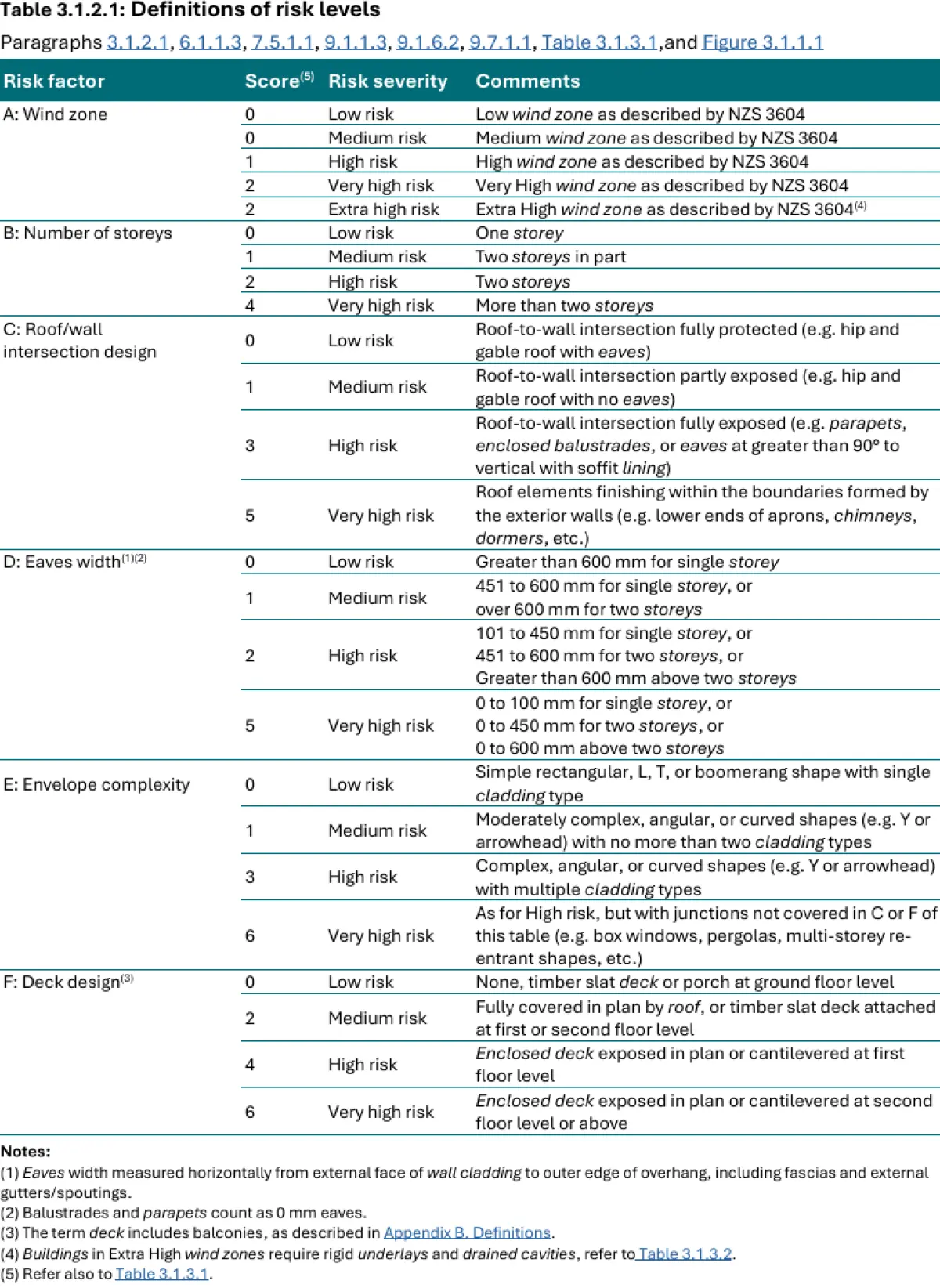
A key tool for weathertightness assessment in E2/AS1 is a risk matrix, which allows designers to calculate the weathertightness risk of the building envelope. The risk matrix identifies six different risk factor categories, each of which is assessed with a low, medium, high, very high or extra high-risk severity (see Table 1 from E2/AS1).
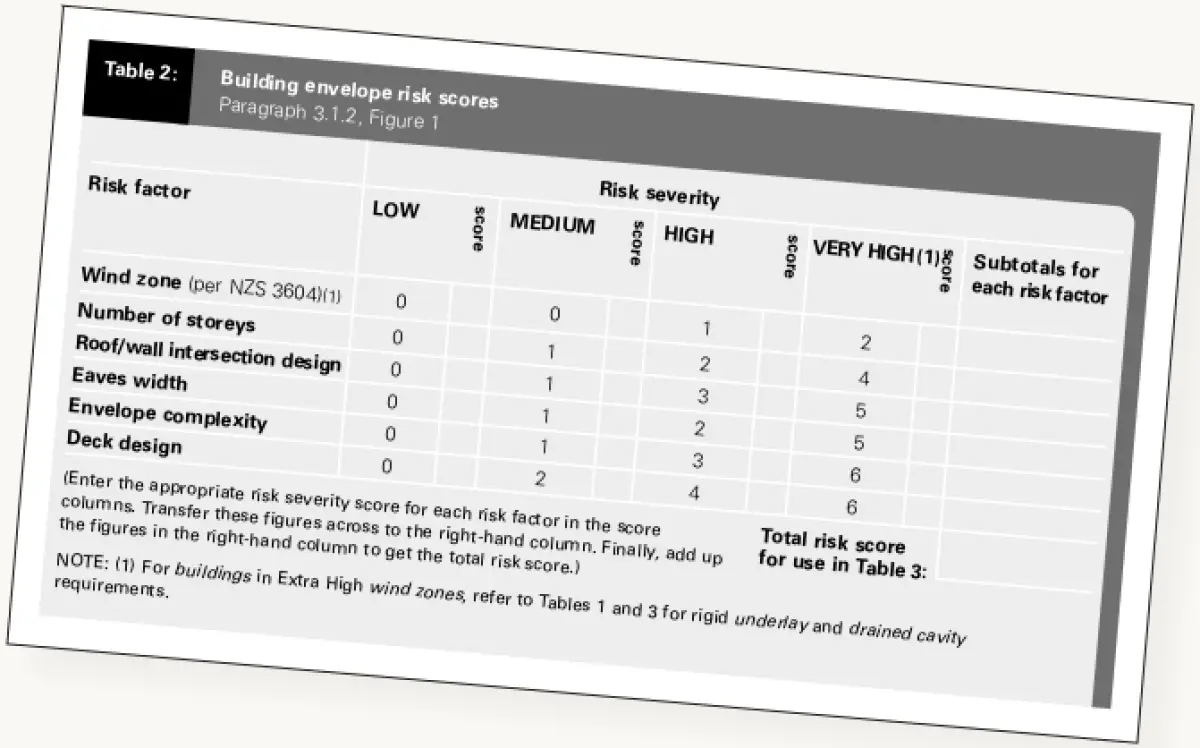
A risk matrix is prepared for each external face of the building with each risk factor allocated a value according to the particular risk. The values are then added together to give a total risk score (see Table 2 from E2/AS1) on which selection of the wall cladding and type of fixing may be made.
Risk factor categories
These are the risk factor categories:
- Wind zone – as per NZS 3604:2011 section 5.
- Number of storeys – may be 1, 2 or 3 storeys. Note that the Acceptable Solution describes ‘more than 2 storeys’, while the scope of E2/AS1 states ‘up to 3 storeys with height measured from the lowest ground level adjacent to the building to the highest point of the roof – except for chimneys and aerials – of 10 m or less’.
- Roof/wall intersection design – junctions and intersections have a higher risk of leaks.
- Eaves width – the presence of eaves provides walls with shelter from rainfall. The amount of shelter provided is a function of both the width of the eave and the height of the wall.
- Envelope complexity – a more complex building envelope means more junctions and intersections and a correspondingly higher risk of leaks.
- Deck design – decks often penetrate the external cladding and therefore pose a significant weathertightness risk to a building. The level of risk also varies according to the deck type – slatted or enclosed, design and location.
Risk scores
Once the values of each risk factor have been added together, the total risk score gives a risk category for each face of the building of:
- 0–6 – low risk
- 7–12 – medium risk
- 13–20 – high risk
- over 20 – very high risk.
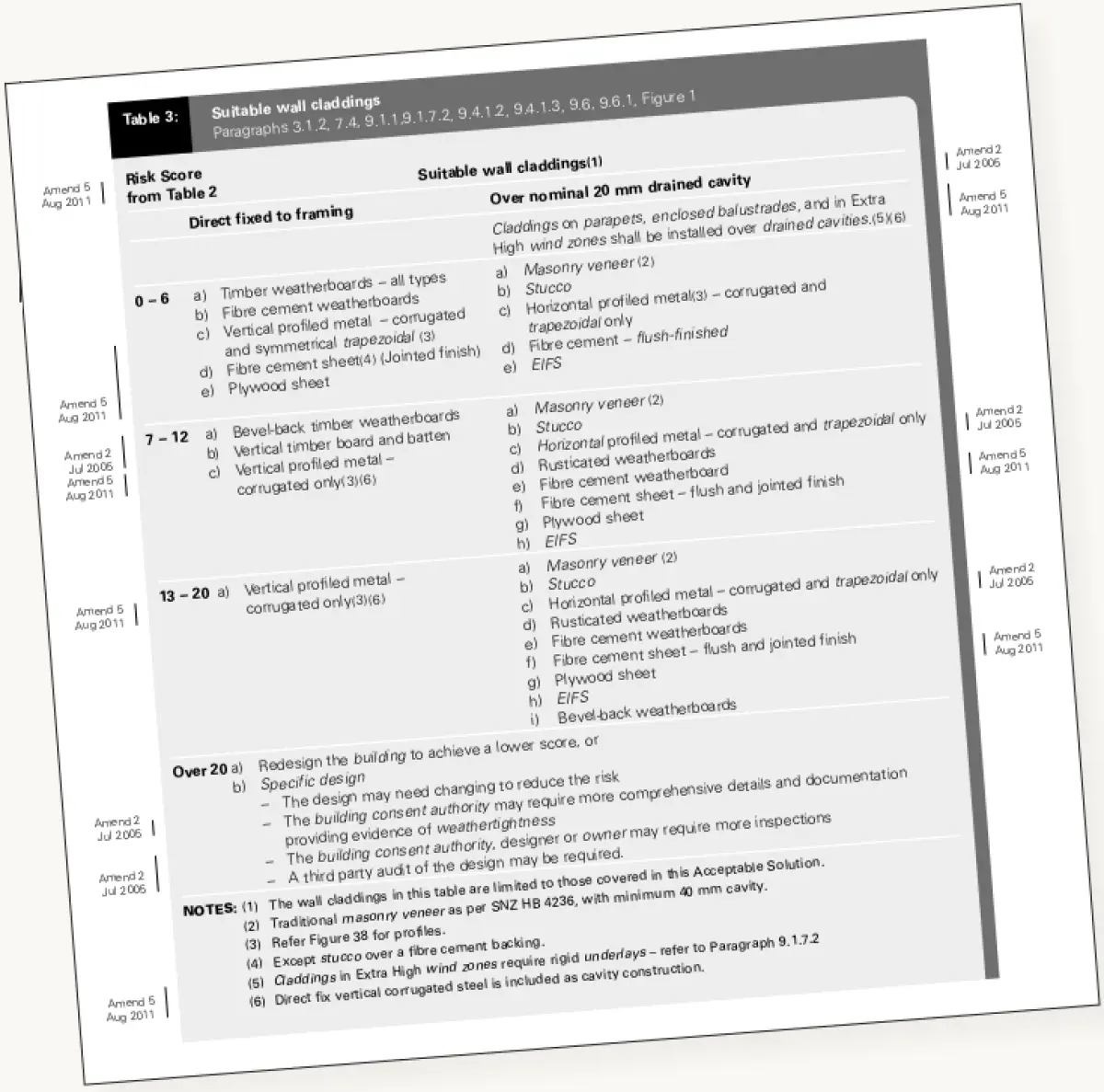
From the risk score, an appropriate cladding and fixing system can be selected (see Table 3.1.3.2 from E2/AS1). If the total risk score for a façade is greater than 20, the building or the façade will need to be redesigned or alternatively require specific design.
Specific design requirements may include:
- changing the design to reduce the risk
- providing the BCA with more comprehensive evidence of weathertightness of the building
- carrying out more inspections during construction
- a third-party audit of the design.
Complete a risk matrix for each façade
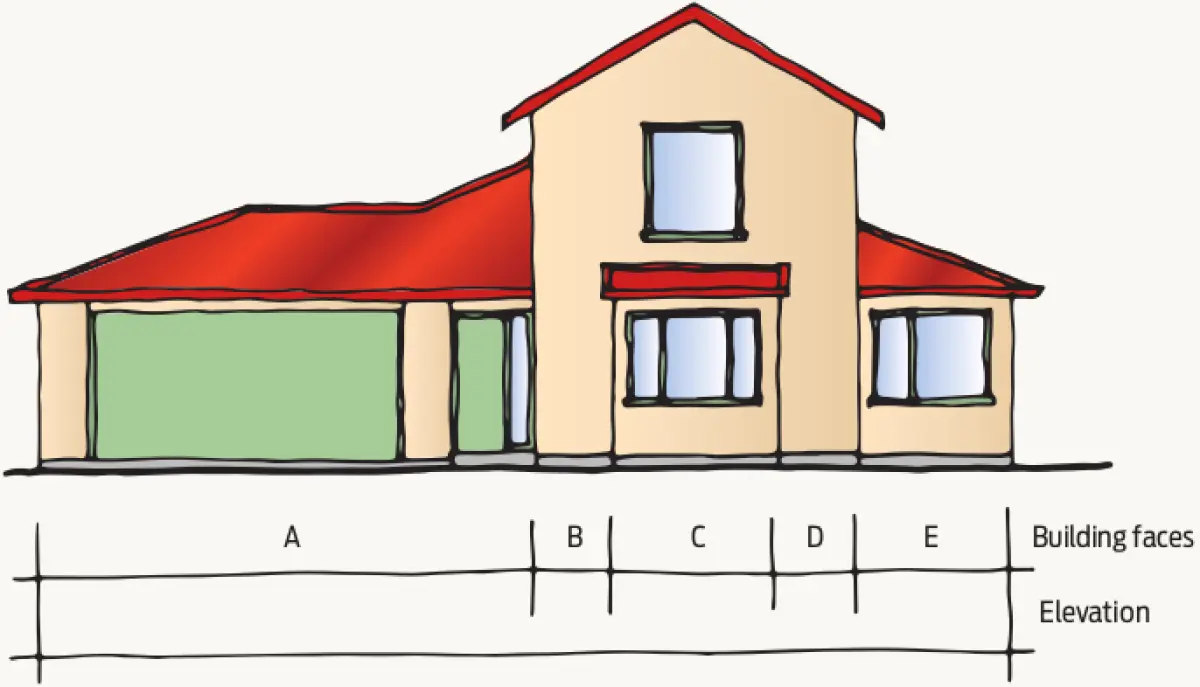
A risk matrix should be completed for each façade of the building and may apply to either:
- each elevation of the building,
- each external wall face of the building (see Figure 1).
An elevation is a plane view of one side of the building, and includes all the parts of the building seen from a particular compass direction. An external wall face refers to either part or all of an elevation depending on how the building is to be assessed.
The elevation approach works best for simple building designs whereas the external wall face approach is more suitable for complex building designs.
A building envelope risk matrix must be included in building consent application documentation.