



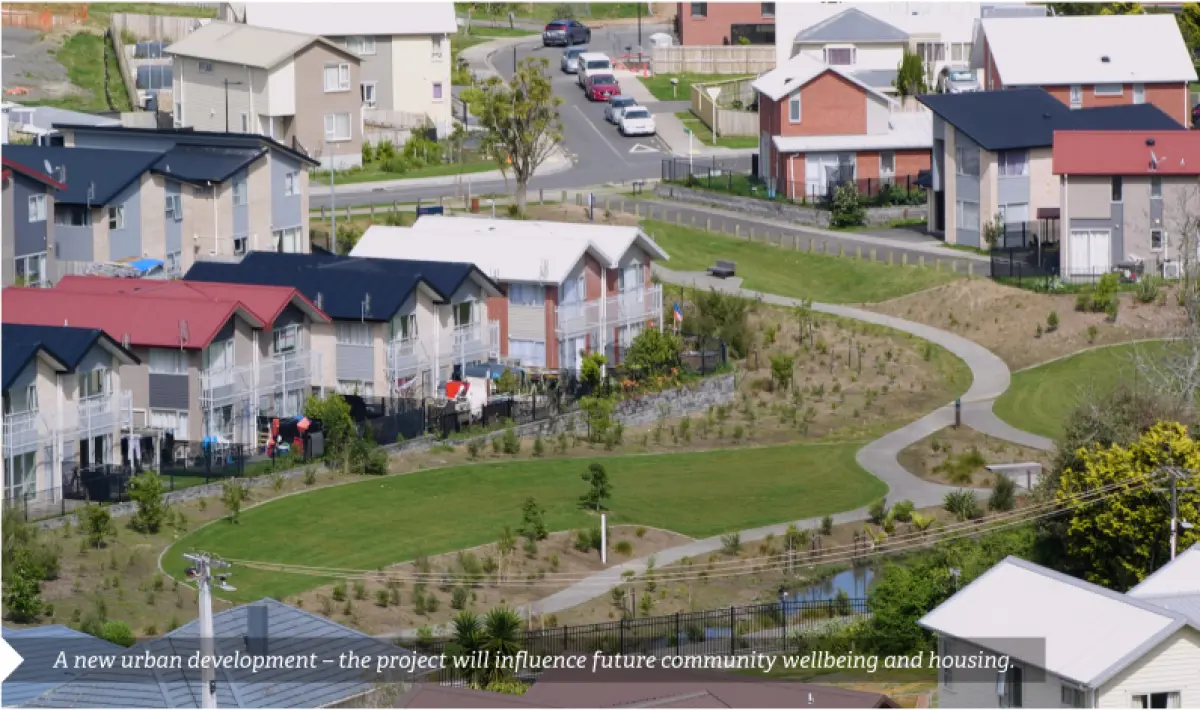
Te Hotonga Hapori – Connecting Communities is a research programme exploring the relationship between urban redevelopment and community wellbeing. Its overarching purpose is to provide evidence that can be used to positively impact the multi-billion dollar transformational urban redevelopment projects taking place across Aotearoa New Zealand.
Who’s in the programme?
Te Hotonga Hapori is led by Professor Scott Duncan from the Auckland University of Technology (AUT) and is funded through MBIE’s Endeavour Research Fund. It is the result of a collaborative co-design process involving partner organisations with a shared vision for people-centred urban development.
Founding partners include AUT, Kāinga Ora, which is undertaking significant urban redevelopment projects across Aotearoa New Zealand, and Isthmus Group, an integrated design studio involved in the design and planning of these redevelopments. More recently, BRANZ joined the Te Hotonga Hapori research consortium.
These partnerships, in addition to those held with key government agencies and international research organisations, will ensure that research findings will inform decision making, urban design guidelines and urban development policy.
In this way, Te Hotonga Hapori offers a rare opportunity to integrate wellbeing research into the planning and implementation of urban redevelopment across Aotearoa, promoting better wellbeing outcomes for people and their communities both here and overseas.
Interrelated projects
Te Hotonga Hapori comprises five unique but interrelated projects, each contributing to the programme’s main objectives to:
- ensure the stories, histories and experiences people value within their communities are heard by those who design and build neighbourhoods
- understand how people’s use of time and the places they move through impacts their daily wellbeing in the context of major urban redevelopment
- explore how the contemporary design of homes affects individual and whānau wellbeing
- investigate how personal wellbeing changes over time in Kāinga Ora tenancy customers across Aotearoa
- track indicators of population wellbeing using anonymised administrative data.
Community Wellbeing and Lived Experiences
This project partners with communities and local stakeholders to learn more about their stories, histories and experiences within their neighbourhoods. Primarily qualitative in nature, it will apply citizen science methodologies to assist communities to advocate for positive change in the places they live. It is the first step towards understanding what places and spaces have the most meaning in people’s lives.
Building Wellbeing in Your Community
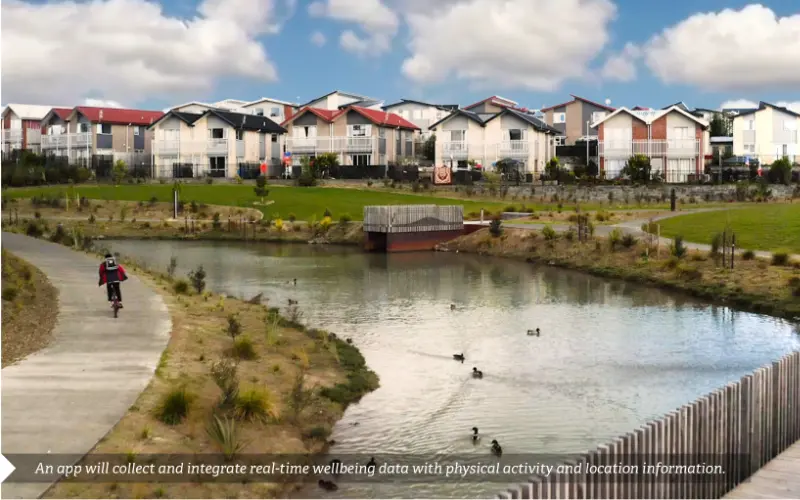
In this project, innovative technologies are being used to better understand how people’s wellbeing is affected by their time use, including movement around and interaction with their local environment. An example is the new Te Hotonga Hapori wellbeing app, developed specifically for this research, which collects and integrates real-time wellbeing data with physical activity and location information.
Building for Wellbeing
This project, led by BRANZ, will examine the impact of housing design on occupant health and wellbeing to capture the selfreported perspectives of residents about the impact their homes and the immediate surrounds have on their wellbeing.
Findings will help the construction industry and sector move towards peoplecentred building design that prioritises individual and whānau wellbeing. This project will assist both industry and government to mitigate the impact of large-scale construction on residents and communities.
Wellbeing in Kāinga Ora Communities
This project was launched in 2022 and centres on the wellbeing of Kāinga Ora tenancy customers and the impact their living environment and neighbourhood has on their wellbeing.
Every year for 3 years, participants will be invited to complete an online survey that examines diverse aspects of wellbeing, gathering both individual and whānaulevel measures of wellbeing.
Tracking Indicators of National Wellbeing
This project utilises Stats NZ’s Integrated Data Infrastructure (IDI) to identify and quantify the area-level wellbeing impacts of urban redevelopment. Researchers will access population microdata contained in the IDI for a range of wellbeing outcomes adapted from the New Zealand Treasury’s Living Standards Framework. Outcomes include:
- human capital measures such as education and labour market outcomes
- physical and mental health measures such as hospital admissions and mental health access
- crime and safety such as victimisation and accident rates.
Key insights and reports to come
Findings from Te Hotonga Hapori will be shared through the programme’s website, academic publications and customised reports for research participants, industry partners and government departments.
The research team will ensure that insights gathered over the 5 years will flow through to future planning and design of neighbourhoods, community spaces and housing. Improving community and whānau wellbeing is a top priority for this research.
Articles on the Te Hotonga Hapori projects will feature in future editions of Build. The research team is interested in engaging with all areas of the housing and construction sector and welcomes questions and feedback.
To contact the research team or learn more about Te Hotonga Hapori, visit tehotongahapori.ac.nz or email Programme Manager Julia McPhee on jmcphee@aut.ac.nz