



For a great many years, most of our houses were designed for natural ventilation by providing opening windows or other openings to the exterior equal to at least 5% of the floor area of the space. That’s in Acceptable Solution G4/AS1 today.
The calculation is unchanged from regulations that existed back in 1947, when many people happily left their windows open for long periods whether they were at home or not. Things are different now.
A change in habits
While opening windows can provide effective ventilation as BRANZ testing has confirmed (see Open windows for dry homes in Build 158), it requires diligent occupants and is not that compatible with modern lifestyles. As a result, a significant proportion of homes are underventilated.
Mechanical ventilation systems beyond the standard bathroom extractor fan and kitchen rangehood are being installed in an increasing number of homes. In some cases, these are installed on the exterior wall of a building and do not use ducting. Other systems, including centralised whole-house systems, require ducting.
Ducting can be a weak spot
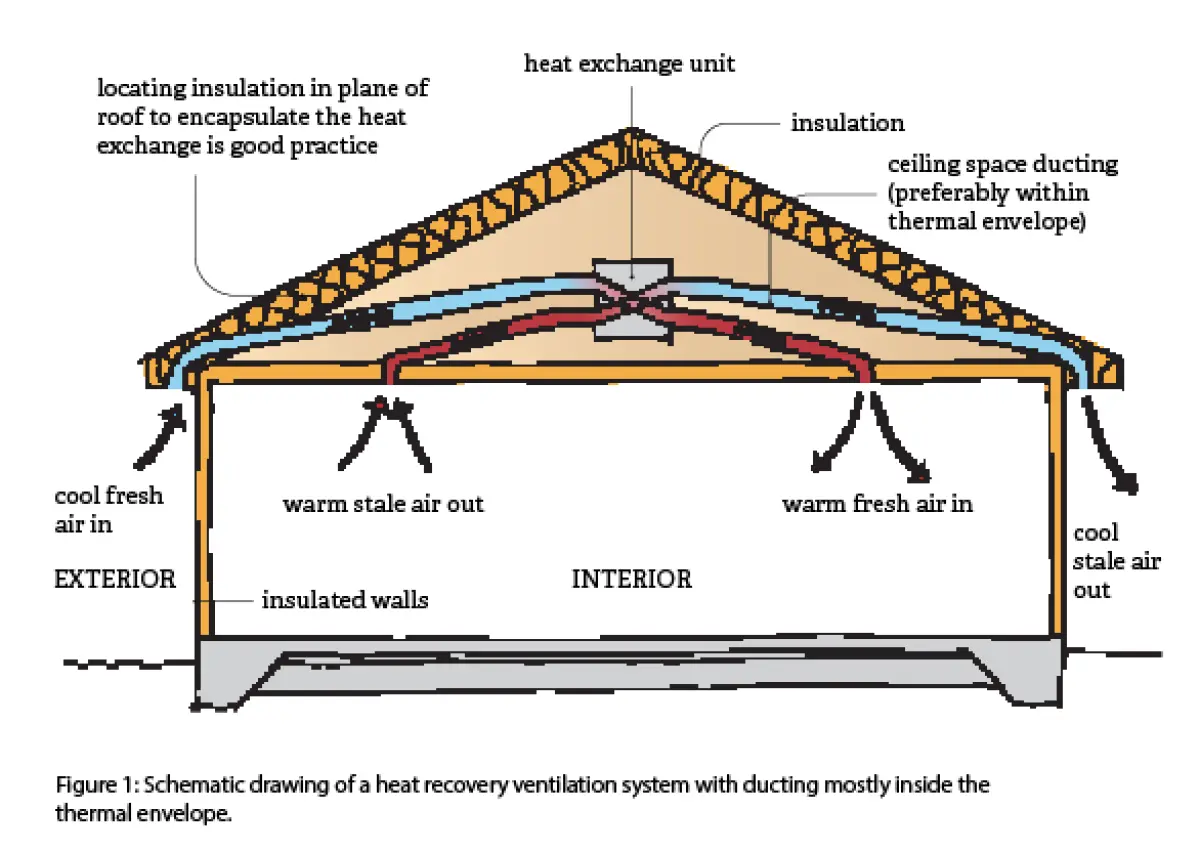
The impact ducting has on a system’s efficiency and how it should best be installed can be seen in tests that BRANZ has conducted with heat recovery ventilation systems (Figure 1 shows the principles of these systems).
There are two fans and two sets of ducts, one to draw in fresh air from outside and another to remove stale internal air. An air-to-air heat exchange core recovers heat from the internal air before it is discharged to the outside and warms the incoming air with the recovered heat.
These systems can perform well but the ducting is potentially a serious weak spot, particularly where the building has a traditional cold roof. The findings around ducting from tests of these systems can apply in many cases to the ducting of other types of ventilation where ducts carry warm air.
Dodgy ducting cuts efficiency
In a balanced heat recovery ventilation system installed in the BRANZ test house, around 90% of heat was recovered from ventilated air within the core. However, the actual delivered efficiency dropped to around 55% when losses through ducting were considered.
A separate test was run where excess ducting length was used to create an unbalanced system. This found an efficiency of 70% in the core, and the efficiency of the system as a whole dropped to around 40%.
A third scenario was tested where the system had equal duct lengths that were wrapped in an additional layer of R1.5 blanket. Total system efficiency improved to almost 60%. In other words, shortening and better insulating the ducting improved the performance of the whole system by about 50%.
Location, insulation are crucial
The walls of ducting carrying warm air are a significant path for heat loss. If ducting in heat recovery systems is installed outside the building’s thermal envelope, the heat recovery performance is significantly reduced and there is an increased risk of condensation forming inside the ducting.
The ducting on the warm air side of the system should therefore be installed within the thermal envelope wherever possible so the air inside and outside the ducting is at the same temperature. While this is achievable with a warm roof design (as in Figure 1), it is not an option for cold roofs where the insulation sits above the ceiling.
Where the ducting is outside the home’s thermal envelope, it should be well insulated. Even where ducting is already insulated, adding extra insulation will be beneficial. In the second test we described here, the original ducting was already insulated but only to around R1.0. The extra layer of R1.5 blanket insulation brought the total thermal performance up to about R2.4.
Get your ducts in a row
Actions to reduce airflow resistance, reduce noise and maximise efficiency:
- Specify larger diameters for higher-flow extractor fans. The larger the diameter, the better and quieter the airflow. The diameter should be 150–250 mm where possible, reducing to 120–150 mm if necessary at ceiling vents or grilles. Smaller ducting is not recommended as airflows need to be higher, creating greater noise and energy use for fans. For more, see BRANZ Bulletin 581. However, when considering whole-of-home permanent mechanical ventilation systems, flow rates are much lower and smaller diameters are generally used.
- Aim for the minimum number of bends in the ducting. Where bends are unavoidable, ensure they have a large radius.
- Have short run lengths.
- Specify smooth internal surfaces for as much of the length as possible.
- Ducting should be well sealed and not allow air to leak into other spaces.
- Hangers holding the ducting should be well fixed to the building structure and spaced to minimise sag in flexible ducting. Ducting may also sit on ceiling joists.
- Ensure the system is accessible for maintenance.
With heat recovery systems, a condensate drain is required for the exhaust ducting to allow the removal of moisture created when the heat is removed from the air.
Additional considerations for ventilation ducting particularly in medium-density housing projects:
- Acoustic requirements may require the specification of duct silencers.
- Passive fire design may require fire dampers and collars in the ventilation system.
- Midfloor as well as internal and external wall and roof construction may have an impact.
After installation, ventilation systems should be checked to ensure they are operating properly. This involves confirming that:
- ducting is properly connected and sealed and there is no air leakage
- airflow rates are as expected
- in heat recovery systems, the air inflow and outflow are balanced – balanced flow hoods can be used as diagnostic tools.
Ducting from kitchens and bathrooms
There are few specific requirements for house ventilation ducting dimensions in current New Zealand standards and regulations. For example, there are none in NZS 4303:1990 Ventilation for acceptable indoor air quality or G4/AS1. This is a significant barrier to the adoption of mechanical ventilation in general.
The requirements are generally around airflow rates. In the healthy homes standards that are compulsory for rental properties, the ventilation standard sets some dimensions that may be taken as a guide for minimum acceptable performance in owner-occupied properties: ‘An extractor fan can meet the minimum requirements through either size or exhaust capacity. If a fan is meeting the requirement by size, the extractor fan unit and the ducting must all have a diameter of at least 120 mm (for bathrooms) or 150 mm (for kitchens). The required diameter of the ducting must be maintained throughout, including through cornering or any changes in direction.’
No ins or outs in the roof space
Ducting for ventilation systems designed to meet Building Code requirements should not draw air from the roof space, and no ducting systems should expel air there.
Supply ventilation systems, including heat recovery systems, should draw fresh air from outside the house to meet ventilation requirements. Building Code clause G4 states: ‘Spaces within buildings shall have means of ventilation with outdoor air that will provide an adequate number of air changes to maintain air purity.’ Roof space air is not outdoor air.
Exhaust air should always be expelled outside the house because expelling it into the roof space can lead to problems from the moisture it holds.