

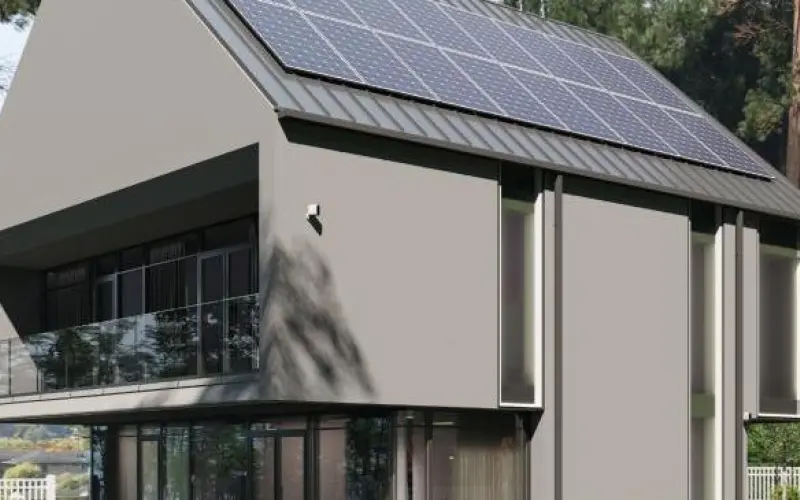


Solar photovoltaic (PV) systems have fallen in price dramatically in the last decade, and that has been one of the main drivers for a boom in installations. At the end of 2022, there were over 41,000 residential installations in Aotearoa New Zealand, almost twice the number there were just 4 years earlier. There were barely a thousand in place 10 years ago.
While the PV systems being installed have improved over the years, the fundamental appearance, form and technology behind them hasn’t changed. The heart of the panel is polycrystalline silicon, and the panels themselves are rigidly framed structures with a weight and an inflexibility that limits where they can be installed.
Innovative printable organic PV systems
At the MacDiarmid Institute for Advanced Materials and Nanotechnology at Victoria University of Wellington, Co-Director and Principal Investigator Professor Justin Hodgkiss is researching printable organic PV systems that will be lightweight and flexible.
They can be rolled up and transported. This means they have far wider potential uses than the current rectangular panels because they don’t require rigid frames and can be installed on surfaces that are not flat and not load bearing. It also means that they have the potential to be manufactured in Aotearoa and exported around the world.
Rather than crystalline silicon, the new technology is based on organic – carbonbased – layers that are printed on a flexible plastic base, manufactured roll-to-roll like wallpaper or multi-layer food packaging. ‘In practical terms, PV systems will change from being rigid like a potato chip to being flexible like the packaging the chip comes in,’ Professor Hodgkiss told Build.
Can be produced in any colour
The ideal colour for maximum solar energy absorption is black, but the PV sheeting can be produced in any colour to match an architectural aesthetic. Samples in dark blue and dark red have already been produced.
Apart from working with colour, the MacDiarmid researchers are also using nanotechnology to find a way of creating a surface where no light bounces off. Light that bounces off is lost and not transformed into electricity.
Potential to be added to other building materials
The new technology does not necessarily have to be a stand-alone PV system added to an existing structure. For example, it could potentially be incorporated into glass, replacing tinted glass in windows, generating electricity from the light falling on and passing through the window. It could be built into other construction materials.
The obvious national benefit is that producing a much larger proportion of our electricity from the Sun can help the country reach the goal of a net-zero carbon economy by 2050.
The new printed PV sheets require lower process temperatures and use less material than traditional silicon-based panels. They would have a faster payback time, with the power they generate more quickly offsetting the embodied carbon in their manufacture.
The embodied carbon and the energy required in the manufacture of a material is an important issue and applies to PV systems as much as any other building material.
Many crystalline silicon-based PV systems are manufactured in China in high-temperature processes using electricity generated from coal. The recycling of the materials at the end of a PV panel’s life is problematic. Manufacturing that uses far less material and renewable energy – and less energy overall – is therefore a step forward.
The durability gap is closing
‘There is a perception that organic materials are not long-lasting,’ Professor Hodgkiss says.
‘But accelerated ageing tests have indicated that the materials have a durability of more than 10 years and likely over 20 years.’ This is currently less than the best silicon panels – some manufacturers of these offer 25-year warranties on their products – but the gap is being closed.
The flexible PV systems also have, currently, a slightly lower power conversion efficiency – the proportion of solar energy they receive that they convert into electricity – than traditional silicon panels. The efficiency rate has been climbing over recent years of research, however.
The research is continuing to seek the optimum recipe of materials for efficiency, durability, sustainability and cost. Serious investment funds for commercial production are likely to become available when the best materials and combinations of materials are identified.
Once production begins, the new PV systems will initially be more expensive than the current technology, as is always the case, but prices will fall as production volume increases. Professor Hodgkiss believes commercially produced organic PVs will soon appear in niche applications requiring flexibility and light weight, and the new PV systems will eventually be cheaper than silicon PV panels.
Given the fact that as much solar energy falls on the Earth in 1 hour as the world uses in a year, the potential is enormous.
Solar PV is about light, not heat
Solar PV systems generate electricity from light, not heat. This means that they are not just an option for warmer areas of Aotearoa but can produce electricity even in cooler areas. If you want to determine the potential for solar PV generation at a given site, several tools can help: