

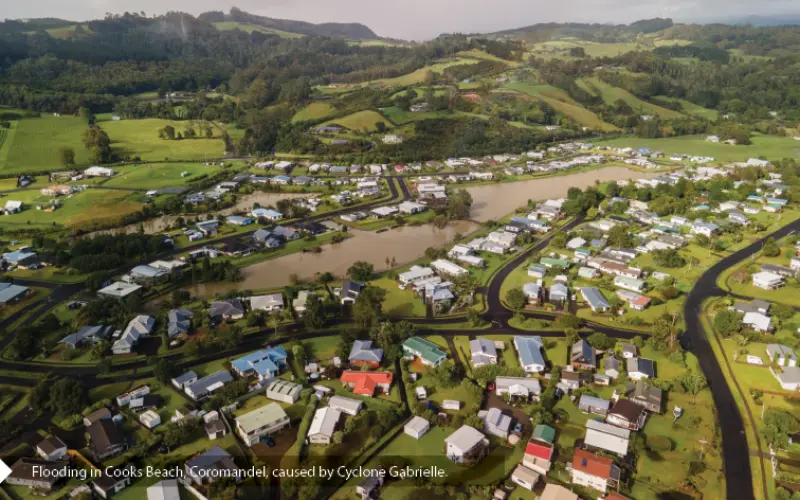


As regions of Aotearoa New Zealand have reeled under the onslaught of extreme weather, bespoke legislation and Orders in Council (OICs) have been used as mechanisms to respond on an event-by-event basis. For example, the Severe Weather Emergency Legislation Act 2023 was passed under urgency and made temporary changes to existing legislation to assist with recovery efforts from Cyclone Gabrielle.
A second piece of legislation, the Severe Weather Emergency Recovery Legislation Act 2023, quickly followed, introducing an OIC mechanism to ‘add flexibility to address specific issues recovering communities may be experiencing’.
The OIC addressed a range of issues, including how waste from the cyclone such as silt and debris was managed. More recently, an OIC was issued for flood protection works in Hawke’s Bay.
Flooding caused by Cyclone Gabrielle resulted in significant areas of land in Hawke’s Bay becoming unsafe to inhabit without the development of new stopbanks and other works to protect homes and communities from future flooding. The OIC temporarily amends the Resource Management Act 1991 (RMA) and associated regulations to speed up flood protection works in Hawke’s Bay.
Current adaptation framework
To date, the response to these events has focused on recovery or repair after the fact rather than increased resilience or adaptation in advance of the future events occurring.
The current framework for addressing climate change includes the national adaption plan (NAP), which goes some way to addressing climate adaptation and infrastructure although it is insufficient on its own, as explained below.
The NAP considers the impacts of climate change now and into the future and sets out a 6-year action plan for Aotearoa to adapt to the warming globe.
A proposed National Policy Statement for Natural Hazard Decision-making (NPS-NHD) was in the works under the previous government and would have directed councils to give greater weight to natural hazards when considering resource consent applications.
If the risk of a hazard such as a flood, earthquake or landslip was deemed too high, new development could be stopped. In areas where the hazard risk was moderate, developers would need to undertake risk-reduction works. The intention was for the NPS-NHD to be introduced early this year as an interim measure, while a more comprehensive National Direction for Natural Hazards was developed in the longer term. The government is yet to comment on whether the NPS-NHD will be issued.
Inquiry into climate adaption
We will see more events like the Auckland Anniversary floods and Cyclone Gabrielle in the coming years. While the temporary legislation and localised OICs were required to support recovery efforts in response to those specific events, Aotearoa needs to stop treating these events as isolated and one-off and start creating a system to manage this new normal.
In this context, it is a welcome step that Parliament has asked the Finance and Expenditure Committee to conduct an inquiry into climate adaptation in Aotearoa. The purpose of the inquiry is to develop and recommend guiding objectives and principles for the design of a climate adaptation framework that is intended to:
- set out the government’s approach to cost-sharing
- help communities and businesses understand what climate adaptation investment is planned in their area and what support will be available to help recover from climate-related events
- improve information sharing
- guide decisions before a severe weather event happens as well as long-term recovery after such an event.
The Committee will prepare a report that identifies the high-level objectives and principles required to support the design of a climate change adaptation framework. This builds on the inquiry into community-led retreat and adaptation funding initiated by the previous government and undertaken by the Environment Committee.
The new inquiry’s terms of reference do not specifically reference managed retreat or the resource management system, which some local government authorities have criticised as inadequate for preventing development in areas prone to natural hazards. However, the approximately 150 public submissions made under the previous inquiry and the expert working group report into managed retreat will be considered by the Committee in this new inquiry.
Legislation required to support the framework is expected to be introduced in early 2025.
New high-level climate strategy
In another relevant announcement, the government recently released a new high-level climate strategy, Responding to a changing climate, which sets out its approach to delivering on Aotearoa’s climate goals. There are five pillars to the strategy, focused on ensuring:
- infrastructure is resilient and
- communities are well prepared
- credible markets support the climate transition
- clean energy is abundant and affordable
- world-leading climate innovation boosts the economy
- nature-based solutions address climate change.
The government provided an expanded definition of the first pillar – ‘Delivering a fair and enduring adaptation system that helps New Zealand be ready for climate change and provides clarity on costs’.
Not on target
Consultation on the second emissions reduction plan has also opened. New projections show the country is no longer set to reach the 2050 net-zero target nor the third emissions budget in 2031–2035.
The figures are a marked departure from projections developed under the previous government, which would have achieved net zero by 2041. According to a Treasury report, if we do not reduce our greenhouse gas emissions trajectory, the cost to meet the 2030 target in carbon credits is $23 billion, which has not been budgeted for.
While we wait for adequate national direction or new legislation, infrastructure and housing are still being built in hazard-prone areas. In Auckland, for example, more than 1,400 consents for new houses and supporting infrastructure were granted in flood plains in the 12 months after the devastating floods of 2023.
RMA shortcomings
Councils are increasingly using RMA instruments such as district plans to influence land use, but the RMA does not provide all the tools councils need – a way to change plans faster to address climate change-induced changes and more funding to update natural hazard data and models. RMA plans cannot direct who should pay for adaptation, including managed retreat, and RMA existing-use rights complicate council initiatives for managed retreat.
Overall, our current system is not equipped to deal with severe weather events. The process is too slow and ad hoc and is reactive rather than proactive. A new national structure and funding system for climate adaptation measures are required to:
- limit the impact of climate-related events in the first instance
- respond effectively and efficiently after the fact.
The new inquiry into adaptation and the progress report on the NAP give a good indication of where we are now and how we can move forward.
While this is a promising start, swift action is required so we can begin to adapt our infrastructure to climate change. Climate-related natural hazard events will not wait for Aotearoa to finish inquiries, reporting and planning.