




New Zealand Building Code (NZBC) Acceptable Solutions and Verification Methods reference national and international standards that define the performance that building components and systems must meet or exceed. Under the building performance system, several compliance pathways exist to demonstrate that buildings comply with NZBC requirements. Many building elements must satisfy multiple NZBC clauses to ensure they perform as intended throughout their service life.
External windows and doors are key examples. These products must remain weathertight, airtight, durable, and operable, while providing effective separation between interior and exterior environments. Assessing their suitability for low-rise residential buidings requires consideration of multiple NZBC clauses, including:
- B1 Structure
- B2 Durability
- E2 Weathertightness
- F2 and F4 Safety
- H1 Energy efficiency
The primary standard used for testing the weathertight performance of windows and exterior doors is NZS 4211:2008 Specification for performance of windows (referenced in the Building Product Specifications) along with its updated version SNZ TS 4211:2022 Classification for the performance of windows. These standards verify compliance with several – but not all – NZBC requirements, covering structural performance (B1), aspects of weathertightness (E2), and airtightness, but not durability (B2), safety (F2 and F4), and thermal performance (H1). As a result, additional evidence is often required to demonstrate full compliance of a window or exterior glazed door with the NZBC.
To support this, building consent authorities (BCAs) may rely on product certification schemes such as CodeMark or BRANZ Appraisals, which provide assurance of fitness for purpose. In the absence of these, BCAs must evaluate a package of technical information, including NZS 4211 test reports and supplementary evidence related to durability, safety and thermal performance.
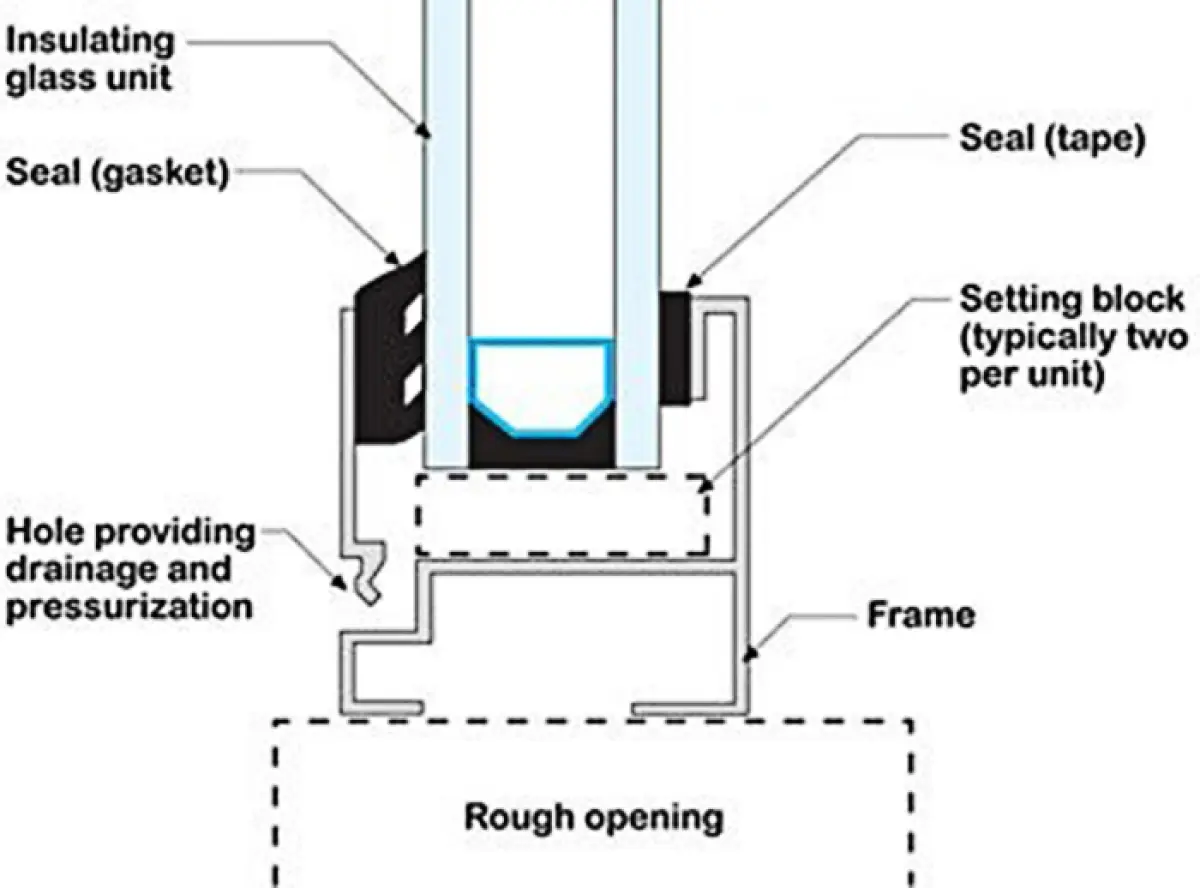
A significant consideration for window and door systems is the integration of insulating glass units (IGUs), which enhance weathertightness, airtightness and thermal efficiency. Most windows and doors manufactured in Aotearoa New Zealand incorporate drainage systems to manage water that enters window frames. Effective drainage helps protect IGUs which are sensitive to moisture, improving durability and long-term performance (Figure 1).
Drainage is not a requirement of NZS 4211, however, and window and door systems can achieve compliance even when undrained. While some undrained systems perform acceptably when new, their ability to maintain weathertightness over a typical 15-year service life is less certain, and insufficient drainage may contribute to premature IGU failure.
Although the NZBC allows multiple compliance pathways, it is essential that the chosen pathway adequately covers all relevant clauses. In the case of windows and exterior doors, ensuring long-term weathertightness, durability, and IGU performance requires careful consideration of whether the system incorporates effective drainage.