

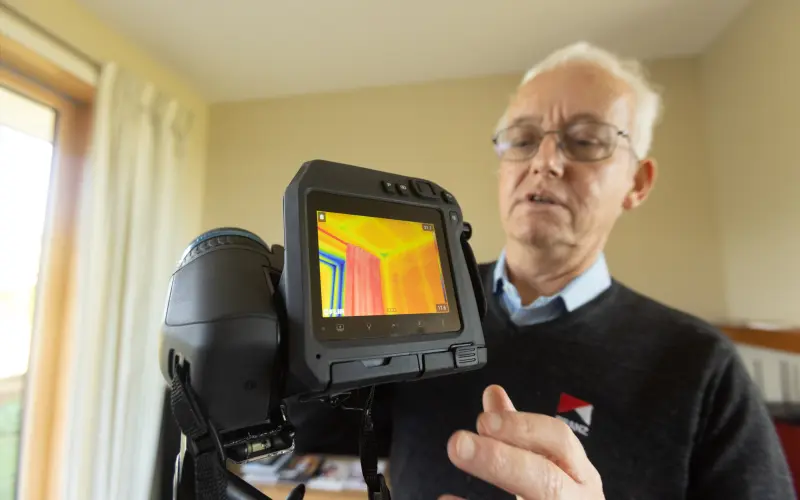


When Ian started work at BRANZ in the early 1990s, a colleague asked him what he was working on. He told them it was insulation materials and thermal performance. ‘And what will you be working on next week?’ they asked. While there was an element of humour in the comment, there was also a lot of truth. Much less thought was given to the topic back then and the testing methods available today didn’t exist.
Testing and research
A large part of Ian’s work is testing insulation materials and products for BRANZ’s commercial clients. While some are from Aotearoa New Zealand, he also does a great deal of work for Australian manufacturers.
The equipment used and its level of precision has changed over the years – in some instances, with Ian physically building or modifying the hot boxes required. He repaired one $150,000 piece of equipment with complex faults so it was working perfectly again. ‘Not bad, eh?’ he says.
Research work, including around retrofitting insulation into existing buildings, has also been an important part of his work. ‘Insulation is one of the few things that pays for itself.’ He notes that iwi housing bodies are taking a longer-term view than some others, looking at family and community needs in multi-generational terms. ‘They are also exploring different homeownership models, which the rest of New Zealand could learn a lot from.’
Ian has worked with EECA in its retrofitting programmes and conducted a number of research projects into the benefits and risks of retrofits, reported for example in BRANZ Study Report SR484 Assessing retrofitted external wall insulation techniques. (He has also experimented with retrofitting techniques is his own home, getting a performance of greater than R6.0 in one area.)
Regulatory input
Ian has had major input into standards committees for NZS 4246 Energy efficiency – Installing bulk thermal insulation in residential buildings, NZS 4214 Methods of determining the total thermal resistance of parts of buildings and AS/NZS 4214Thermal insulation materials for buildings.
His work is strongly reflected in the current Acceptable Solutions for Building Code clause H1 Energy efficiency. While BRANZ research has covered the whole building envelope, work around concrete slabs on grade has had a significant impact.
Ian understood early on that, if there was no insulation on the vertical slab edge, most of the heat is not lost downwards into the ground but conducted along the slab and out through the exterior face of the footing – something he pointed out in Build 109, way back in 2008. The insulation data in Appendix E of the current H1/AS1, which includes vertical slab edge insulation, reflects this research.
Holding industry to account
Where companies or industry organisations have made claims not supported by evidence or promoted insulation methods that may carry risks in terms of moisture transfer, Ian has held them to account.
‘In the early days of raft slabs, there were some claims that they gave great insulation of around R5.0 or even R6.0,’ he says. Today, raft or waffle slab systems are regarded as uninsulated under H1/AS1.
Over the years, there has also been promotion of some blown-in or injected insulation methods for retrofitting uninsulated walls with a risk of the new insulation providing a bridge for moisture from the back of the cladding to the framing, potentially leading to weathertightness issues. BRANZ has highlighted the risks in this approach.
Ian also says that specifiers and contractors deserve to know exactly what insulation they are getting. He says this goes beyond just looking at a brand or specific product and being aware of the country and perhaps even the plant it was produced in.
Some countries and some manufacturing plants deliver a product of different quality or performance or density. Two products may both be rated at R2.4, but one is lower density and the other higher density, which can be relevant to where they are best used. Some of the largest companies in the world have over 50 plants.
‘A supplier may say that a product comes from the UK, but was it actually manufactured in the UK?’ There has also been a risk that a manufacturer’s seconds may be sold into the global market without being appropriately labelled. ‘BRANZ has a role looking out for that sort of stuff, particularly with New Zealand being at the end of the global supply chain.’
Appropriate labelling and product testing descriptions are important. An example is the temperature that testing is conducted at. ‘If a product is tested at 10°C rather than 5°C, that can exaggerate its performance. The testing details should be made clear where the data sheets are reporting performance,’ he says.
New products, new challenges
One thing that excites Ian is the range of new insulation products on the horizon that offer substantial benefits in terms of sustainability and thermal performance. Wood fibre products are currently imported from Europe but could be made here, and both hemp and flax also hold potential as the basis for good insulation products.
Vacuum panels are proving to give very high levels of thermal performance for a much thinner product. The panels can give 10 times the performance of some foams, which means that a panel 10 mm thick can give the same performance as some foams 100 mm thick.
BRANZ has tested a vacuum panel just 14 mm thick and found it delivers a performance of R5.0. ‘The comparatively thin dimensions mean they are used in restoring historic buildings overseas and in making old stone buildings liveable, with the vacuum panels installed on the inside.’
Ian makes the interesting point that the COVID-19 pandemic actually spurred a lot of development work in thermal insulation. ‘The Pfizer vaccine needed to be stored at -70°C, so more storage facilities meeting this requirement had to be developed.’
There are also challenges that climate change will intensify such as the risk of heat gains in homes and a greater need for active moisture control and ventilation. A lot of the answers can be provided by whole-house modelling but this is not a standard part of most new-home design.
He reiterates the fact that houses overheating is not due to over insulation but under ventilation and with too little planning for shade devices and the like.
A practical understanding of installation
Ian’s knowledge and experience isn’t just based on work in the lab. His first job out of high school was installing insulation in roofs in his home province of Northland. ‘You don’t want to be redoing it, so do it once and do it right,’ he says.
Based perhaps on that early experience as well as the subsequent years of research, he says that too much focus is given to insulation brands and not enough attention paid to the importance of installing insulation properly and getting the fit right.