

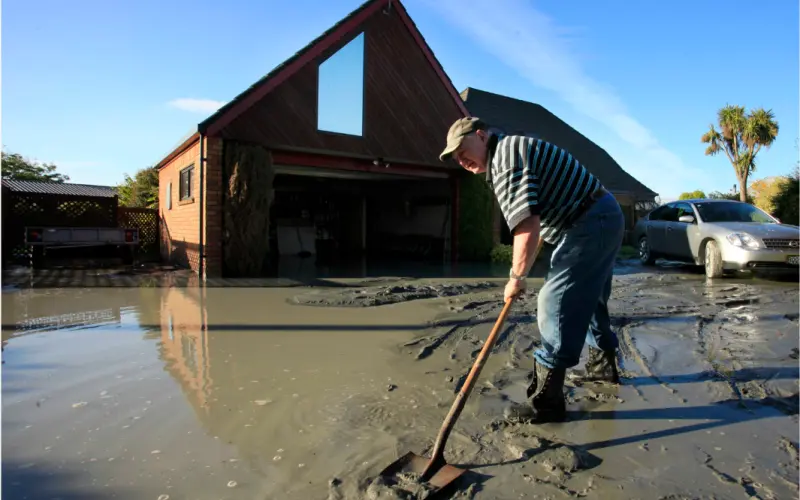


Many designers and builders know that, starting 29 November 2021, new rules for liquefaction kicked in. The official wording is longer and more formal, of course, but to sum it up in a nutshell – if you want to build a home on land that is prone to liquefaction, you need an engineered foundation.
What does engineered foundation mean? What does liquefaction-prone mean? And why did we change the rules to begin with?
Build spoke to industry specialists Mike Jacka, Senior Geotechnical Engineer at Tonkin & Taylor, Tim Farrant, Engineering Manager at MBIE, and Marie-Claude Hébert, Senior Geotechnical Engineer at Christchurch City Council, to explain all this in an easy-to-understand way.
Canterbury earthquakes changed everything
Before the earthquakes that hit Canterbury in 2011, liquefaction was an obscure geotechnical term, understood by engineers but largely ignored by the public. This was for good reason – Aotearoa New Zealand urban centres had never experienced liquefaction as severe as that seen in Canterbury in 2011.
Our engineering community knew it could happen. After all, you only need ground shaking, loose sediment and a high water table – all common in New Zealand – but it’s the sheer scale we didn’t expect.
Before 2011, only large commercial developments had foundations specifically designed to withstand the effects of liquefaction. For residential dwellings, the risk just wasn’t perceived as significant enough – until Christchurch happened. All in all, the bubbling mud that seeped up burying roads and creeping into homes:
- brought up over 400,000 tonnes of silt and sand in the first earthquake alone
- affected 60,000 homes (8,000 of which were damaged beyond repair)
- caused buildings to shift on their foundations (some by more than 40 cm)
- broke electrical cables, sewerage and water pipes.
The overall economic cost was an astounding $40 billion. Not all of it was due to liquefaction, but we realised that, had our homes’ foundations been more resilient, the damage would not have been as bad.
Engineers already knew how to build liquefaction-resilient foundations as other countries had experienced severe liquefaction events in the past. Examples are Japan in 1964 and San Francisco in 1989. We had the tools to know it could happen, but we didn’t think it would happen or be as bad – until it happened, and it was.
Technical categories introduced in response
By late 2011, in response to widespread damage, the government divided Greater Christchurch into green and red zones. Red was deemed too badly damaged to warrant repair and was mostly in the eastern suburbs, while green was worth repairing – although repairs were not always straightforward. The green zone was further subdivided into technical categories (TC) 1, 2 and 3 to describe the complexity of this work and how prone the land was to future liquefaction. TC1 was deemed the easiest to build on, TC3 the most complex.
This marked a point when Canterbury essentially separated from the rest of New Zealand in its approach to foundation design. The Building Code itself did not change – it continued saying, as it had for years, that buildings needed to remain serviceable, which also meant readily repairable, after a moderate earthquake.
What changed, however, was people’s perception of what serviceable meant in Canterbury. Insurers, particularly, needed to have confidence that foundations specified as part of rebuild were going to withstand future earthquakes because, otherwise, why would they want to insure against such a massive disaster again? MBIE published a document describing the new rules – Repairing and rebuilding houses affected by the Canterbury earthquakes.
It specified, for example, that, from 2012 onwards, any homeowner wanting to build a residential dwelling or an extension within a TC3 zone needed to have a geotechnical engineer assess for liquefaction vulnerability to make sure that their foundation could, in theory, withstand another large earthquake.
Roll-out for rest of country
After 4 years of building more-resilient foundations in Canterbury, giving builders time to get used to the techniques and supply chains to be sorted, New Zealand confronted the sustainability of this dual model. After another large earthquake in 2016 in Kaikōura caused liquefaction as far away as Wellington, the question became how can we continue requiring stronger foundations in Canterbury alone when similar ground conditions are all over the country?
It wasn’t just about the consistency of the Building Code but also insurability and fairness. If Canterbury needed stronger foundations, didn’t the rest of New Zealand need and deserve them too?
Defining liquefaction risk
Initially, MBIE had to tackle the definition of liquefaction-prone. Outside Canterbury, each council had its own way of defining liquefaction risk. To clarify the situation, in 2017, the government published a guidance document Planning and engineering guidance for potentially liquefaction-prone land, which embraces a consistent shared approach.
It was no longer sufficient to say ‘prone to liquefaction’ or ‘not prone to liquefaction’. You needed to specify exactly how prone – low vulnerability, medium, high? The labels couldn’t be assigned willy-nilly either. A structured methodical approach was necessary so that, regardless of where in New Zealand you applied for a building consent, you could trust the information provided.
Foundation types rolled out in 2021
In 2019, it was announced that, from 2021 onwards, foundation types already well established in Canterbury would be rolled out to the rest of New Zealand.
They were, essentially, the same technical category solutions (TC1 for low vulnerability to liquefaction, TC2 for medium and TC3 for high) but without calling them technical categories on the liquefaction map itself.
Some councils responded immediately by investing in geotechnical soil tests and groundwater monitoring so those applying for building consents would have a reasonable idea about the liquefaction risk they were exposed to. Others classified most of their area as ‘possible’ or ‘undetermined’ instead, essentially requiring building consent applicants to invest in their own geotechnical testing
The reality today
I asked Mike, Tim and Marie-Claude if the change has been worth it. All answered yes.
That’s because, after the earthquakes, most Christchurch residents said, never again. They knew what living through disaster felt like, and they didn’t wish it on anyone. There’s something else. When MBIE consulted with the industry in 2019, the overwhelming feedback was that it’s time.
So on 29 November 2021, more than 10 years after the Canterbury earthquakes, we made the change. Because it was time.
Key technical details
The three conditions that need to be present for liquefaction to occur:
- Ground shaking.
- Loose sediments – usually sand or silt.
- High water table – usually higher than 4 m below surface.
Professionals qualified to undertake liquefaction assessment:
- CPEng Geotechnical Engineer.
- PEngGeol Engineering Geologist.
Buildings to which new liquefaction rules apply:
- New builds and extensions at importance level 2 and above – residential, commercial and industrial.
- New rules do not apply to importance level 1 outbuildings such as sheds and stand-alone garages as these are not required to remain serviceable after an earthquake. Attached garages, however, are the same importance level as the main dwelling and need the same level of foundation design.
Foundation types as described in Canterbury guidance:
- Type A – timber floor with piles.
- Type B – timber floor with perimeter foundation.
- Type C – slab on ground.
Foundation categories as required in different liquefaction vulnerability areas:
- Very low or low vulnerability – TC1.
- Medium vulnerability – TC2.High vulnerability – TC3.
Foundation types commonly used for each technical category:
- TC1 – engineer sign-off is not required. Foundation types A and B as well as C if tied slab is used.
- TC2 – engineer sign-off is required. Foundation types A and B as well as C if stiffened raft slab is used.
- TC3 – specifically engineered foundations only. Deep piles – commonly 5–10 m, ground improvement such as stone columns or a surface structure such as a raft or a relevellable platform.
Investigations required in addition to existing liquefaction zoning:
- Medium vulnerability – at least additional shallow subsurface investigation, taking hand auger borehole down to 3–4 m. Depending on the results, deep ground investigation may be required.
- High vulnerability – deep ground investigation is almost always required. Driving of piles to refusal is not sufficient as they may be refusing in liquefiable sand.