



The BRANZ research project Future of Work: What do we know, what do we need to know to transition to zero-carbon construction? examined the challenges the construction sector is experiencing in developing skills and competencies for zero- carbon construction.
Challenges faced
We need to reduce our new residential building stock carbon emissions by 72% to ensure that global warming does not exceed 1.5°C. The construction sector is supportive of taking action to address climate change (see the article The future of work: part 2 in Build 199 on pages 60–62.)
The challenges the sector faces are due to the limited experience of zerocarbon design and construction. The construction needs to be upskilled, requiring a significant push from the education and training sector to deliver guidance and resources for all parts of the construction sector.
To begin the zero-carbon journey, the research project first needed to understand what zero-carbon construction skills are required for the construction workforce. BRANZ zero-carbon construction competencies were based on a review of international initiatives for zero-carbon skills and training and previous BRANZ research.
Conversations were held with construction trades, designers and architects about skills and competencies for zero-carbon construction as part of a wider project developing competency profiles for sustainability and zerocarbon skills for construction trades and designers and architects.
The focus was on key aspects of:
- knowledge
- skills and competencies for zero-carbon knowledge
- zero-carbon building
- sustainable products
- waste minimisation
- reuse and recycling
- water
- zero-carbon practice – implementing zero-carbon knowledge
- legal requirements
- whole-build process
- personal capability – communication and collaboration skills.
Skills and competency profiles
After creating the skills and competency profiles, these were validated by asking builders and carpenters about what they see as the challenges in implementing zero-carbon construction skills.
We selected tradespeople at different career points – speaking with apprentices, recently qualified or mid-career construction professionals, more-experienced tradespeople and construction trades educators.
Our aim was to see if these key activities resonated across diverse levels of tenure in the sector or if there were different key activities prioritised based on levels of experience. The key activities primarily reflect builders as that was the trade most discussed in the international information we analysed.
However, we assessed these with other trades to see what general key activities might be applicable to their specific trade. To make sure the competency profiles we developed were relevant for the Aotearoa New Zealand construction workforce, we evaluated these key activities with experts across the construction sector by conducting one-on-one interviews.
What did people tell us?
Overall, everyone we spoke with was supportive of the key activities identified and saw the need for the sector to develop them. What dominated most of our conversations with tradespeople was not the skill and knowledge requirements included in the key activities but how tradespeople could implement these key activities in their everyday practice.
One of the main challenges we discussed was the general lack of knowledge of zero-carbon building or opportunities to work on jobs with zero-carbon building as a focus. Those further on in their zero-carbon journey have had the experience of building more sustainably either through overseas experience or having a client who has encouraged this.
One builder who has been in and around the sector for the past 20 years and has had their own business for the past 10 years said, ‘I’ve been quite keen on building green and building sustainable for quite a long time. Now we’re talking zero carbon and I’m trying to front foot everything I can on this. So over the last few years, we’ve gone through building the best way we can – I’ve started moving into more sustainable builds.’
In this example, zero-carbon construction is spoken about from an individual or client-driven perspective rather than a consensus position. Comments like this were not common among our sample, as most construction trades professionals we spoke with were not incorporating this activity into their building practice.
Builders are keen to make this change, but most of our sample did not feel they were in the position to take charge of the shift in construction practices. We also could not find consensus across the trades about who should take responsibility for driving this transition through the construction sector.
Some thought that the main drivers for zero-carbon design and building should be architects and designers who should be specifying lower-carbon options in terms of material selection. As one builder qualified for 3 years explained, ‘In terms of making homes more carbon friendly that would be designed in that way. And we’d just be told what materials to use and what to do to make it better. I guess our side of it was we’d just be doing what we’re told to.’
Builders saw themselves as implementers in that their key task is to deliver whatever is in the plans, and they had enough confidence in their abilities to deliver these key activities if they had been clearly signposted. Those who were not setting their own workstreams or finding clients – particularly apprentices – pointed to their employer and the wider need for more legislation to help direct some of these requirements for zero-carbon construction.
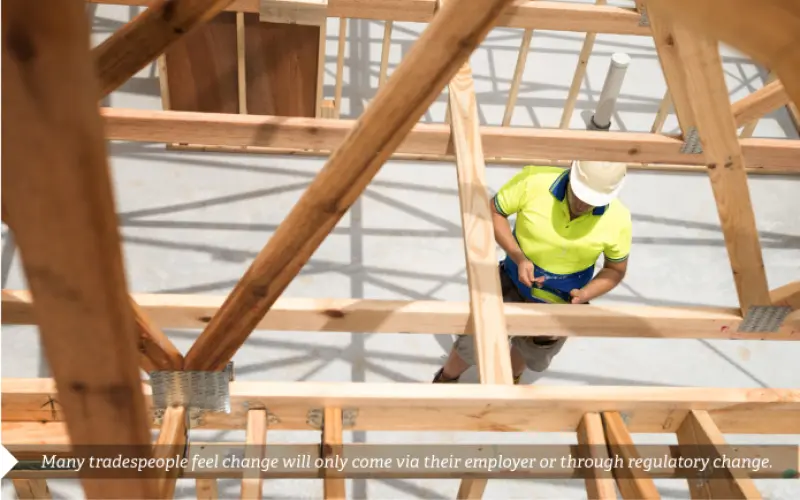
Several apprentices were keen to be more sustainable but mentioned any wholesale changes to their practices would only come through their employer and through larger regulatory change. For apprentices, the types of jobs they work on determine the types of knowledge they develop during their apprenticeship. Therefore, the requirements of the job and the idea of what a tradesperson does during the construction process shape the type of zero-carbon knowledge tradespeople felt they should have.
A tradesperson has limited control when considering the full scope of construction. Construction tradespeople told us that decisions around design are made well before they are involved. Tradespeople felt that their role in zero-carbon construction lies in the interpretation and implementation of sustainable features through the building plans, assessing the correct and safe installation of sustainable products and the ongoing management of waste practices on site.
Going forward
Overall, the tradespeople we spoke with were supportive of the key activities but highlighted the significant structural constraints in delivering them. A lack of knowledge such as case studies demonstrating best practice and a network of peers to help deliver the information were cited as some of the biggest barriers.
Many of the challenges for implementing zero-carbon skills and competencies in construction were outside of their perceived control. However, tradespeople are becoming more sustainable in their day-to-day activities by reducing waste and constructing sustainable buildings. Some had clients or architects who promote low-carbon design and construction.
We found that tradespeople are willing to be more climate conscious and build more sustainably, but they also need the right infrastructure to enact those changes.
The work that BRANZ and partners such as ConCOVE and the Construction Sector Accord are doing is creating the social infrastructure necessary for the sector to start to embed this knowledge.