

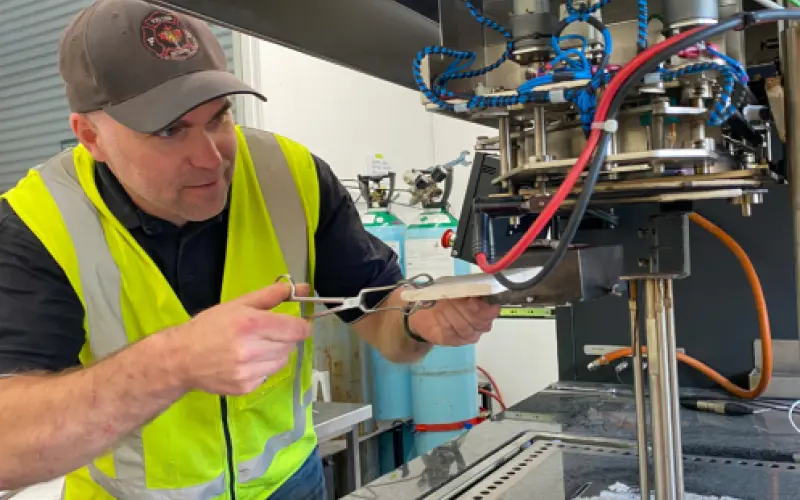


Q. What’s your background – where you grew up and your education?
I grew up on a farm in Central Alberta, Canada, near the eastern slopes of the Rockies. The most comparable area in New Zealand is mid-Canterbury. I did bachelor’s and master’s degrees in mechanical engineering at the University of Alberta. After working for a few years, I moved to Christchurch and completed my fire engineering PhD at the University of Canterbury.
Q. What led you to engineering as a career?
As a farm kid, I was surrounded by fascinating machinery and was always interested in how it worked. The main career optionsI considered were a hands-on trade, likely welding or engineering. But engineering does not encompass welding in Canada as it does in New Zealand as it is a regulated term restricted to use by the equivalent of chartered professional engineers.
I was fortunate to have reasonably strong academic performance, and that was what tipped me into engineering. However, I always wanted to combine both to some degree. Fire research and volunteer firefighting provide that balance for me.
Q. Where have you worked before coming to BRANZ and what do you do at BRANZ?
My bachelor’s degree was a co-op degree, which had an extra year of work experience blended in. I worked in several roles in the oil and gas industry as a co-op student. When I finished my master’s degree, I started a PhD at the University of Cambridge on aero acoustics. For a variety of reasons – climate change being a big one – I left Cambridge to work at the Alberta Research Council on biogas research. There I got into volunteer firefighting and eventually made the jump to forensic engineering as a full-time job, focusing on fire investigations.
I spent a lot of time investigating one fire that led me back into research. This fire involved a 4-storey sprinklered light timber-framed seniors’ complex that was a complete loss, although everyone got out despite many occupants having mobility challenges and the fire occurring in the early hours of the morning. The building had many aspects I have since looked at as a fire researcher, including effectiveness of fire safety systems, fire spread over combustible façades and risk perception, tolerance and acceptance.
At BRANZ, I am a fire research engineer and the Building fire-safe densified housing programme leader. I undertake and lead research to improve building fire safety practices in New Zealand. At present, housing densification is the major topic we are focusing on, making sure that we will meet society’s expectations for fire safety.
Q. Is there a typical day, and if so, what does it look like?
A typical day could be boiled down to a mixture of talking and preparing communications to stakeholders, completing admin tasks, dealing with the myriad of small questions and queries that come up and trying to keep up with the mountain of information that gets produced by the fire safety community around the world. Of course, I also try to pack in as much core research as possible. This includes planning and conducting experiments, analysing data, running calculations and models and writing up outputs.
Q. What are the chief issues fire engineers in New Zealand are engaged with or concerned about at present?
The Canadian seniors’ complex fire I mentioned wraps up many of these issues. Alberta went through a building boom in the mid-2000s with a densification shift to similar typologies as what we are seeing a lot more of currently in New Zealand. That fire was only one of many – in fact, there was a working group formed in Alberta to address what were called high-intensity residential fires. This effected many changes to the Canadian building codes.
The crux of the issue is that fire safety problems can take a while to show up, and if a large population of buildings have been built in the meantime that then have issues, society must either live with them or spend a lot of money to fix them. The UK and Australia are also testament to this situation with their current cladding rectification issues. Current pressures to reduce separation, use more combustible materials and reduce cost all have the potential to increase fire risk. The key is to maximise all the other societal benefits without creating untenable fire risk.
Q. Are there specific situations when the work you do has had a direct impact on the New Zealand building system such as the Building Code?
The best example has been changes to the external fire spread controls in the protection from fire compliance documents. Some changes proposed in 2020 were diluted partly because some industry members perceived them as a timber ban. That is not the intention of our research. If anything, we are trying to prevent the kind of adverse societal reaction following a devastating fire that has happened in the UK, where the use of combustible materials has been banned in external walls of certain buildings over 18 m and severely limited over 11 m. This is still an evolving space and an area of active research for us.
Q. What are the most challenging aspects of your job and those that are most satisfying?
Conducting large-scale fire experiments fits both categories. Because they are expensive and time-consuming to run, it is a challenge to make sure we are asking the right research questions and designing them to make the best use of the opportunities we have to conduct them. There are often aspects that we did not expect or account for that we can learn from, but completing a large-scale fire experiment is also very satisfying.