

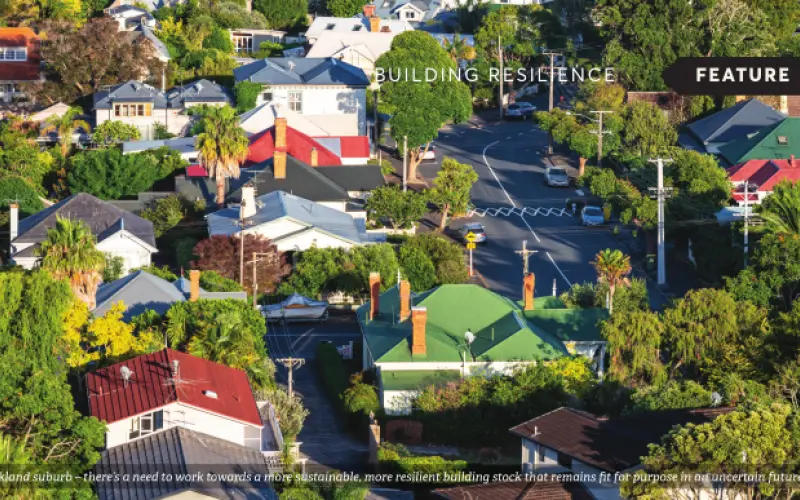


Toka Tū Ake is responsible for providing natural hazard insurance to residential property owners in Aotearoa New Zealand. Contributing to risk reduction and building resilience is a big part of how it does this, especially in the built environment.
Strong building regulation and governance is one of the most effective ways to manage natural hazard risk. Along with land-use planning, insurance and resilient infrastructure, it determines how communities and the built environment come through natural hazard events.
A plan for more resilient homes and buildings
The work of Toka Tū Ake towards a more resilient built environment in Aotearoa is laid out in its Resilient Homes and Buildings Action Plan. The plan is complemented by its Smarter Land Use Action Plan, which lays out its commitment to proactively reduce current and future risks through smarter, risk-informed land-use planning. Together, they set out where Toka Tū Ake views the biggest opportunities to improve the built environment and how it can be most effective in working towards those goals with key partners.
The Resilient Homes and Buildings Action Plan has three overarching objectives of:
- raising the bar for our new builds
- managing the worst risks in our existing buildings
- making sure the built environment system enables more natural hazard resilience.
The work Toka Tū Ake does around new homes and buildings focuses on making sure future buildings are designed to meet the expectations and needs of owners and occupiers, including for natural hazard events.
Raising the bar for new builds
Recent memory demonstrates that our buildings have not been serving our communities well enough. From homes situated in known floodplains to excessive levels of damage in earthquakes, natural hazards must become a driving factor in decision-making for the built environment. We need to work towards a more sustainable, more resilient building stock that remains fit for purpose in an uncertain future.
Contributing actions under this objective include supporting MBIE in promoting low-damage seismic design, considering the intersection of climate change adaptation and natural hazard resilience and driving best practice for design practitioners.
Managing the worst risks in existing buildings
Our existing building stock is a diverse mosaic comprised of pieces from different times built to different standards and with different materials. We still use many of these older buildings despite understanding that they were not built to the same standards we expect today.
It would not be economical, practical or environmentally responsible to demolish all these buildings and rebuild to new higher standards to reduce the risk. Instead, there is a massive opportunity to reduce risk by proactively managing Aotearoa’s existing building stock.
This objective focuses on effective retrofit and strengthening strategies. Toka Tū Ake is interested in encouraging voluntary improvements as well as increasing the array of policy levers for managing existing buildings. Much of this work will be supported by continued investment in fundamental research into engineering science and building performance.
Enabling more natural hazard resilience
Where the previous two objectives target the resilience of individual buildings, Toka Tū Ake also wants to enable more resilient decision-making across the built environment ecosystem in Aotearoa. The current combination of regulation, resources, systems and underlying scientific bases can arguably impede positive change if not actually encourage unsustainable development.
A healthy, thriving system that is fit for purpose and remains adaptable to new information is much better positioned to deliver resilient outcomes in the face of compounding challenges like the climate emergency, an affordable housing crisis, retaining skilled staff and unclear regulations.
Work targeting the system includes supporting the update and implementation of the new National Seismic Hazard Model, collecting and curating critical datasets for risk management, submitting on relevant plans and policies and supporting regular review and updates to standards and regulation.
Developing hazards risk portal
Toka Tū Ake is also developing the Natural Hazards Portal, which we expect will grow into a public-facing, self-service source of natural hazard risk and risk management information. It will offer a comprehensive view of natural hazard risk at the individual, local, regional and national levels. Clear and transparent sharing of risk information leads to better understanding of risks and more risk-based decision-making.
Looking forward, the Action Plan lays out our intentions to reduce the impacts of natural hazards on people and property by increasing the resilience of the built environment. It is a living document written with an initial timeframe of 5 years (2022–2027) and will be updated and revised as its actions take effect and its focus shifts.
Relationships are necessary
The built environment is a complex ecosystem with many contributors, users and stakeholders, and Toka Tū Ake recognises that it can’t realise its vision alone. The Action Plan relies on strong relationships across central and local government, professional and trade organisations, the research community, insurers and reinsurers, building owners and the wider public in general.