



Sustainable construction is about building in a way that doesn’t deplete natural resources or have harmful impacts. Practical examples are using recyclable and renewable materials, minimising waste and using renewable energy.
The carrots to encourage this take the form of government funding of a wide range of initiatives – from the Warmer Kiwi Homes programme through replacement of fossil fuel boilers right up to $140 million towards an electric arc furnace for New Zealand Steel.
The sticks are increasing fees and charges – in particular, the waste levy being gradually lifted to discourage the amount of waste going straight to disposal. From 1 July 2026 the waste levy is $70 per tonne for municipal landfill (class 1), $40 per tonne for construction and demolition fill (class 2) and $15 per tonne for managed or controlled fill facilities (classes 3 and 4).
The problem with carrots is that you need an awful lot of them to make an impact. The problem with the increased waste levy is that it remains a very small stick. It has only increased from an extremely low base and is low compared to most developed countries. Walk around many building sites today and you see relatively little evidence of careful waste sorting and recycling, with most waste still headed for disposal.
The impact of energy rating schemes
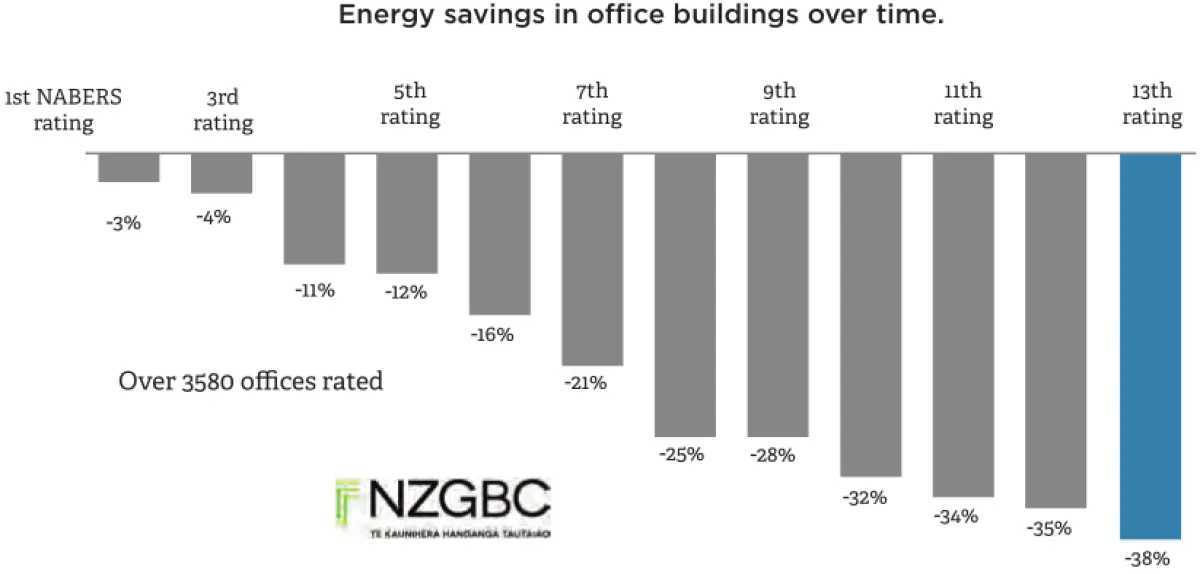
Are there better ways of doing things? Chief Executive of the New Zealand Green Building Council (NZGBC) Andrew Eagles points to the Australian experience, where substantial benefits flowed quickly from the government mandating the NABERS (National Australian Built Environment Rating System) energy rating scheme. A 2010 law required that spaces within office buildings of 2,000 m² or more must get a NABERS energy efficiency rating. The threshold was reduced to 1,000 m² in 2016.
‘In Australia, you’ve seen a massive transformation as building owners invest in energy efficiency improvements,’ Andrew Eagles told Build. As Table 1 shows, the results are astonishing, with energy savings of close to 40% achieved. Since ratings became a requirement, Australian businesses have saved over AU$1.7 billion in energy bills. ‘The thing is that, if you make the performance of buildings transparent, the market drives the changes.’
The benefit of a transparent ratings scheme doesn’t just apply to commercial buildings. Andrew Eagles sees a particular importance in performance ratings for homes. ‘A home is the biggest thing people will ever buy, yet they have no idea how energy efficient it is. It is very unfair on Kiwis.’
Since 2008, homes that are sold or rented in the UK have been required to have an energy performance certificate (EPC) given a letter from A to G. This helps consumers with information on the health and efficiency of the homes when purchasing.
The ratings also provide guidance on how to improve the home. Since April 2020, landlords have not been able to let properties with an EPC rating below E. The UK Government has a target to upgrade all homes to EPC C by 2035.
Energy rating schemes are clearly a powerful way to assess the performance of building stock and an incentive for building owners to upgrade their properties.
Designing and constructing a home to achieve a rating doesn’t necessarily mean higher costs – it chiefly means doing things differently. NZGBC engaged Aurecon to review specifications required to achieve a 6 Homestar v5 rating and to compare this with specifications for Building Code clause H1 compliance.
Its 2023 report (with costings by quantity surveyors Kwanto) found that, for different types of home and location, the additional cost for 6 Homestar was zero in several cases and 0.5% or below in most cases. The report is available on the NZGBC website.
Watching your waste line
A report prepared by Eunomia Research and Consulting for the Ministry for the Environment published in 2023 found that demolition waste is the singlelargest category of waste in Aotearoa New Zealand. Just over 4 million tonnes annually are reported – the actual total is likely to be higher. The report says that 223,000 tonnes of aggregate and 249,000 tonnes of mixed construction and demolition (C&D) waste are recovered each year. This indicates that only around 12% of our C&D waste is recovered – the rest goes to cleanfills and landfills.
The waste levy has increased several times in recent years, with one specific aim being to reduce C&D waste. The difficulty is that, even at the new higher levels, the cost is still extremely low by international standards. For example, in some areas of Australia, charges of AU$250–360 per tonne are typical for different types of C&D waste.
How has the Australian market responded? Government figures say that around 81% of all C&D waste is recycled, and C&D recovery rates climbed significantly in the 15 years to 2021 (Table 2). The high disposal costs are not the only reason for this, but they are a significant contributor.
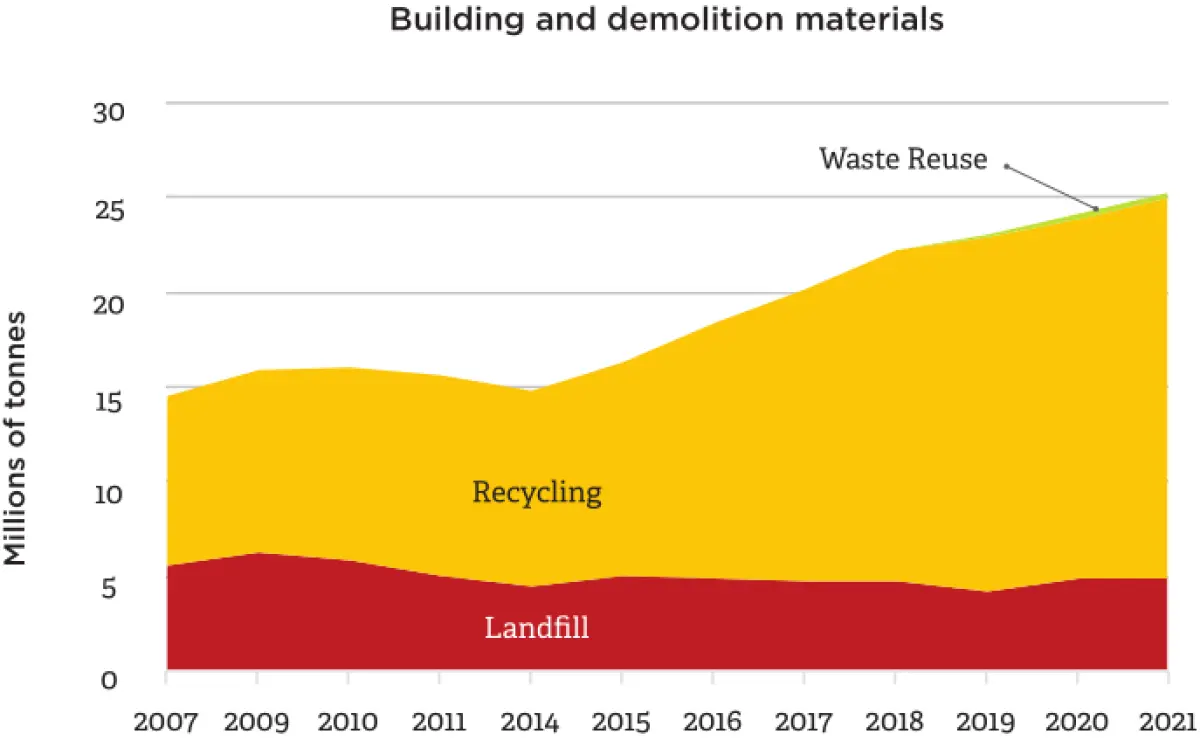
These rates are achievable in New Zealand. Kāinga Ora has a declared aim to reuse or recycle at least 80% of uncontaminated materials from Auckland and Northland development sites and 60% from all other regions. In 2022, it exceeded this, with 87% of uncontaminated materials reused or recycled in Auckland.
Home building projects working to a 6 Homestar requirement or better must have a site-specific waste management plan helping contractors identify waste streams and guiding ways to reduce disposal.
On a project at Auckland University of Technology (AUT) North Campus, Naylor Love undertook a waste management trial and managed to divert over 90% of construction waste from landfill (see A masterclass in diverting construction waste in Build 201). In a New Zealand first, the company has developed an NZQA micro-credential for resource sorters, and this supports inductions on Naylor Love worksites.
While saving money through waste diversion was a bonus for Naylor Love, the company’s Group Environmental Manager Annie Day says she still sees a lot of house construction sites that just have a single large skip with the contents most likely ending up at landfill or cleanfill. ‘I don’t think the cost of disposal is high enough here for people to review their procedures.’
There is evidence in recent research that supports her view. The 2023 Ministry for the Environment report found that, ‘The general feeling of those involved in the construction waste diversion industry is that until disposal costs are higher, the motivation to sort at source or to use a construction waste service that incorporates a sorting stage will remain purely as an environmental choice and the market will be limited.’
Changes on the horizon
With the modest increases in the waste levy just about to be introduced, there is little prospect of the government making substantial increases in the near future. But there has been discussion of other initiatives to reduce waste and introduce energy performance ratings.
MBIE projects held over from 2023 include proposals to make it mandatory for a waste minimisation plan to be prepared for certain building or demolition work and making energy performance ratings mandatory for large new and existing public, industrial and apartment buildings. The power to make these requirements would be put in place in 2024 and the requirements themselves introduced in future years.
BRANZ updating REBRI
BRANZ is currently updating its REBRI resource aimed at reducing the amount of building material waste generated at C&D sites and reducing the proportion sent to landfill and cleanfill. The updated resource is likely to be available later in 2024.
Sustainability certification schemes
One practical approach to achieving greater sustainability is to certify a project using one of the established certification schemes. These are the main schemes available:
- Homestar – the country’s main certification scheme for new home design and construction, administered by NZGBC.
- Green Star – covering all types of commercial buildings, it was launched by Green Building Council Australia in 2003 and has been adapted for Aotearoa. It is administered here by NZGBC. There are over 250 certified Green Star buildings here with a further 200 going through the process.
- NABERSNZ – a certification/rating scheme for office buildings based on the Australian NABERS scheme but adapted for Aotearoa. EECA holds the licence and NZGBC administers the scheme in this country. When a government agency wants to lease a building over 2,000 m², the building must have NABERS certification. Around 130 buildings are assessed per year.
- LEED (Leadership in Energy and Environmental Design) – a global certification scheme not widely used here.
- BREEAM (Building Research Establishment Environmental Assessment Methodology) – a global certification scheme owned by BRE in UK not widely used here.
- Living Building Challenge – an international scheme with very strenuous requirements. The Living Pā at Victoria University is following this scheme.