



Our homes have a job to do – they must look after us through all our stages of life, in sickness and in health. That’s why ideally new-build customers should be encouraged and supported to design with foresight rather than hindsight, ensuring the home they build is as comfortable and efficient as it can be for years to come.
Beacon ran a research project in collaboration with ANZ Bank New Zealand Ltd, researchers from Te Herenga Waka – Victoria University of Wellington and two independent new-build performance advisors.
The aim of the research was to explore the impact of a bank introducing its home loan customers to independent new-build advisors. We were curious how that might help customers along their build journey.
The final report – Supporting bank customers to build more comfortable and efficient homes – was funded by the BRANZ Building Research Levy.
Home performance means a home is doing its job well by providing a healthy environment for its occupants while having minimal environmental impact. It means taking a whole-of-house approach, considering energy, water, optimal indoor conditions, waste and materials.
However, when engaging with bank customers, this was described as designing and building a home to be more comfortable and efficient to better reflect their ideal priorities when building a home.
Background
Beacon Pathway’s Waitākere NOW Home, built in 2005, showed that considered design made it possible to use existing materials and technology to build a new home on a modest budget that was warmer in winter, cooler in summer and cheaper to run than an average home at the time.
Nearly two decades later, BRANZ research tracking the sustainability of housing in Aotearoa shows that, with few exceptions, new detached homes still fall short of achieving the same results. We wanted to explore what might close the gap between the status quo and what the Waitākere NOW Home showed is possible.
Our research – conducted between December 2022 and September 2024 – was grounded in our shared understanding that those building a new home in Aotearoa navigate a lot of complexity, particularly if building with comfort and efficiency in mind.
Personalised advice that meets people wherever they are on their building journey has proven effective in enabling them to navigate this complexity. Given that most people have a relationship with a bank, we considered banks could be well placed to facilitate access to such advice.
Two principles of our research:
- Early considered design – on building size, orientation, size and placement of windows – can result in significant improvements to home performance with little, if any, increase in budget.
- Customers may make several informed trade-offs resulting in better performance if they are supported and enabled to do so.
How we did the research
We collaborated to co-create and trial a set of activities designed to create change in behaviour patterns. This centred around seeing if a group of ANZ customers might change their design plans based on the advice of the performance advisor.
Our ANZ partners asked a selection of new-build home loan customers if they would take part in the project. If they accepted, we interviewed them about their current design plans, then connected them to an expert advisor who offered personalised advice on how they might design and build a more comfortable and efficient home.
Post-intervention interviews then explored customers’ responses.
What we discovered
Our examination of a customer’s lending and building journey highlighted synergies presenting opportunities for banks to work closely with their new-build home loan customers around how their home will perform we found:
- Trial participants thought the bank, as a neutral third party, was well positioned to connect them to an independent advisor, and this lowered the risk for both parties.
- Participants felt ill-equipped for their building journey and didn’t necessarily even know what questions to ask.
- The personalised advice received filled a gap in understanding.
Banks play a critical role in Aotearoa’s housing ecosystem and can provide leadership to influence its sustainability performance. They also have strong incentives to support customers to build more comfortable and efficient homes such as their strategic environmental, social and governance objectives and new obligations as climate reporting entities. Our research suggests there may be benefits in banks referring customers to an advisor.
How banks could support their customers
- Upskill bank staff to have more informed conversations with customers about the benefits of considering performance early in their planning.
- Identify customers contemplating building and engage with them early about optimising performance in their designs.
- Explore a range of incentives and other benefits banks could offer customers to build a more comfortable and efficient home – from financial incentives if customers build to a certain benchmark (such as ANZ’s Healthy Home Loan that requires Homestar 6+) to other less-formalised approaches (such as referring customers to a new-build advisor).
- Create an interactive building-lending journey map that sets out the roles of different parties and optimal timing for different decisions, then link customers to other resources and services (see Figure 1).
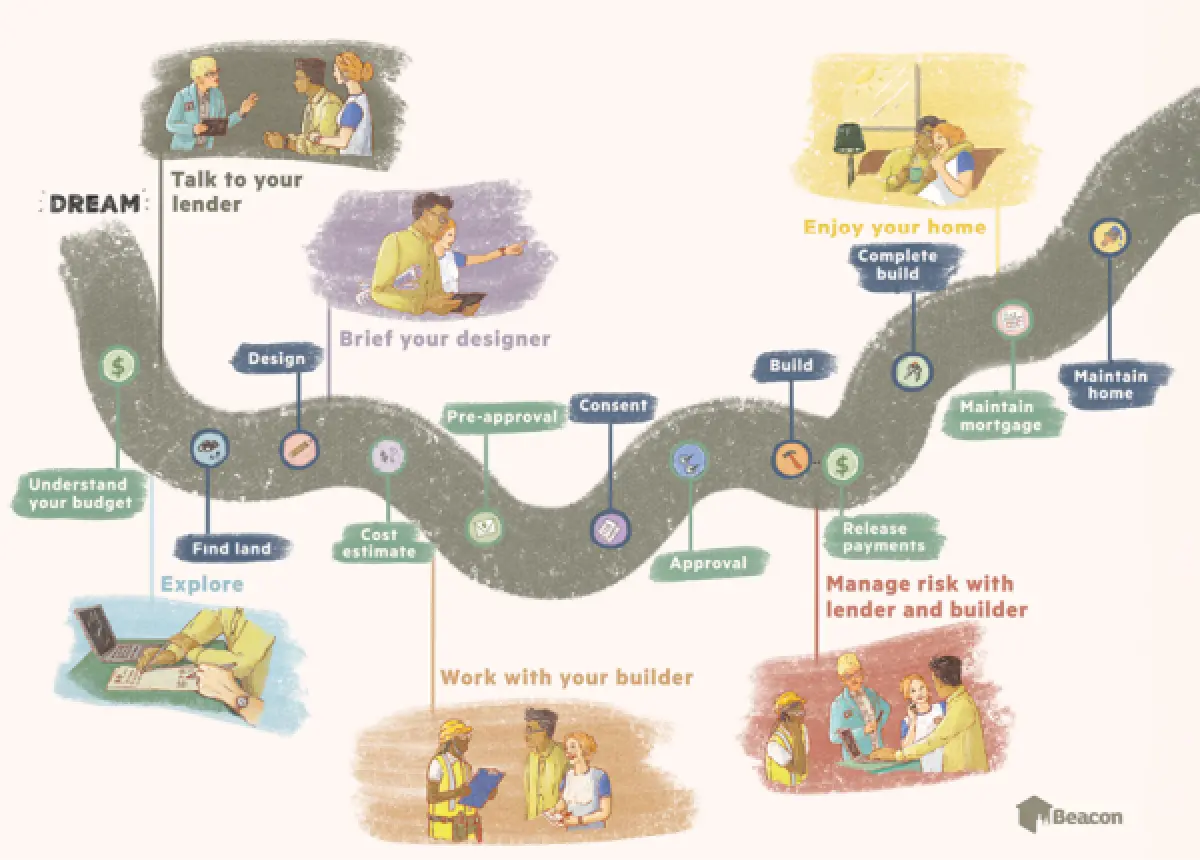
These opportunities can combine to create a framework for a bank to support customers throughout the process, recognising the benefits of early engagement to improve a home’s comfort and efficiency.
Thoughts for the future
While the research was limited to new homes, Beacon and BRANZ see potential in applying these insights to customers borrowing to renovate existing homes.
At present, however, we are uncertain whether the home performance advice sector in Aotearoa is positioned to meet the requirements of banks that may wish to connect customers to such advisors.
Beacon is carrying out further research into the advice sector, including the operating requirements to respond to future demand.
NOTE: Beacon Pathway is a research and consultancy organisation with a mission to create homes and neighbourhoods that work well into the future and don’t cost the Earth.
For more:
- Visit The Waitākere NOW Home
- Read the Beacon Pathway Research Report