

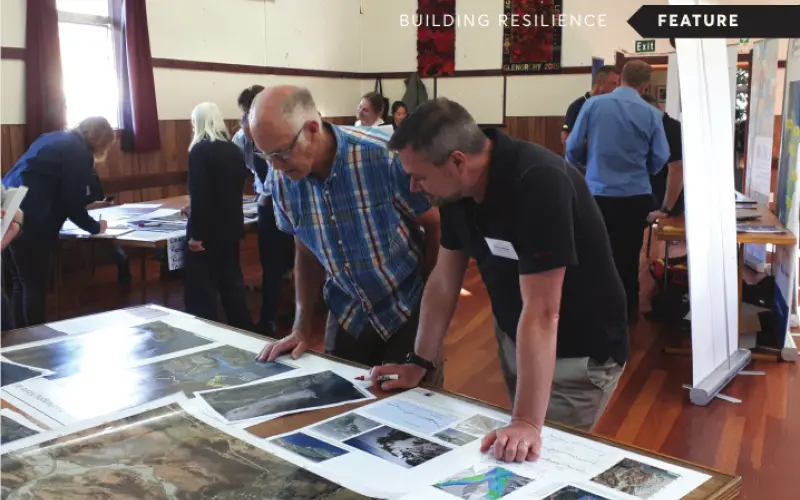


When disaster strikes, it can take hours, even days, for official help to reach cut-off communities. How well communities come together and how quickly they recover depends on how connected their members are with each other.
‘Communities with higher social capital recover faster. This means having good community spirit, knowing your neighbours and getting involved in community groups,’ says Anna-Kay Spaulding-Agbenyegah, a PhD candidate at Massey University. She is helping the West Auckland communities of Henderson Valley and Kumeū-Huapai develop longterm recovery plans in response to increasingly frequent flooding and landslide events. (The previous article has more information on the floods in Henderson Valley.)
Both communities have high community group involvement, but Henderson Valley community members are more knowledgeable about floods and are more connected with each other and so they recover faster,’ Anna-Kay says.
Value of emergency management groups
Many communities have volunteer emergency management groups that coordinate resources and conduct wellbeing checks during and after events.
‘It’s really important for people to know who might have something that could help them rather than be on their own,’ says Manomita Das, a PhD candidate at Massey University’s Joint Centre for Disaster Research. Manomita is studying how community groups bring people together to work collectively towards disaster preparedness.
‘The 2017 Edgecumbe flood had this catalytic influence where it brought the community closer together. It instilled faith in the community that, if something happens, they will be there for each other.
‘Also, their experience with the flood made them realise how people react and where they go, which has helped them identify evacuation centres and develop an evacuation plan,’ Manomita says.
This plan was developed by the Edgecumbe Community Emergency Response Team, which was set up after the flood. Participation in the group is an expectation of various professional positions within the community, meaning there is always someone who knows the community well filling vital coordination roles.
‘Everybody is working voluntarily. Nobody is mandated to be there. But each role, such as the school principal or fire brigade chief, has that expectation that you should be a part of this,’ Manomita says.
When the rural community is diverse
Bringing communities together to prepare for and respond to hazardous events is not without its challenges.
‘Community resilience is about bringing everyone along, not just the loudest in the room,’ says Jamie MacKenzie, Natural Hazards Adaptation Specialist at Otago Regional Council. She recently completed a master’s thesis evaluating community engagement in the rural communities of Glenorchy and Kinloch at the head of Lake Wakatipu. Community members range from deeply connected families who have been living there for generations through to temporary residents such as tourists and seasonal workers. Improved access has seen the community become increasingly diverse, with more commuters and lifestylers moving in.
‘Until 1962, Glenorchy was only accessible by boat, so there’s a legacy of “OK, we’re on our own out here”,’ Jamie says. ‘But some people who are newer to the community have greater reliance on the road, aren’t as well socially connected and are not as aware of all the hazards, so they’re less resilient.’
An urban community
The urban community of Mount Cook in central Wellington, though different, is facing similar challenges.
‘It’s hard to reach out to students, busy young professionals and people in public housing,’ says Manomita. ‘Some people are apprehensive to attend public meetings where there might be some prejudice or other people treating them in a way that is not respectful. The community has not found a way to cut through that barrier yet.’
Mount Cook Mobilised is a pre-existing community group that has broadened its scope to include disaster preparedness. In addition to active social media channels, it conducts newsletter drops and attends other community events to try and reach as many people as it can.
‘It’s about having a presence and building that trust,’ Manomita says. ‘Irrespective of newsletter drops, Facebook pages and other means, everyone agrees face-to-face communication is the most important. If you walk down the road and you see someone, just say hi, and the conversation is built from there.
‘It’s a simple place to start but it’s something everyone can do to help increase connectedness and build resilience in their own community.
‘You are more prepared if you’re better connected because you have this network of people that can take care of each other,’ says Jamie. ‘That sense of belonging that people have and that shared value for place is really important for resilience.’