

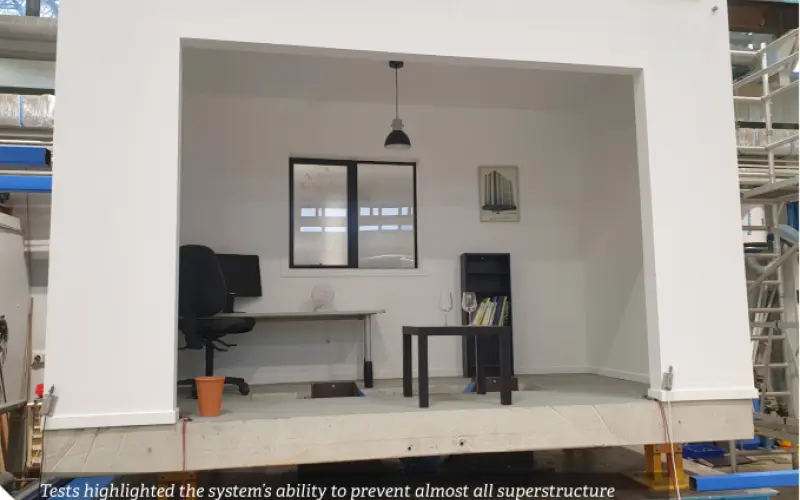


Driven by the desire to avoid a repeat of the widespread damage and disruption housing experienced in the 2011 Canterbury earthquakes, researchers at the University of Canterbury (UC) have been developing a low-cost base isolation system for residential buildings.
Prevents most structure damage
In 2022, the system was successfully tested on the UC shake table by subjecting a typical household room to around 100 high-intensity ground motion records from major historical earthquake events, including Kaikōura 2016, Canterbury 2010– 2011 and simulated Alpine Fault records.
These tests highlighted the ability of the system to protect houses and minimise damage in earthquakes. Even wine glasses were left standing after a particularly strong Canterbury earthquake record where the peak ground acceleration was close to 2 g.
Since these tests, the team has been developing a phase II system to bring to the market, with a particular focus on improving constructability and reducing costs.
System overview
The residential base isolation system employs a sliding-type device in combination with a suspended concrete slab foundation upon which a typical timber-frame building can be constructed. The sliding system was designed to prevent damage from earthquakes across a range of intensities while still providing adequate resistance to prevent building movement in strong winds.
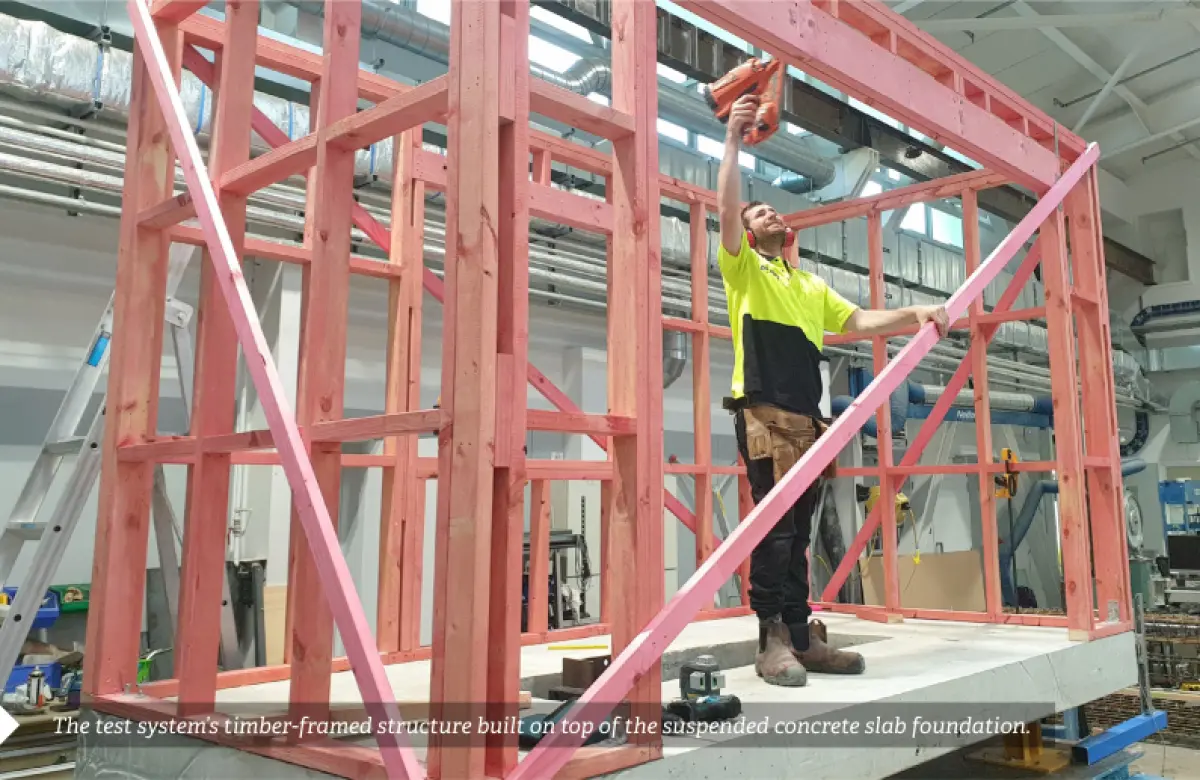
The ability to limit structural damage during moderate-intensity events is crucial because light-frame wood buildings are known to be damaged at very low levels of deformation – and repair costs can add up.
Research after the 2011 Canterbury event found that around $8 billion of earthquake recovery funds were attributed to repairing house damage where ground effects such as liquefaction were not an issue. Clearly, protection during the moderate events that frequent our shaky isles is desirable.
Working with potential early adopters and architects has widened the team’s perspective beyond the implementation of the isolation devices alone. Architectural features such as decking, external stairways and vehicle garage access also need consideration.
Low-cost and practical solutions were identified such that typical home features can be detailed to withstand the building movements. Services are another key consideration, and flexible connections are needed for water, power, gas and internet connections. The complete package in the end is a highly earthquake-resilient home that offers excellent protection for the structure and contents with the aim of being immediately occupiable after even the strongest shaking.
Maintenance and relevelling
Design of the system not only focuses on protecting the structure but also on providing easy access to the devices, so periodic inspections of the critical components can be undertaken with minimal disruption to homeowners. The ease of access also means components can be swapped out as they age, although this should be infrequently.
A key feature of the base isolation system is the ability to easily relevel a house if an extreme earthquake were to cause permanent ground deformation. Significant relevelling of houses was required after the Canterbury earthquakes, and this can be challenging and costly to fix for traditional buildings, particularly those built on concrete slabs.
The system is particularly suited to good ground conditions, but further work is under way for a cost-effective solution that works on softer and more liquefiable soils – TC2 and TC3 land categories. (For more on TC2 and TC3, see the article in Build 131 Foundation repairs and land categories on pages 52–53.)
A focus on costs
Base isolation systems for homes will cost more than a typical NZS 3604:2011 Timberframed buildings slab-on-grade solution. But the additional costs are probably a lot less than what might be expected.
The original solution required a design that would allow a concrete slab to be cast such that it remained suspended on the isolators – an approach that required the use of biodegradable formwork only available from Australia. The phase II system in development means this product is no longer required, removing another variable in the construction process and cutting costs.
The isolation devices themselves are constructed of proprietary products and require minimal assembly, which means they can be produced cheaply. While the primary addition to cost comes from the need for a suspended floor slab with two-way steel reinforcing, the benefits in building performance mean upfront costs can be offset by a reduction in earthquake loss and disruption throughout the building’s design life.
That won’t have an impact on the average consumer due to Aotearoa’s model of insurance, but the intangible benefits include peace of mind and reduced stress for homeowners, particularly those who lived through the Canterbury earthquakes.
Designing with the future in mind
In Aotearoa, there has recently been a clear focus towards building for the future and designing homes that are energy efficient. Careful thought has therefore been given to insulation requirements and led to the team rethinking about the way the concrete slab was constructed.
A key development for the phase II system is the ability to provide insulation across the whole underside of the suspended concrete slab, which can accommodate a range of insulation products to suit various locations and environments.
What’s next?
Development and testing has so far only considered the impact of horizontal accelerations. Future research will incorporate a vertical isolation component with the intention of offering further versatility and protection – particularly for sites near fault lines where vertical accelerations can be high.
The team is also developing solutions for sloping sites – recognising that hilly residential areas in places like Wellington will be of major importance when considering Aotearoa’s future earthquake resilience.