



While Aotearoa New Zealand lags far behind Australia in installed solar PV capacity, there has been a significant increase in the past 5 years. Today, 68,000 of over 2,000,000 electricity connections (mainly residential) have solar PV installed, with plenty of room left for growth.
When solar makes financial sense
In recent research, EECA has looked at where and under what conditions investing in solar PV makes sense. By analysing real-world 30-minute electricity demand data from nearly 47,000 homes across Auckland, Wellington, Christchurch and Queenstown over a full year, the report highlights the financial benefits in each location – measured by the internal rate of return (IRR), an estimate of the annual growth rate of an investment.
For designers and builders, knowing that solar PV is planned for a new-build home ensures the right design decisions are made and it saves on rework later. Understanding the value of solar technology and the factors that influence returns also means being able to support clients to make informed, future-proofed investment choices.
Here, we highlight the key take-aways from the report, offering practical insights into how solar design, consumption patterns and pricing structures affect returns.
Location does matter
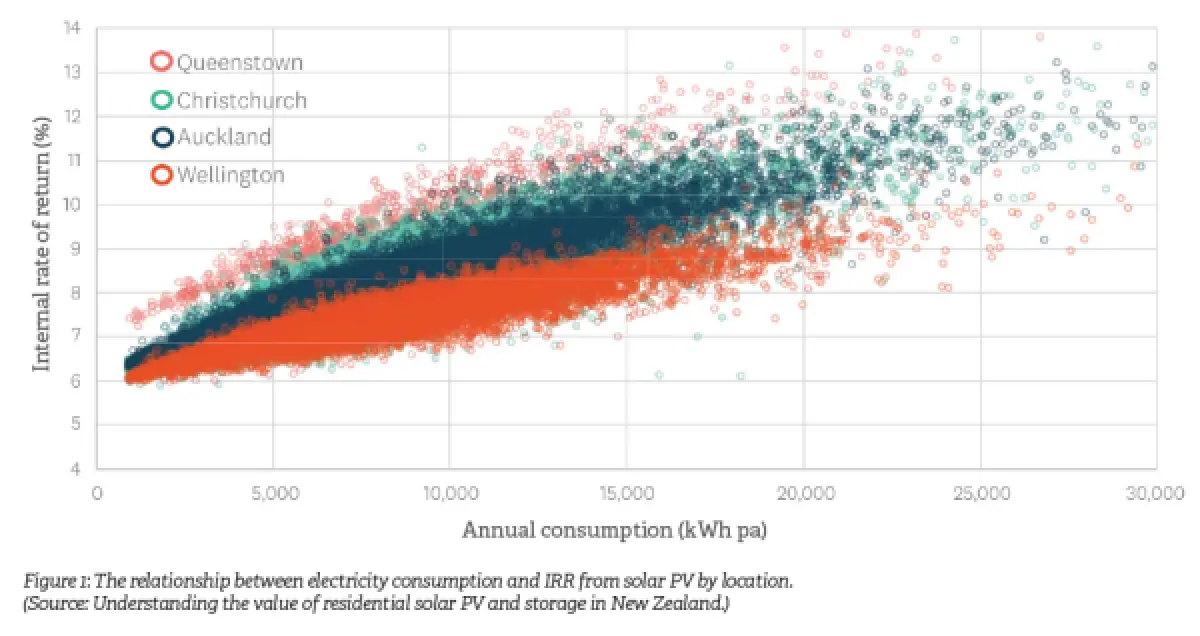
With varying climate, sunlight hours and electricity prices, financial returns across the country are not equal. Debunking the popular belief that Auckland and the north have the best conditions for solar, Queenstown came top out of the four locations for investment performance.
Queenstown showed the highest IRR due to strong solar resources and high electricity prices. Auckland followed closely with the second-best solar resource, followed by Christchurch and Wellington.
Time of electricity use is a factor
There are more savings to be made when electricity use aligns with sunshine hours.
Homes using more power in the morning (7–11am) and daytime benefit most since solar generates electricity then.
Strategies to make the most of this include charging electric vehicles (EVs) during the day and using simple timers or solar diverters to store solar energy in hot water cylinders.
Higher electricity use, greater potential savings
Choosing electric appliances where possible when they need replacing, for example, for heating, cooking and water heating, is am opportunity to save with self-generated electricity.
Households with high electricity consumption can benefit from the installation of solar with IRRs of 8–12%, equating to simple payback periods of 10-7 years.
Figure 1 shows the relationship between electricity consumption and IRR from solar PV by location for all modelled households (assuming a 5 kW-ac PV system, no battery, energy prices varying by time of use and location, and a flat solar buy-back rate).
Tilting north, northwest, east or west?
The research confirms the widely held view that north-facing panels with a tilt of 30° or more are best. This orientation allows for most generation over the course of the day. It’s best for daytime energy use or those exporting excess to the grid.
Some homeowners opt for east and west-facing arrays with the aim of matching generation with use – east-facing to meet morning demand and west-facing for early evening demand.
However, overall electricity generation is significantly lower than for north-facing panels. Also, this arrangement does not reduce peak demand by much as there is little to no generation during a winter evening, which is when demand is usually at its highest.
Battery storage enhances value in some cases but cost is a barrier
Battery storage is an additional extra that can boost overall returns from solar PV,
but with current prices starting at $5,000 for 5 kWh battery storage, they’re too costly for many Kiwi households.
The research assumed a near-future battery cost of approximately $714 per kWh of usable capacity – equating to around $2,500 for a system with 5 kWh of nominal capacity. At these price levels, adding batteries to a solar system can either increase or decrease the internal rate of return (IRR) by roughly 1 percentage point. Notably, an increase in IRR typically depends on having a time-of-use electricity pricing plan in place.
The best battery technology and capacity for each situation depends on component costs, location, electricity plan, consumption profile and even how much control there is over energy-consuming devices in the home.
Batteries also bring other benefits such as greater self-sufficiency, peak demand reduction and back-up power during outages.
Unfortunately, battery prices in Aotearoa remain high due to lack of scale, but prices would likely come down if uptake were to increase.
EECA recommends that the PV installation industry, through industry bodies, collaborates on procurement to seek more bargaining power to acquiring batteries at lower prices, while maintaining quality, and that the lower prices are passed on to consumers.
While battery prices remain out of reach for many, using a hot water cylinder with either a timer or a diverter offers the most cost-effective means of energy storage.
Electricity pricing structures influence return
The electricity pricing plans offered by electricity retailers have a significant influence on the return from solar PV systems.
Dr Gareth Gretton, EECA Lead Advisor, Research, Evaluation and Insights, says it’s worth shopping around to find the best available electricity retail plan considering the solar system that will be installed. ‘Selecting the right plan could significantly improve the financial outcome.’
The research also examined potential future changes to electricity pricing structures, including three different rates based on the time of day that also changed with the season. In some scenarios, these changes led to a reduction in IRR of up to 3 percentage points.
At the network level, reducing peak demand and buying back from solar and battery customers has the potential to reduce the need for future investment in new generation capacity, helping keep future electricity costs down. The benefit of this is to be reflected in the new requirement for lines companies to pay households who export to the grid at peak times.
Retailer buy-back limits will also influence the optimal solar and battery sizes. Whether it’s a limit of 5 kW versus 15 kW, it’s important to size right for maximum return. Where 5 kW limits are in place, these are likely to rise with changes to the maximum permitted voltage on networks.
Steps for solar success
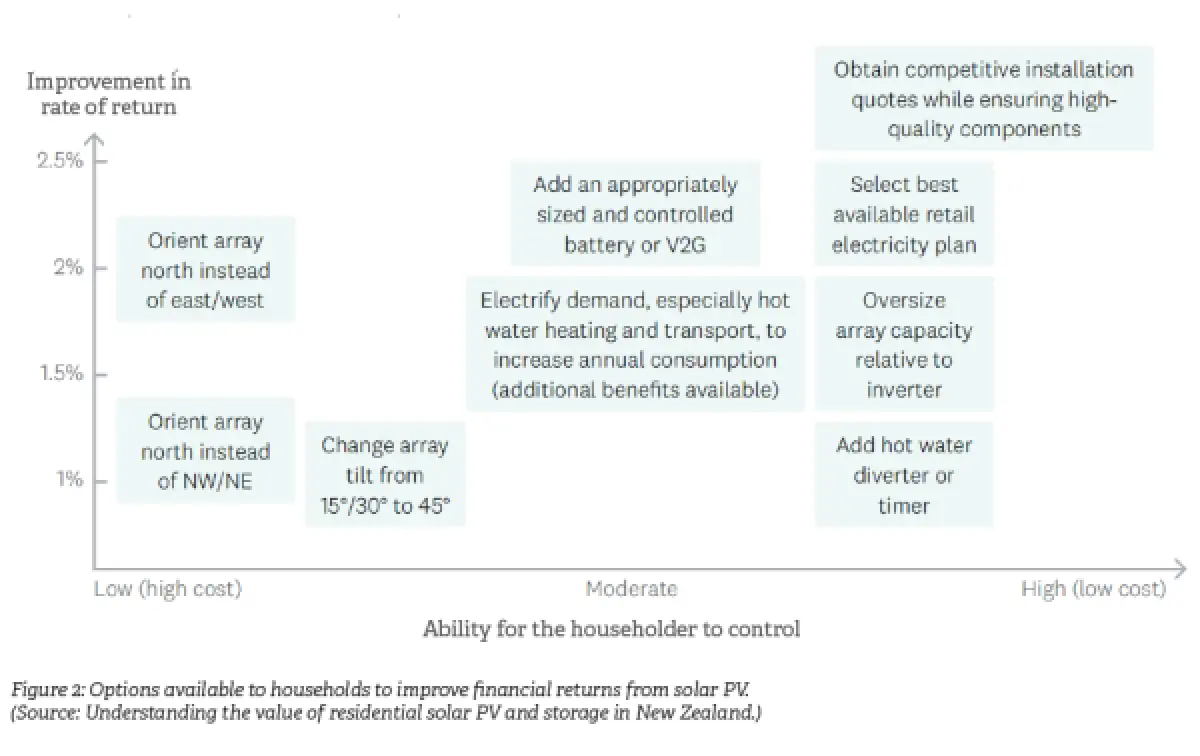
There’s much for a homeowner to consider in making well-informed decisions about solar PV installation, including decisions about how to maximise financial return (see Figure 2).
Builders and architects can play a crucial role in helping clients reach a decision, including on whether to make the extra investment for batteries. If you have a new-build client wanting to take the plunge, you’ll need to consider:
- roof orientation and pitch – design for north-facing roofs with optimal tilt
- space for panels and batteries – allocate sufficient area and structural support
- wiring and metering – plan for future upgrades, including EV chargers and diverters.
In conclusion
Beyond economic considerations, solar PV with storage has resilience and sustainability benefits, providing protection against outages and contributing to home sustainability certifications and national energy goals.
EECA’s report confirms that residential solar PV – especially when paired with smart design and energy storage – offers compelling financial and resilience benefits for households.
Factors that influence the financial return include local sunlight hours and electricity prices alongside changing technology costs, storage options, solar installation configurations and alternative transmission, distribution and retail pricing structures.
For those interested in installing solar PV, the way to achieve best financial return is to pay the right price for a quality product.
‘It’s a big investment, so people need to shop around solar installers to find the best deal, then check which components have been specified to make sure they are reliable and sourced from reputable manufacturers,’ says Dr Gretton.
For builders, architects and construction professionals, integrating solar-ready features into new builds and renovations is not just good practice – it’s a strategic move towards a more sustainable, energy-efficient future.