



NZBC clause B2 Durability requires that decking and associated fixings must have a minimum 15-year durability. Acceptable Solution B2/AS1 cites New Zealand standard NZS 3602:2003 Timber and wood-based products for use in building, which identifies timber species, grades, levels of treatment and in-service moisture ranges that meet the durability performance requirements.
For 15-year durability, hot-dipped galvanised steel nails and screws may be used to fix decking (NZS 3604:2011 Table 4.3), but note 4 states that, where timber has been treated with ACQ or CuAz preservative, type 304 stainless steel or silicon bronze fixings must be used and that stainless steel nails should be annular grooved to provide sufficient withdrawal resistance.
Choice of decking
The most commonly used decking timbers in NZS 3602 are:
- radiata pine
- kwila
- vitex (also known as vasa)
- cypress species (particularly macrocarpa).
Also popular is jarrah, an Australian hardwood with Class 1 durability and a life expectancy of more than 40 years in situations where it is exposed to the weather above ground.
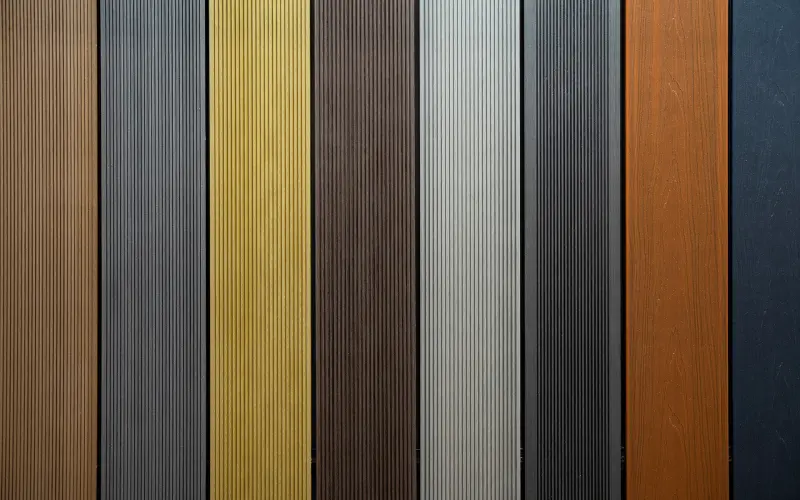
A sustainable alternative is composite decking, sometimes called plastic wood. These are manufactured from recycled plastic (HDPE) and waste timber fibre, which is heated and pressurised then extruded into a decking timber shape.
Timber grades and treatment
Wet-in-service timber for decking must be SG 6 (structural grade) (No. 1 framing in NZS 3603) or SG 8 (G 8 in NZS 3603) and may be either machine or visually graded (NZS 3604 Section 2).
Radiata pine must be treated to hazard class H3.2. Other timber species may not need to be treated if naturally durable. The preservatives for H3.2 treatment are typically waterborne, copper-based preservatives such as copper chrome arsenate (CCA), alkaline copper quaternary (ACQ) and copper azole (CuAz).
Confirm the sustainability
The sustainability of decking timber varies. Check the certification to confirm the sustainability of timber sources (see Table 1).
Composite decking uses recycled materials, so it provides a sustainable alternative to timber decking. It looks like timber but is UV, insect, mildew and moisture resistant, is low maintenance (no rotting, splintering, warping or loss of colour) and comes prefinished so it requires no painting, staining or oiling.
Check the slip resistance
Where a deck is part of the main access route into a building, it must have a slip resistance of not less than 0.4 in accordance with D1/AS1.
Timber decking is typically grooved on one face and smooth on the other. Uncoated, profiled timber has a slip resistance of 0.45–0.6 at 90° to grooves so it meets the requirements of clause D1, while smooth timber only has a slip resistance of 0.2–0.35.
Where the deck is part of the main access into the building, the grooved face must be uppermost and the decking should be laid perpendicular to the direction of the traffic. If a deck is not part of an access route, the smooth side, which is easier to keep clean, may be laid face up.
Step down or gap to deck
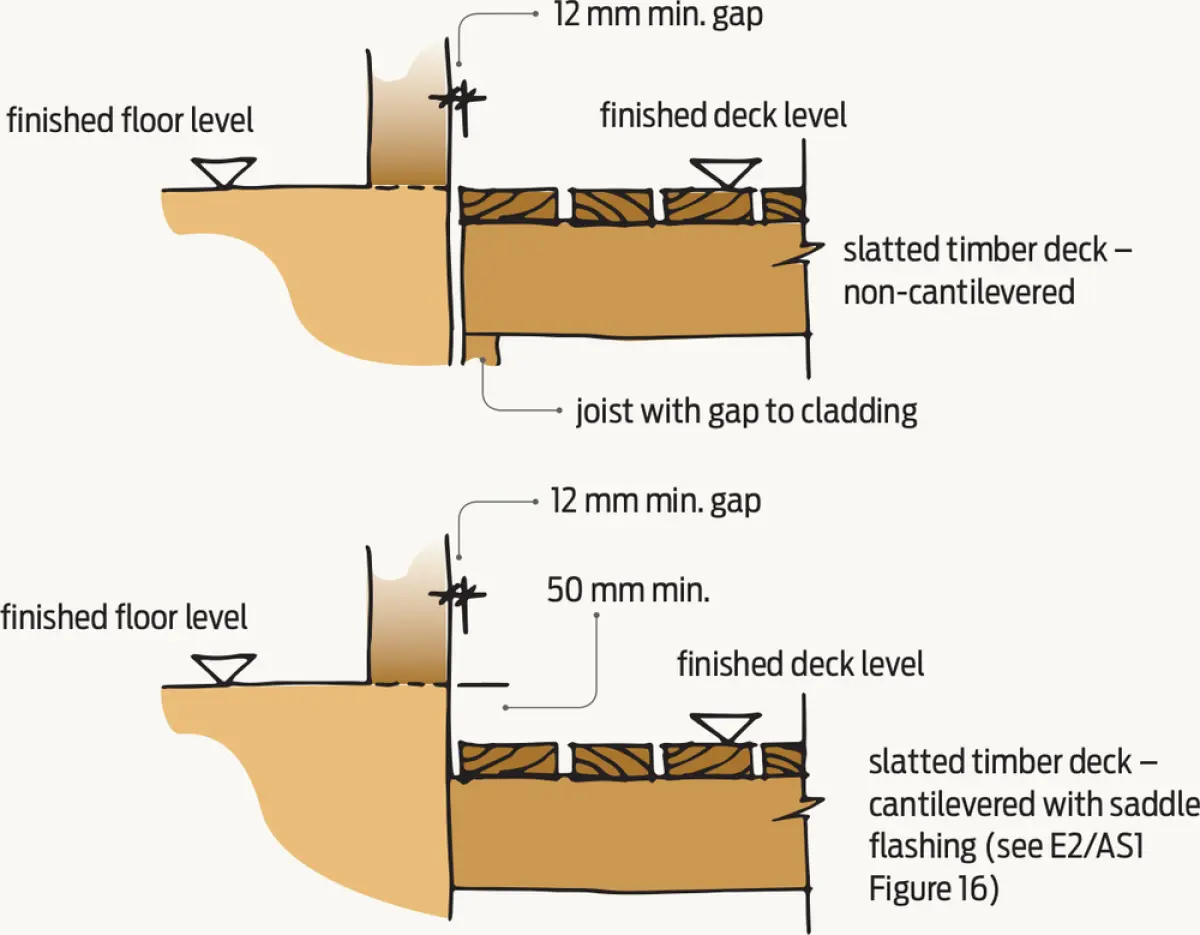
The finished level of a slatted, cantilevered deck (see Figure 1) must be at least 50 mm below the threshold or internal floor level and the joist penetration through the cladding saddle flashed.
For a non-cantilevered deck, the finished level may be at the same level as the threshold or interior floor level, but a 12 mm gap must be maintained between the exterior wall cladding and the adjacent decking.
Decking sizes
Timber decking boards are typically 90 × 19 mm (ex. 100 × 25 mm) or 90 × 32 mm (ex. 100 × 40 mm) although wider decking is also available. Joist spacings for 19 mm thick boards must be at 450 mm centres maximum and 600 mm centres maximum for 32 mm boards.
| TIMBER | COLOUR | HARDNESS | DURABILITY | STABILITY | SPLINTERING TENDENCY | SUSTAINABLE | OTHER CHARACTERISTICS |
|---|---|---|---|---|---|---|---|
| Radiata pine (H3.2) | Medium brown | Softwood | Medium | Medium | Some splintering | Yes – NZ sources generally with FSC certification | No leaching |
| Kwila | Dark red/brown | Hardwood | High | High | Low | Limited supplies – check source and obtain certification | Machines and finishes well, bleeds brown st |
| Vitex | Dark yellow brown, weathers to grey | Hardwood | High | High | Low | Yes – check source and obtain certification | Durable so an excellent decking timber for coastal situations |
| Macrocarpa | Light golden brown, weathers to grey | Softwood | Medium | Medium | Low | NZ sources available from shelter belts and plantations | No leaching |
| Pacific jarrah | Dark red/brown | Hardwood | High | High | Low | From Western Australian – check source and obtain certification, some recycled available | No leaching or bleeding |
Composite decking boards are available in a range of widths and thicknesses similar to timber and in lengths between 4.8 and 5.4 m long, depending on the manufacturer. Joist spacing are in the manufacturer’s instructions and are generally between 400 and 450 mm.
Timber decking installation
Install timber decking with:
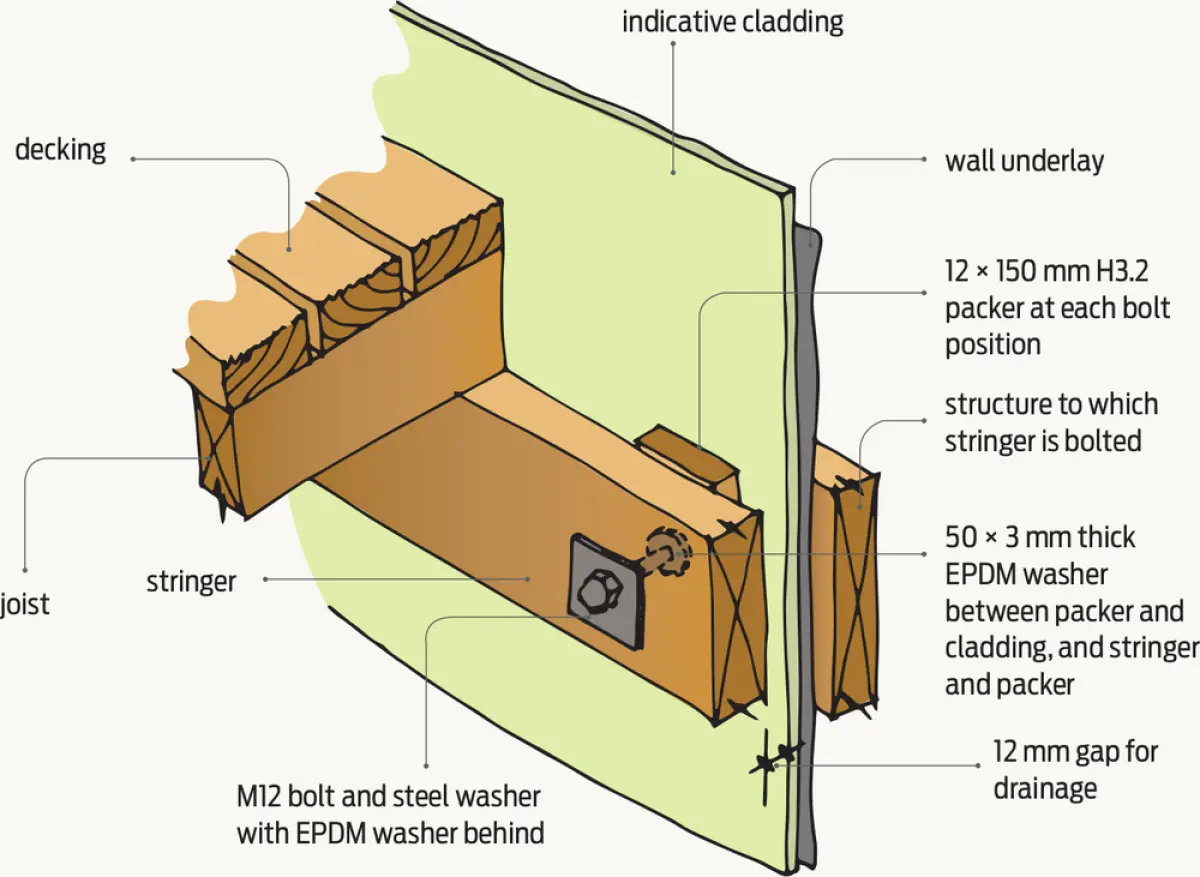
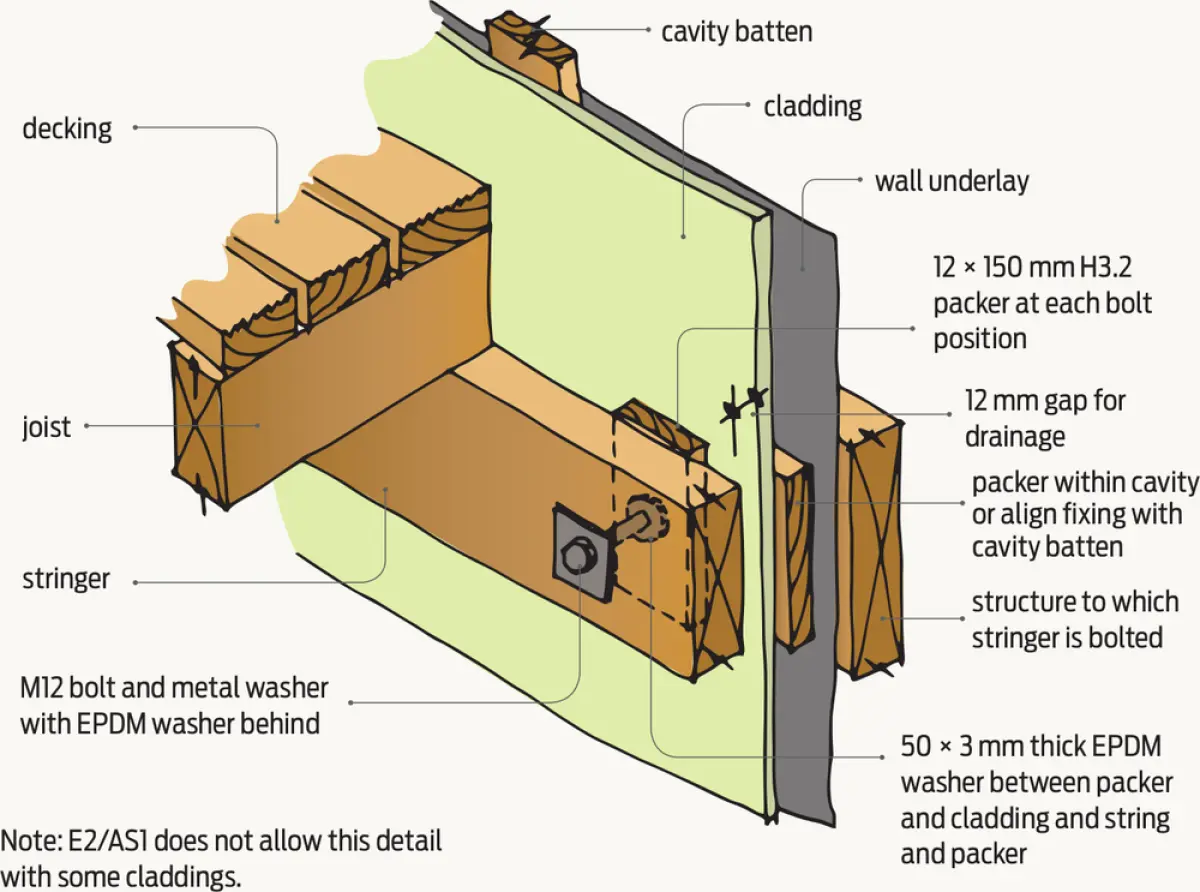
- a 12 mm minimum gap between the building cladding and decking for drainage and maintenance (E2/AS1 paragraph 7.1.1) (see Figures 2 and 3)
- 3–6 mm gaps between decking timbers lengthways (use appropriate diameter nails as spacers)
- 1–2 mm gaps at butt-jointed ends.
End joints should be butted and must be made over joists. Scarf joints can be used but may leave a sharp edge when the timber shrinks. Sand or arris the ends of the timber to avoid splintering and when fixing butt joints, skew nails slightly inwards. Joints should be staggered where possible.
NZS 3604:2011 doesn’t have a nailing schedule for slatted timber decks. However, it requires sheet decking up to 21 mm thick to be fixed with 60 × 3.06 or 2.8 mm diameter nails, so the same size nails minimum can be used for fixing 19 mm thick boards. BRANZ recommends 75 mm long nails for 32 mm thick timber decking.
Fix decking boards to each joist with two nails. Hand nailing helps pull boards onto the joist. Drive nails flush with the decking – avoid depressions in the timber where water can pool.
Composite decking installation
Install composite decking with:
- a 12 mm minimum gap between the building cladding and the decking for drainage and maintenance
- 5 mm gaps between decking lengthways and at each butt end joint to allow for movement (or according to manufacturer’s instructions).
Fixings are generally stated in the manufacturer’s instructions.
Range of finishes
Timber decking may be left unfinished or may be protected from weathering and/or UV light by applying:
- deck oil
- timber stain (water or oil based)
- non-slip paint
- non-pigmented sealer (this does not give UV light protection).
Timber decking may also be available with a preapplied finish.
Before applying a finish, check the surface is dry and free from dust, dirt and oil and apply in accordance with the manufacturer’s instructions.
Apply stain lengthwise along each board to avoid overlaps that may result in a darker colour at the overlap. Do not apply the stain too thickly as this may also result in uneven colouring.
Do not use natural linseed oil or linseed oil-based finishes on decking timber as the oil facilitates mould and fungi growth.
Storage and handling
If possible, get radiata pine decking timber delivered to site well in advance.
Strip stack the timber off the ground, cover and protect from the weather. A free flow of air around the timber during storage allows it to dry and for initial shrinkage to occur before it is installed.
Store composite decking in accordance with the manufacturer’s instructions.
Maintenance
Sweep decks regularly to prevent a build-up of dirt and debris, and check the surface of timber decking.
Recoating is likely to be required annually for oils and biennially for stains.
If timber decking has moss or lichen growth, treat with a moss and mould killer to completely remove all growth. Ensure all the treatment is removed before applying a new finish.