



NZBC clause G7 Natural light objective G7.1 aims to ‘safeguard people from illness or loss of amenity due to isolation from natural light and the outside environment’. G7.2 goes on to state that ‘habitable spaces shall provide adequate openings for natural light and for a visual awareness of the outside environment’.
Performance provisions also require achievement of minimum illuminance levels and location of openings in ‘suitable locations’.
Acceptable Solution requirements
Acceptable Solution G7/AS1 requires vertical windows in external walls of the dwelling of no less than 10% of the floor area. Window head heights are to be at least half of the room width for windows on the same or adjacent sides of the room and one-quarter the room width for windows on opposite sides of the room.
These requirements are applicable to habitable spaces in the dwelling but exclude any bathroom, laundry, WC, hallways and walk-in wardrobes – ‘spaces of a specialised nature occupied neither frequently nor for extended periods’.
Skylights as an option
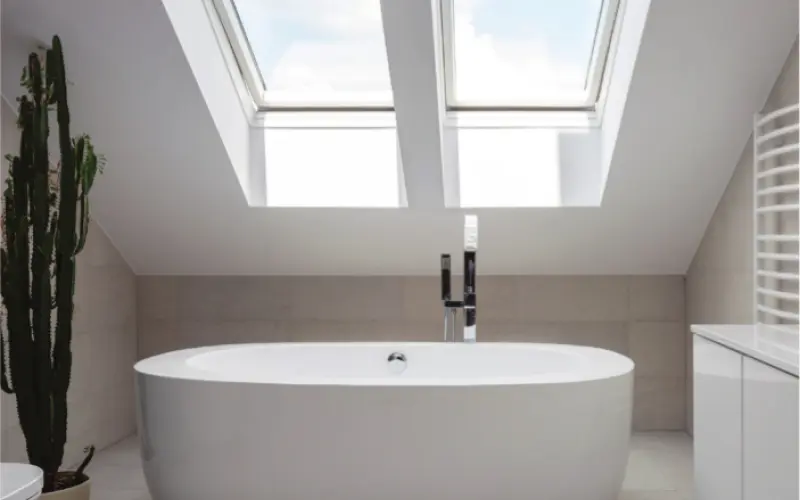
In my years as an architect, I have often used alternative options for daylighting these non-habitable spaces. I remember the first time I was given the brief to provide a ‘Zen bathroom’ in an upmarket home. One of the fundamental points of difference we chose was to use no wall-mounted windows, substituting a large single opening skylight overhead instead.
The client loved the elimination of security and privacy issues, the extra continuity of the wall surfaces and the great natural light that flooded the entire room. She said that the direct sunlight and the sight of sky and clouds made her feel more connected to the outside world, enhanced because there was no need for obscure glass, blinds or window shutters to shield the neighbours. And she loved lying in the bath at night looking at the stars.
I went on to design many such spaces with only skylights for natural lighting, and these were always spaces that provided a pleasant surprise for the homeowners when they were built. Sometimes they were purely for aesthetic reasons, others for more practical reasons such as avoiding the need for expensive fire windows if the building was too close to the property boundary. Fully opening skylights also provide the ability to completely change the air in the room almost instantly or be left slightly open for continuous ventilation.
Skylights not an option in G7
The fact that rooflights or skylights are not an option in G7/AS1 to meet natural lighting requirements for habitable spaces has always seemed to be an opportunity lost to me as a designer.
I have tried to include skylights to meet daylighting requirements in building consent applications over the years but have always been knocked back, often because they did not provide compliant ‘visual awareness of the outside environment’. When we did include them, they were as an extra, over and above the daylight quota provided via traditional windows in walls.
But more and more, I see design situations where skylights would be a valuable tool to help achieve required daylighting levels if they were permitted.
Some issues with current requirements
I was shown through an almost complete large multi-unit residential development recently. Some of the units were long and narrow with neighbours through party walls to each side. They were heavily overglazed at each end only to meet prescribed daylighting requirements.
One north-south oriented apartment was already overheating at midday, and I could only anticipate the issues that would arise with control of potential heat loss from the over-glazed southern façade.
The use of skylights may not have completely eliminated these issues but would have been a helpful option to incorporate in the overall design.
Windows can be a disadvantage
These long narrow floor plans emphasise the shortcomings of the reliance on windows only to provide daylight. The window as sole daylight source can be a large distance from some parts of the habitable space. The subsequent use of borrowed light and reflective surfaces to distribute the daylight further into the building – as per G7/AS1 – seems a poor compensation for real daylight, which could often be delivered via a roof window or skylight.
The ‘visual awareness of the outside environment’ aspect of these medium-density multi-unit dwellings can also be compromised by the close proximity of neighbouring units. There may well be a compliant wall-mounted window installed to illuminate a room, but if it looks straight into a neighbour’s room, some form of blinds or curtains will be used to preserve their privacy.
The goal of natural lighting may have technically been met, but human nature will choose to override it to preserve psychological comfort. While we can legislate to position clear-glazed windows in exterior walls within the visual awareness zone, we cannot prevent occupants from covering these windows to hide the close proximity of neighbours.
The net result is that the prescribed and achieved internal daylight levels and external visual awareness requirements are lost.
An overhead natural daylight source such as a roof window in the same room, with no compromised privacy, may well be left alone to function unimpeded.
Modern roof windows have many advantages
If faced with a choice of looking at a wall or looking at the sky, which would most people honestly choose?
Modern, mechanised climate control roof windows are solar powered and can be programmed to open when the room temperature gets too high, when internal humidity levels rise and even when preset CO2 levels are reached within the space.
These are technologically sophisticated machines that definitely enhance the amenity of a room – in many cases, to a level far in excess of what most windows can achieve. Why are these roof windows not considered part of Acceptable Solution G7/AS1 instead of having to deal with the complexity of Verification Method G7/VM1?
Visual awareness can be difficult
Acceptable Solution G7/AS1 2.0.2 states that it is acceptable for awareness of the outside to be provided through another space. The visual awareness zone is between the levels 900 mm and 2,000 mm above floor level.
If there is no opportunity for an external window directly into a bedroom, how realistic is it to consider a view shaft from that bedroom through an adjacent room to a window in another external wall? What level of amenity does this deliver to the wellbeing of the occupant of this bedroom? Again, I would personally far rather have a skylight directly into the privacy of my own bedroom!
MBIE reviewing clause G7
Much of Building Code clause G7 Natural light and Acceptable Solution G7/AS1 were first published almost 30 years ago. MBIE recently asked for submissions on this as part of Building Code Update 2021 – Proposal 4 Natural light for higher-density housing. This review is an important opportunity to update the provision of natural lighting in buildings.