




The Building Code requires all building elements to be adequately supported against earthquake forces. In the case of storage water heaters, the objective is to prevent the storage tank from toppling, moving away from the wall or sliding along the wall during an earthquake.
This minimises damage due to movement and increases the chance of keeping the plumbing connections intact so building occupants can use the water following a seismic event.
Restraints and fixings
G12/AS1 provides seismic restraint methods for water heater storage tanks with a capacity up to 360 litres in light timber-framed construction – those designed according to NZS 3604:2011 Timber-framed buildings. Storage tanks with a capacity greater than 360 litres are outside the scope of G12/AS1 and may require an Alternative Solution for building consent purposes.
Storage water heaters should be restrained using 25 × 1 mm galvanised steel straps that are tensioned when fixed in place. Each strap should be fixed to the wall framing at both ends using 8 mm coach screws with either a single 30 × 2 mm thick washer or two 20 × 2.5 mm washers. The coach screws must penetrate the framing timber by at least 50 mm. In retrofit situations, additional timber framing may be needed to ensure there is adequate strap fixing.
However, strapping alone is insufficient to prevent movement. During an earthquake, a strapped cylinder can still rock from side to side, parallel to the face of the wall. To prevent this, storage water heaters should be further restrained using two 50 × 50 mm vertical blocks on either side of
the storage tank’s closest point to the wall. The blocks must run the full height of the storage tank and be fixed to the wall framing using 100 × 3.75 mm nails at 600 mm centres maximum. A similar restraint system should be used when the water heater is located in a corner between two walls.
Strap locations
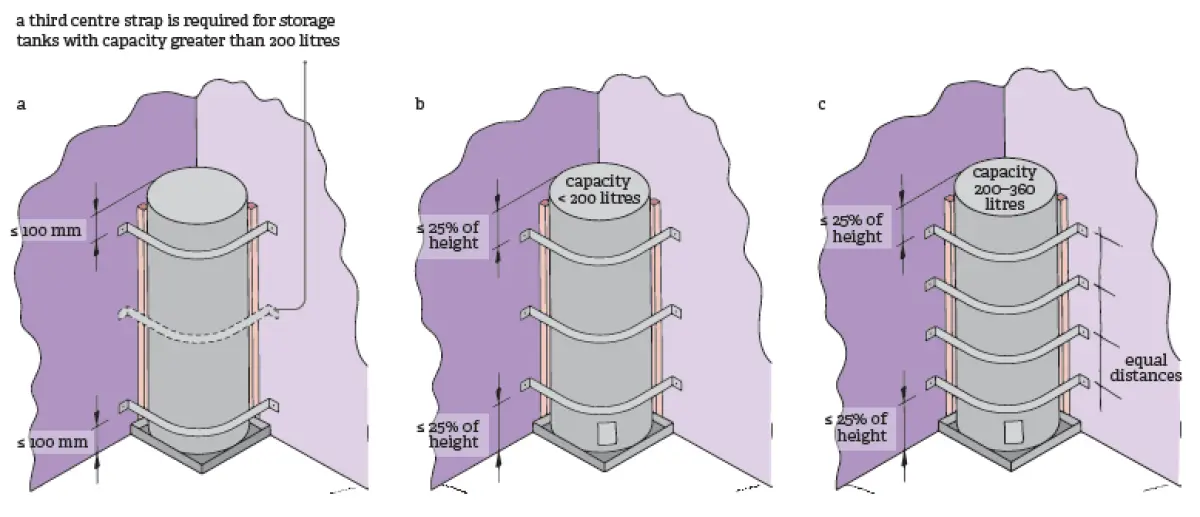
Straps should be located at the top and bottom of the tank no more than 100 mm from the top and bottom edges of the cylinder. Storage tanks with a capacity greater than 200 litres require a third strap located at the centre of the cylinder (Figure 1a).
Straps should not be located where they may obstruct, damage or otherwise clash with the water heater’s inlet or outlet plumbing or controls. However, this requirement sometimes led to confusion – how to place a strap within the required 100 mm distance from the top or bottom edge and still avoid the plumbing connections and controls. Some water heater designs make the clash unavoidable.
The current G12/AS1 provides the answer. Where it’s not possible to achieve the 100 mm maximum strap distance, straps should be placed within the top and bottom 25% of the cylinder.
In this situation, tanks with a capacity less than 200 litres require an additional strap located at the centre of the cylinder (Figure 1b). Tanks with a capacity greater than 200 litres require two additional straps (a total of four) placed evenly between the top and bottom straps (Figure 1c). Table 1 summarises these requirements. At least three straps are always required, regardless of tank capacity, where the storage water heater is located more than 12 m above finished ground level.
Some water heater designs may require different strapping arrangements, especially where the tank has an uneven vertical weight distribution such as those with an integrated heat pump.
Where fittings and pipework connect to the water heater through the floor or another support structure, at least 50 mm of clearance should be provided between the fitting and floor or support structure. This reduces impact damage to the fitting if the storage tank should move slightly during an earthquake.
For full details, see clause G12 Water supplies.