


As buildings in Aotearoa New Zealand are often designed with earthquakes in mind, their steel beam-column joints are detailed to provide greater flexibility and provide an explicit, controlled failure hierarchy. This is not the case in other countries where seismicity is less of a concern.
The improved detailing is sometimes said to improve structural behaviour under fire conditions. However, observations during and after numerous fires – both accidental and experimental here and internationally – have shown joint behaviour and failure modes do not align with their behaviour under earthquake conditions. The question is, does our seismically compatible joint detailing truly improve structural performance under fire conditions?
The fire performance of seismically compatible detailing follows, and the results and conclusions of a research project looking at the issues are summarised.
Earthquake design influences on joint detailing
Seismic design in Aotearoa should provide good structural behaviour through capacity design. This controls the failure of the building by ensuring desirable and gradual failure mechanisms (ductile links) are the weakest part of the building, while undesirable and sudden failure mechanisms (brittle links) remain stronger.
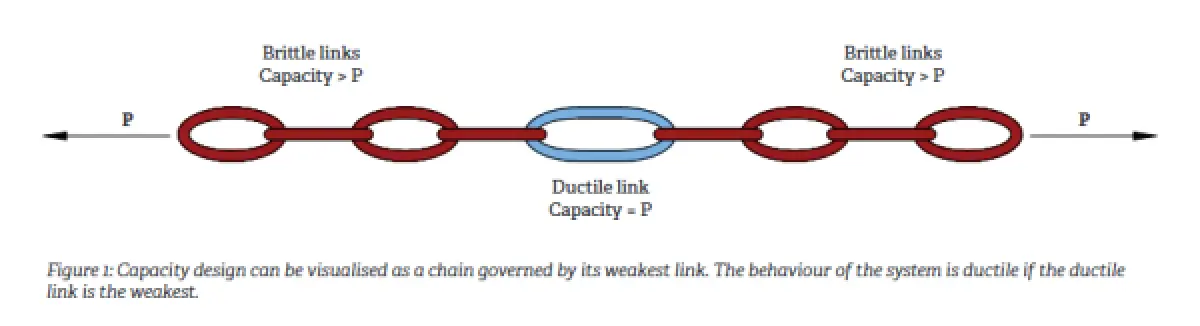
link is the weakest.
The whole-building response is governed by the weakest mechanism, akin to a chain failing at its weakest link (see Figure 1). Alongside other likely issues, the following key detailing considerations are made to ensure good performance of these joints using pre-engineered connections as defined by the Steel Connect tables (SCNZ 14.1:2007 and 14.2:2007):
- Joints are considered brittle links and should be stronger than other parts of the building.
- The behaviour of the link should be predictable for inter-storey drifts of at least 2.5% (rotations of 0.025 rad, 1.4o) to avoid introducing additional forces such as those from beam-column contact (see Figure 2).
- The failure of the joint itself should be ductile by preferring ductile mechanisms such as bolt hole bearing over brittle mechanisms such as bolt fracture – a capacity design of the joint and its components.
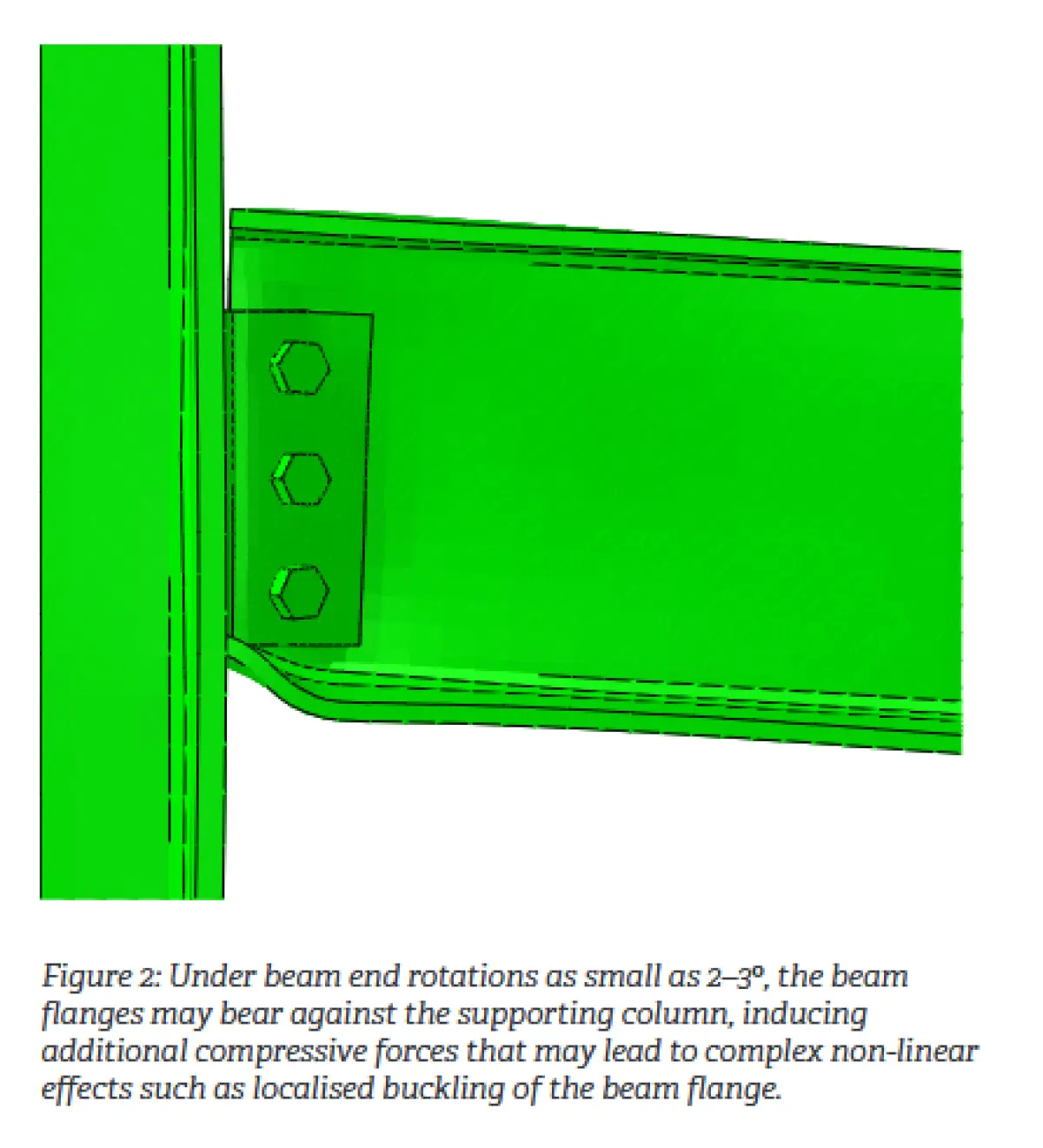
flanges may bear against the supporting column, inducing
additional compressive forces that may lead to complex non-linear
effects such as localised buckling of the beam flange
Fire condition demands
Fire conditions also pose significant challenges to a building’s structural stability. Each of these challenges corresponds to the detailing considerations for seismic conditions previously mentioned:
- Reduction of strength and stiffness of steels at high temperatures combined with thermally induced axial forces.
- Large beam deflections due to reduced stiffness, thermal expansion and significant axial loads, which contribute to large beam end rotations.
- Non-uniform material degradation due to varying localised temperatures of different steel components and more rapid degradation of different types of steels such as heat-treated high-strength steel bolts.
The magnitudes and mechanisms of the fire effects do not resemble those from seismic conditions. The reduction of material strength reduces joint capacities. Large axial compression develops from restrained thermal expansion and later large beam tension forms during catenary action and subsequent cooling (see Figure 3). Combined with the reduced joint capacity, this often causes an inelastic non-linear response of the joint.
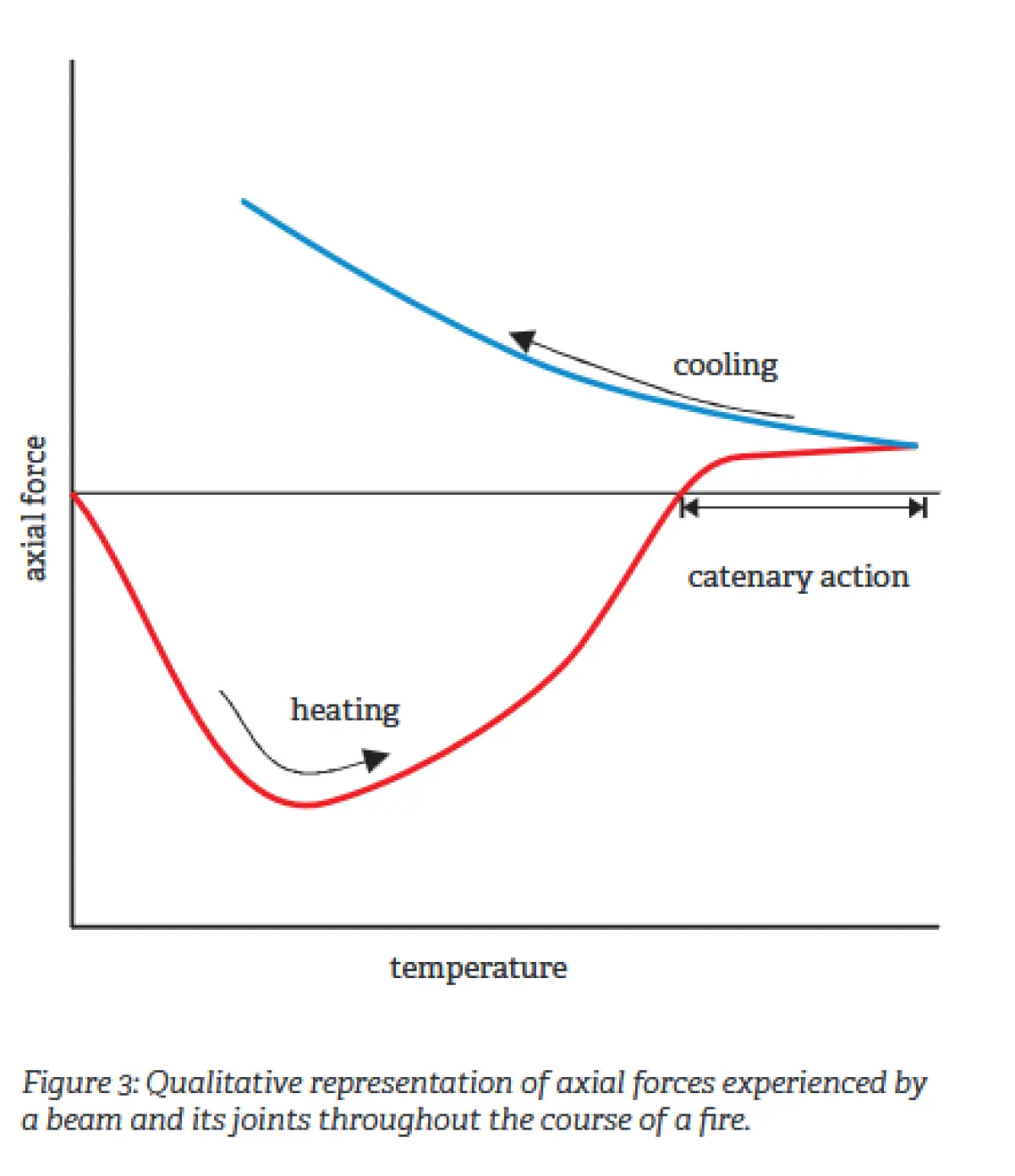
a beam and its joints throughout the course of a fire.
Large rotations, which may reach and even exceed 0.16 rad (9.2o) (corresponding to beam deflections of L/20 as per the standard fire test, against which steel protection schemes are usually certified), often result in beams bearing against columns, elongation or tearing of bolt holes and fracture of bolts (see Figure 4).
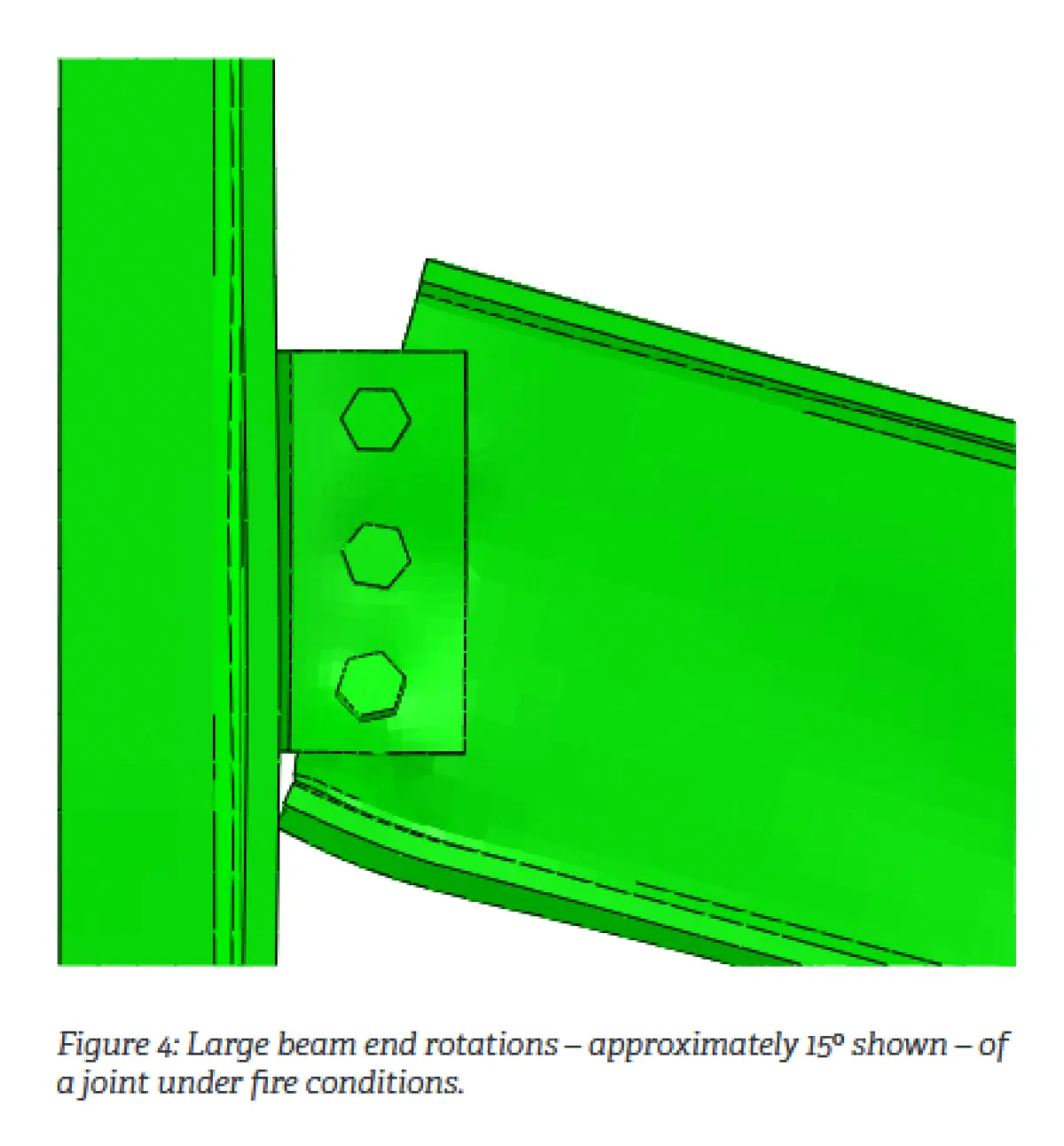
a joint under fire conditions.
If the rotations are large enough that the beam bottom flange bears against the column, significant moments can develop that may invalidate nominally pinned or simply supported design assumptions. High-strength steel bolts degrade much faster than mild steel beams, plates and columns and often end up governing the joint failure.
Study of seismically compatible detailing in a fire
During the research, detailed finite element simulations were conducted to quantitatively compare joint designs used in Aotearoa – representing seismically compatible detailing – with British joint designs representing non-seismically compatible detailing.
Three joint types were investigated:
- A fin plate joint – also known as a web side plate joint.
- A fin plate with a top flange plate – a local specific detail that may be included with nominally pinned joints to aid axial force transfer.
- A moment end plate joint.
These joints connected the beam and columns of an interior bay frame exposed to the standard fire. Columns were protected, and connections and non-composite beams – with a limiting temperature of 590oC – were unprotected.
The response of frames with either local or British details was analysed and compared, followed by a parametric study varying each joint type to assess the effects of specific detailing differences such as plate thickness, bolt size or beam-column gap.
The numerical study showed little difference in terms of failure characteristics between the New Zealand and British fin plate or moment end plate joints. In fact, the details from Aotearoa showed earlier failure times than their British equivalents. However, inclusion of a top flange plate to the fin plate joint significantly increased fire resistance when compared to the bare fin plate joint.
Failures of the fin plate connection with or without a top flange plate connection (Figure 5) were governed by bolt fracture despite seismic detailing practices supposedly moving the failure mode away from the bolts. This was because of the much more rapid degradation of high-strength steel bolts compared to mild steel plates and members.
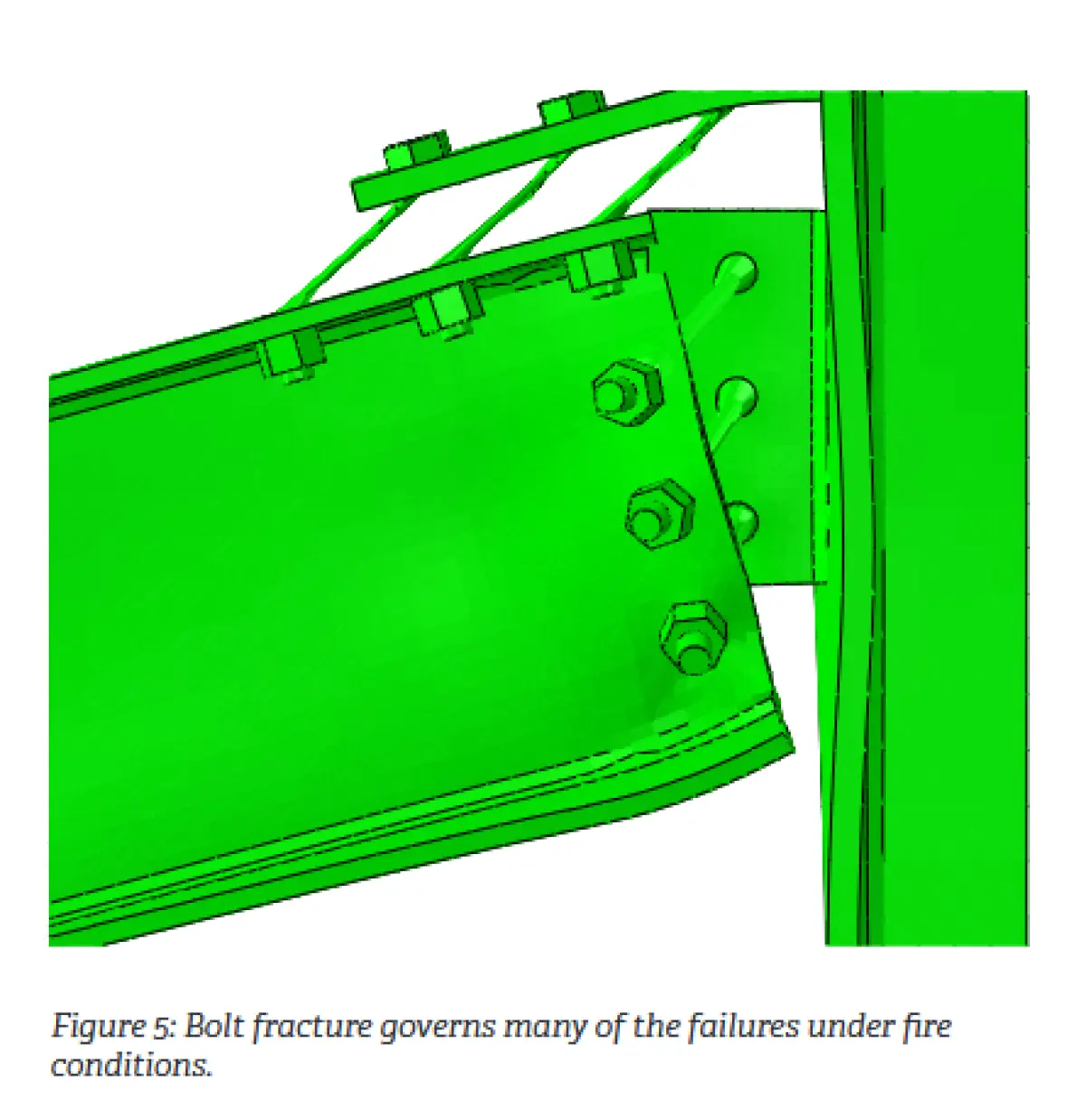
conditions
Bolts failed sooner when thinner plies were included due to reduced thermal mass leading to faster heating. For example, a bare fin plate joint with an 8 mm plate (local detailing) failed after 15.0 minutes compared to 15.5 minutes for a 10 mm fin plate (British detailing). Failures of the local and British moment end plate joints were governed by beam plastic hinge fracture, occurring slightly later in the more flexible British detail (49.6 minutes vs 47.8 minutes), which shared some damage with the plastic hinge zone. The detail in Aotearoa concentrated damage to the plastic hinge zone only.
Conclusions and recommendations
- Aotearoa’s seismically compatible detailing does not always improve the fire performance of a beam-column joint compared to joints designed without seismically compatible detailing and may, in fact, result in reduced performance. Conclusions and recommendations from overseas studies to improve connection fire performance – for example, the use of slotted holes and alternative joint types such as angle cleats – therefore also apply to construction here.
- Bolt failures often governed the response of the joints despite ambient temperature design practices shifting the failure to the plies.
- Capacity of the bolts under high temperatures should be checked alongside the ambient temperature design.
- Bolt fracture could be delayed or avoided by delaying temperature rise by, for example, using thicker plies to increase thermal mass, preventing direct fire exposure through shielding and encasement from a floor slab or thermal protection and using additional or larger bolts.
- Top flange plate connections can improve the fire resistance of the fin plate joint while simultaneously offering benefits under seismic conditions.
- Experimental studies on seismically compatible detailing in Aotearoa should be conducted to provide further strength to these arguments