



On 15 August 2023, the House underwent the third and final reading of the Natural and Built Environment Bill and the Spatial Planning Bill. These Bills are now law.
Nearly 3,000 written submissions were received from the public on the Bills, and a range of changes were recommended by the Environment Select Committee from public feedback, many of which have made their way into the final versions of the Bills. The fundamentals of how the new framework will operate haven’t changed much through public feedback – there will still be a stronger focus on environmental protection, more prescriptive plans and an intention to reduce consenting requirements.
What you should care about now
This doesn’t mean our system is going to change overnight – some aspects have, but there is a lot of water to go under the bridge as we transition to the new framework as well as significant uncertainty with an election imminent. Here are the key immediate changes, followed by other notable changes that are on their way.
Fast track is here to stay
The COVID-19 Recovery (Fast-track Consenting) Act 2020 (FTCA) has been widely regarded as a success due to the ability to achieve quicker consenting outcomes, without notification or hearing processes, and limited appeal rights. A similar fast-track process is now immediately available under the Natural and Built Environment Act 2022 (NBEA). This has the same two stages – the Minister for the Environment is a gatekeeper and must refer a project for eligibility for a fast track, after which a full resource consent application can be made to an expert consenting panel.
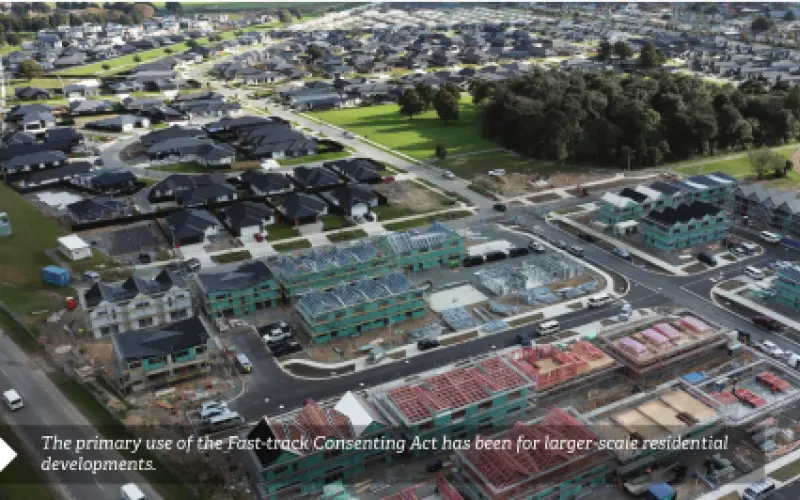
A key difference is that the new process is only for housing and infrastructure projects. This includes housing developments that contribute significantly to addressing demand for housing in a region, both in terms of scale and type. It also includes infrastructure relating to water, energy, transport and other government projects such as schools, hospitals and defence facilities. We saw a range of different types of projects use the FTCA with success, but its primary use has been for larger-scale residential developments, including retirement villages. Based on that trend, we can expect similar types of projects to continue to enjoy the use of the new fast-track process due to the ongoing pressures to deliver housing supply in all areas of the country.
Water takes
It’s not uncommon for developments to include groundwater bore takes to supplement site water servicing, particularly for non-potable uses. Under the NBEA, water takes are capped at 10 years, so any new water take consent obtained under the new system can’t be for more than 10 years – subject to some limited exceptions.
However, the transitional provisions will affect water take durations for applications granted after the NBEA came into force – before the new NBEA combined plans are finalised. Irrespective of what the RMA regional plan currently says about water take durations, these new takes are capped at 5 years after the date the relevant allocation rules come into legal effect in the new NBEA combined plan for the region.
For example, assuming the allocation rules in a particular new NBEA plan come into force in 2028, a water take consent granted tomorrow will expire no later than 2033, irrespective of what the current regional plan says. That may be a significant change to what the regional plan currently provides for. If you are looking to get water takes approved, prepare for shorter durations.
What you should care about soon
A draft of the National Planning Framework (NPF) must be released within 6 months of the NBEA coming into force. The NPF will pull together all national direction – including for example on urban development and highly productive land, with new direction for infrastructure – and will be a critical piece in informing the development of new regional spatial strategies and combined plans across the country.
It has been indicated that the national direction on infrastructure and development will include standards on construction activities such as noise and vibration, erosion and sediment control, dust and works in waterways. Standardising these types of activities – which typically have consistent and wellunderstood environmental effects – is critical for giving certainty to developers and streamlining consenting processes. Getting involved in the development of the NPF provides a good opportunity to secure consistent national direction on these matters.
What you can care about later
The RMA and associated district and regional plans remain in force until a region’s combined plan is developed under the NBEA. That process will take some time. Given not every region is expected to notify its regional spatial strategies and combined plans at the same time, these are expected to be developed over the next 7–10 years, with three test case regions undertaking the process first. Keep a look out for what those regions will be and whether you have development plans in those regions soon. If so, you may want to consider whether you seek necessary consents sooner under the RMA as the devil we know.
And … it might all be gone by Christmas
The National Party has said it will repeal the NBEA and the Spatial Planning Act 2022 (SPA) by Christmas if elected, with an alternative framework to be developed over the next 3 years. If there is a change of government, the design of our new resource management system and any similarities to the NBEA and SPA remain to be seen.
For more detail on how the new framework will operate, see our previous article Constructing a new resource management system in Build 194. Based on that trend, we can expect similar types of projects to continue to enjoy the use of the new fast-track process due to the ongoing pressures to deliver housing supply in all areas of the country.
Note: This article is not intended as legal advice. For specific advice, contact your legal advisor.