

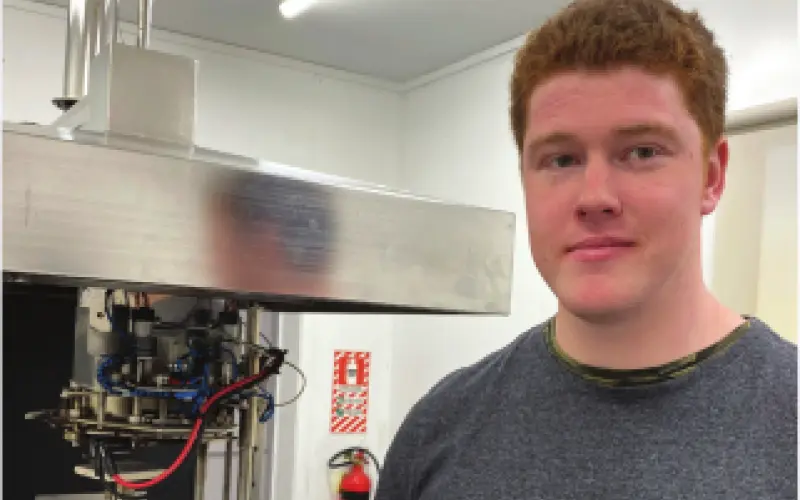


Q. What’s your background – where you grew up and your education?
I grew up in the small town of Dannevirke, located in the Manawatū region. After finishing NCEA and acquiring university entrance at Dannevirke High School, I moved to Palmerston North to study chemistry and physics at Massey University. After completing my double major Bachelor of Science in chemistry and physics, I moved to Wellington to take the first step into my career as a research scientist here at BRANZ. After my first year at BRANZ, I started a part-time honours in physics at Victoria University of Wellington, which I should be finishing this year. This is to continue to grow my skills as a scientist and prepare me for a PhD later in life.
Q. Was there any event, a teacher or family background that drew you to becoming a scientist?
I don’t think I had a particular event that motivated me to become a scientist. From an early age, I was always interested in some field of science. When I first started to read as a child, I got into my mother’s old nursing training manuals, and they were some of the first things I read. With them, I started to draw lines between curiosity, learning and the application of knowledge to solve problems. After a short time figuring out how I could pursue this method for a living, I was lucky enough to know what I wanted to do in life. The only ambiguity was what were the issues I wanted to apply my scientific interests to.
Q. Why did you decide to specialise in fire research?
Fire and thermodynamics in general encompass both physics and chemistry in its essence and behaviour, so going into fire science seemed like an amazing opportunity to use both of my scientific backgrounds in the same field. This doesn’t mean I have completely reserved my work in BRANZ to the physics of fire dynamics and the chemistry of combustion. I have also been involved in the material space of the Better Building research team, helping where I can.
Q. What’s your work history – pre-BRANZ and now at BRANZ?
Straight out of university, I did a paid summer research project based in prebiotic chemistry investigating if there was an effect of the DNA pattern on the melting behaviour of DNA. During my time at university, I was employed over summer at a cold storage facility and worked some semesters as a lab demonstrator and tutor. Working at BRANZ has been my first real step into my career as a research scientist. I have been working here for a little over 2 and a half years on a few projects with various tasks and challenges. I’ve been involved in a lot of coding, from developing the B-RISK validation and verification software to developing code to process video files to track flame height. I’ve been involved in the construction of project specimens and overall experimentation in the fire research space. I’ve also used my multi-discipline background to work in some of the material research teams’ projects, helping with sample and data collection and helping with gas chromatography–mass spectrometry where I can.
Q. What does a typical day look like?
The best thing about research is that it always stays fresh. I could be working on a literature report around the toxicity of combustion products of building materials one day and then trying to code an automatic tracking program that follows the movement of fire in a video file, although the philosophy of research does follow a consistent plan. Typically, I will be working on a research project, analysing data, writing up on the findings of the results and appropriately using the information to create the best beneficial impact I can. This could be disseminating the information to a section of the building industry or constructing a new tool or education piece to address the found gap.
Q. What are the chief issues concerning fire research scientists?
At present, there are a range of concerns in the fire space – from the use of new green energy sources like lithium-ion batteries and green hydrogen fuel to the potentially increasing risk of wildfires in Aotearoa New Zealand with climate change. With the push towards higher-density construction and increasing the use of timber for greener construction, my main concern is buildings being constructed without properly considering and mitigating each new fire risk. It’s not that the idea of these are a direct concern but that these practices are new in Aotearoa. Just like anything new, they have the risk of being initially incorrectly implemented and leading to unforeseen issues or consequences down the line.
Q. What are the most challenging aspects of your job and those that are most satisfying?
Strangely, the most challenging part of being a researcher can sometimes be the most satisfying and the easiest parts can require the most effort. The way the work evolves requires a learning mindset to adapt to all sorts of new challenges – learning a new coding language to process data, communicating with new stakeholders or understanding a new material or process. The new tasks are usually exciting mountains to climb – the most satisfying part is standing on the top of the mountain of scattered scribbled scrap paper with a new understanding of something and a story or insight to share. Meanwhile, the times that require the most effort can be the small not complicated things that require heavy repetition. When you must sit down and do almost the same thing a few hundred times, it can get a little draining, but that’s what’s required sometimes for the most robust conclusions. The challenging flow of research is exciting and satisfying, while in some monotonous tasks it can be the most difficult.
IN BRIEF
New BRANZ CEO
Claire Falck has been appointed to the role of Chief Executive Officer at BRANZ, following a period as Acting CEO. Claire has held senior roles with Rio Tinto Alcan, New Zealand Police, Ministry of Social Development and the former Housing New Zealand Corporation. Before joining BRANZ, she was Practice Lead at MartinJenkins.
Where and how to build
The University of Auckland has received a $450,000 grant from Toka Tū Ake EQC for a project into reducing natural hazard vulnerability by improving the information and engineering assessment methods around how and where to build. Research will focus on improving understanding of the potential strength of earthquake shaking, assessment of flood defence systems, tsunami inundation, and impacts and seismic assessment of existing residential buildings. This will include national, regional and Māori built environment scale projects.
Assess your product’s description
A new online resource helps manufacturers and importers of building products to meet building product information requirements. The Building Product Information Requirements (BPIR) Ready tool allows users to self-assess a product and prepare a BPIR summary that can be utilised as the basis for evidence-backed disclosure information per the requirements of the regulations.
Correction
In the previous issue of Build, the image of the Adventure Whare, one of the finalists in the 2023 Timber Design Awards single family dwelling, was incorrectly attributed. The architects of this project are Studio Well Architecture.