

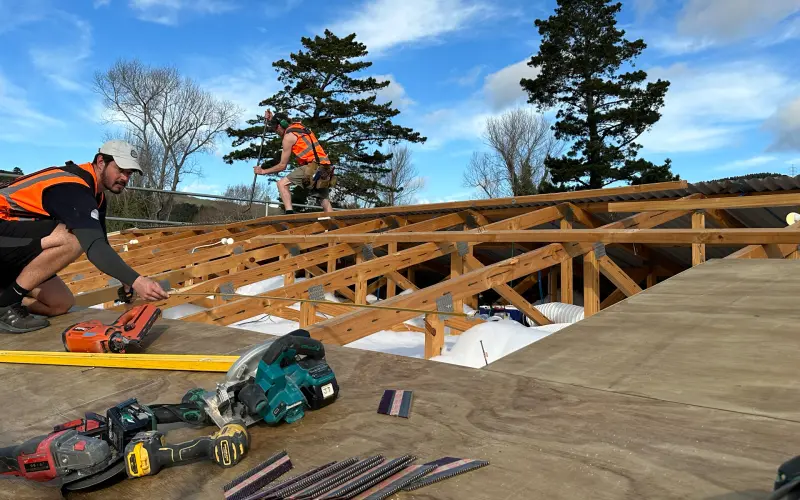


BRANZ, alongside other researchers and industry partners, is exploring how the health and comfort of Kiwis can be improved by addressing the problems of temperature extremes and dampness that plague many of our homes – both new and existing.
Their research has shown that a construction technique known as a warm roof evens out the large temperature swings characteristic of conventional roof designs, dramatically reducing the risk of moisture problems in the roof structure and offering multiple other benefits for homeowners and occupiers.
What is a warm roof?
The tried-and-true method to put together a profiled metal roof in Aotearoa New Zealand is to mount the cladding, roof underlay and wire mesh on top of the purlins.
If it’s a skillion roof, the insulation goes in the gaps between the rafters. If it’s a pitched roof with a ceiling void, the insulation typically goes between or, more lately, on top of the ceiling timber.
In both cases, the roof structure (and roof space if there is one) lie outside the insulated envelope of the building. Consequently, they are impacted to a greater extent by the climate – solar radiation during the day and radiative cooling at night. This results in large temperature swings – heating up to well above the outdoor temperature during the day and cooling to below it at night. Where the rafters penetrate the insulation they also present a significant thermal bridge.
This kind of construction is known as a cold roof.
A warm roof typically uses a layer of rigid insulation on the exterior surface of the structure, either with an integrated cladding (this could be a membrane or a metal skin bonded to the insulation) or with traditional roof cladding over the top like the BRANZ test building (see Build 161).
This brings the roof structure and roof space inside the insulated envelope of the building, protecting them against swings in exterior temperature. They maintain a temperature close to that of the living spaces below.
Significantly reduced condensation risk
Evening out the temperature in this way means that, under normal living habits, condensation is very unlikely to form on the roof structure and in the roof space. In cold roofs, by contrast, condensation can form on the underside of the roofing underlay and on the structure itself – a problem made much more likely if there is little roof ventilation and moist air is able to move upwards from the living spaces, (for example, through downlight recesses) and into the roof space.
The durability of a cold roof depends on the site receiving enough solar radiation during the day to aid drying, which can’t necessarily be relied upon.
Excessive moisture in the roof space can have a number of consequences, including reducing the effectiveness of insulation, damaging building components and promoting the growth of mould. It can be complicated to resolve. Just adding ventilation is no guarantee of a quick fix because the cooling of the roof deck below ambient temperatures can mean that nighttime ventilation actually adds moisture to the space. See, for example, the description in Build 178 of a solar extraction fan installed in a Tauranga home to solve a persistent moisture problem.
Wider benefits
Beyond the direct benefits associated with reduced moisture, warm roofs offer multiple advantages to homeowners and occupants:
- Warm roof insulation has significantly less thermal bridging than other methods of construction (there are still screw fixings and suchlike but their impact is less significant).
- The way warm roofs are constructed will typically add rigidity to the roof structure.
- The lifespan of the roof cladding will typically be extended as the condensate load on the cladding will be reduced.
- The insulation tends to make the living spaces quieter.
- Less variability in the roof space temperature enhances the efficiency of air conditioning and other forms of heating and ventilation with ducting that passes through the roof space. This is because the roof space conditions are the same as in the conditioned area of the building.
- In some buildings, a warm roof can eliminate the need for separate climate-controlled plant room.
- Warm roofs help to reduce the risk of overheating risk in the living space.
- The higher R values mean a rework of the structure isn’t required.
- Warm roofs potentially reduce the corrosion risk for built assemblies.
An investment in long-term gains
While warm roofs can cost more to install because of the additional insulation and materials, the enhanced thermal efficiency they provide, and their reduced maintenance needs can lower running costs in the long term – offsetting the initial expense.
What’s more, warm roof technologies continue to evolve. Some new panellised options are quick to install, requiring little more labour time than traditional forms of insulation.
Retrofitted warm roofs offer major advantages to refurbishment projects. Where roofs are at end of life, it is straightforward to add significant thermal resistance with the same level of disruption as a conventional re-roof.
The technique is also an increasingly popular option for new builds, particularly low-pitch and skillion roof projects, and can make a significant contribution to designs aiming to create a healthier, more comfortable living environment.