

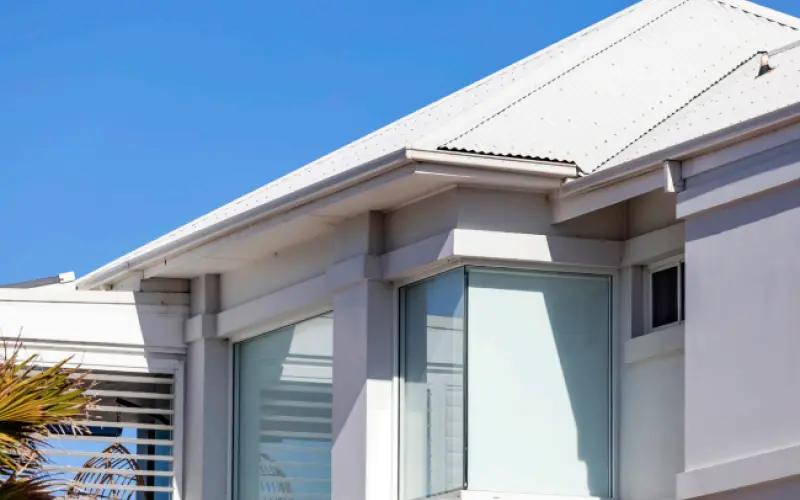


Acceptable Solution B2/AS1 to New Zealand Building Code clause B2 Durability requires roof claddings to meet a minimum durability of 15 years. A profiled metal roof typically has a life expectancy longer than this depending on a number of factors such as environment, roof design, type and grade of metal used, quality of installation and maintenance.
Causes of corrosion
Corrosion occurs as a combination of atmospheric pollutants – although primarily salt, which is almost always present in Aotearoa New Zealand’s coastal marine environment. Industrial and geothermal pollution is also present in the atmosphere in some parts of Aotearoa. Unless washed off regularly, the pollutants react with moisture, resulting in corrosion.
Prior to the 1960s when long-run metal roofing became available, profiled metal roofing sheets were only available in short lengths, requiring end laps. Dirt and moisture readily accumulate under the end laps, causing corrosion. Corrosion is also more likely to occur at eaves and around flues and other roof penetrations. Lack of maintenance, an inadequate roof slope resulting in poor run-off and run-off from a dissimilar metal are other causes of corrosion.
Options for reroofing
When a metal roof requires replacement, the easiest option is to replace with a similar roofing material. Profiled metal roofing is lightweight and less likely to require additional structural or other roof support. It comes in a range of colours and prefinished options. Profiles available include:
- corrugated
- trough section
- trapezoidal.
Metals for roofing include zinc/aluminium alloy-coated mild steel, galvanised mild steel, aluminium, zinc and copper. The mild steel and aluminium profiles can be formed in several ways:
- Roll forming – feeding metal coil through a series of rollers that gradually bend the metal into the desired shape.
- Brake pressing – metal is pressed and bent (similar to stamping) into the desired shape. This technique is most commonly used for pressed metal tiles and to form flashings and guttering.
- Folding – a similar process to pressing and also used to form flashings and guttering.
Copper and zinc are typically installed as a flat sheet with standing seams or batten roll joints rather than as profiled metal roofing.
| Grade | Minimum base metal thickness (BMT) (mm) | |
| Mild steel for profiled metal roofing | G550, or G300 for rolled, crimped or trough section | 0.4 |
| Aluminium for profiled metal roofing | 5000 series | 0.7 |
Roof pitch
Roof pitch can affect durability as roofs with a pitch over 5° are generally likely to receive better rain washing.
Acceptable Solution E2/AS1 to clause E2 External moisture sets out a minimum pitch or roof slope for different metal roof profiles:
- Corrugated – minimum 8° pitch.
- Trapezoidal – minimum 4° pitch where crest height is less than 27 mm or 3° pitch where crest height is more than 27 mm.
- Trough profile – minimum 3° pitch.
Metal grades
E2/AS1 also sets out grade and base metal thickness (BMT) requirements (shown in Table 1), which must be selected in accordance with Table 20 in E2/AS1 for corrosion protection based on exposure zone. Exposure zones are in accordance with NZS 3604:2011 Timber-framed buildings Figure 4.2. Exposure zones B, C and D, relating to the severity of exposure to wind-driven salt, are defined in NZS 3604:2011. Zone B is low risk, zone C is medium risk and zone D is high risk.
Profiled metal roofing
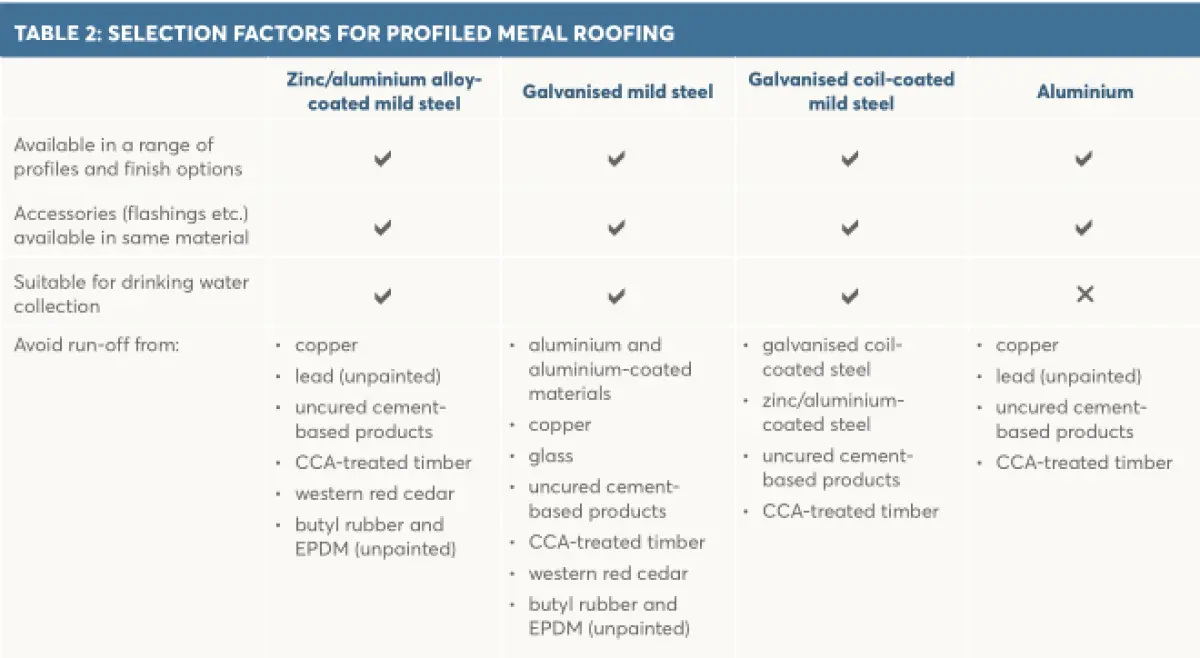
Factory-painted zinc/aluminium alloy-coated mild steel profiled metal roofing is relatively low maintenance and requires little maintenance throughout its life. It outperforms traditional galvanised coatings in almost all roofing applications due to the combination of the sacrificial protection of the zinc and the barrier protection provided by the aluminium. However, it is not recommended for extreme coastal environments and should not be used within 200 metres of breaking surf. Selection factors for profiled metal roofing are in Table 2. All profiled metal roofing requires an absorbent underlay.
Will a building consent be required?
If the roof cladding to be replaced has met the Building Code minimum requirement for durability – remained weathertight for 15 years or more – and the same roofing type and profile are being used to replace the existing roofing, a building consent is not required.
Situations where a building consent will be required include where the roofing:
- has not remained weathertight for 15 years
- is to be replaced with a different roofing material
- is to be installed to a different slope or roof plan
- is adjacent to wall cladding that is also being replaced.
In all situations, all reroofing work must comply with the performance requirements of the relevant Building Code clauses.
The New Zealand Metal Roof and Wall Cladding Code of Practice (available at www.metalroofing.org.nz/cop) and E2/AS1 contain guidance on installing profiled metal roofs.
Restricted building work
If the replacement roofing is not like-for-like, is adjacent to wall cladding also requiring replacement or structural changes are required, the work is classified as restricted building work. It must be carried out or supervised by an LBP with a roofing licence or may be carried out by the homeowner if the requirements of an owner-builder exemption are met and any required building consent or permits are obtained before starting work. The owner-builder exemption means the work will be recorded on the council records as having be done by the owner and will be visible to future potential buyers of the property.
Although replacing a roof with a comparable material does not need a building consent and is not restricted building work, BRANZ strongly recommends employing an LBP with a roofing licence to undertake the work. Working on a roof can be dangerous, with many serious injuries having been caused by falling off roofs. As a minimum, roof edge protection should be installed but scaffolding is preferred to ensure safety as well as provide safe access to the roof.
What may (or may not) be under the existing roof?
Houses built before the 1960s may:
- have no roof underlay
- have been laid directly over an older roof such as asbestos-cement shingles
- have purlin spacings greater than currently permitted
- have damaged roof framing or roof framing that does not comply with current requirements
- be laid directly over 25 mm, close-butted timber sarking, which means there will be no purlins and the sarking will not provide the required 30 mm screw-fixing penetration required into timber purlins – a solution may be to install purlins over the sarking as long as the purlin fixings can achieve sufficient capacity to resist uplift
- have a roof pitch too low for a profiled metal roofing material to be used.
The presence of sarking, damaged or insufficient framing or lack of or damaged underlay will all be visible from within the roof space.
Consider opportunities for improvement
Reroofing provides opportunities to improve the roof such as:
- replacing or adding insulation
- insulating previously inaccessible spaces such as skillion roofs
- inspecting and replacing poorly installed or old electrical wiring or plumbing
- repairing or replacing damaged framing
- improving connections between framing members and adding roof plane or roof space bracing
- adding solar panels to the roof. Solar panels are generally installed on mounts or proprietary brackets on the roof that are attached through the roof to the rafters. A broad range of mounting systems are available to suit most roof types and applications.
Maintenance and washing
The durability of metal roofs is improved by rain washing and regular maintenance, primarily washing. Parts of the roof that require washing are areas not regularly washed by the rain such as where the roofing material is sheltered by an overhanging roof gable or balcony, the underside of verandas and low-pitched roofs covered with leaf litter or other debris.
If the roof is used for collecting water for domestic use, disconnect downpipes from the guttering before cleaning. To clean a metal roof, waterblast or hose and scrub using a soft-bristled broom and mild detergent. Lichen and moss should be treated with a lichen and moss removal product, following the manufacturer’s instruction for use. Once cleaned, the roof should be thoroughly rinsed to remove detergent or roof treatment products.
Painted metal roofs should be repainted as soon as (or before) there is any sign of failure. This not only maintains the protection required but also improves appearance.
Recommended cleaning frequency for painted zinc/aluminium alloy-coated or galvanised mild steel or unpainted aluminium is annually in mild or moderate marine environments and every 6 months in severe marine, geothermal, industrial and special zone environments.
Unpainted zinc/aluminium alloy-coated or galvanised mild steel should be cleaned every 6 months.