

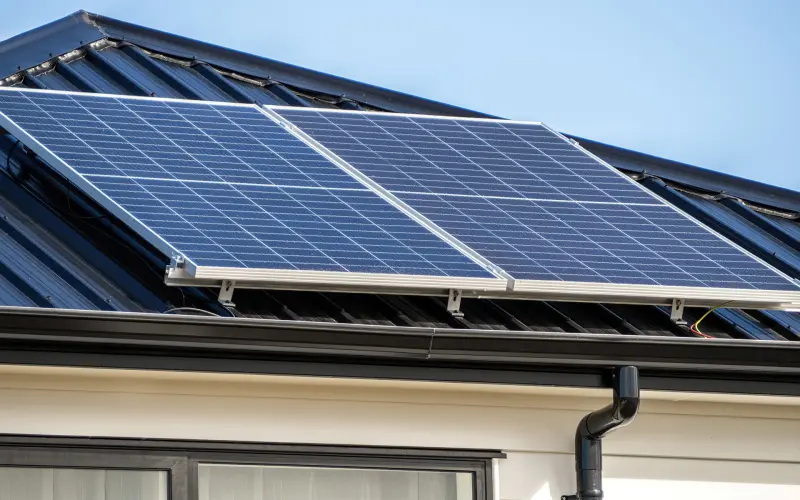


They say your home is your castle – but in today’s world, it should also be your power plant. Most of us still rely on expensive and mostly imported oil and natural gas as well as a centralised electricity grid. But there is a cheaper, smarter and more sustainable alternative: a two-way energy system where electric machines are powered with renewable electricity, much of it from our rooftops. Having a home equipped with solar panels and batteries puts the power – quite literally – back in your hands.
Solar is golden
In Aotearoa, rooftop solar has become the cheapest form of delivered electricity available to homes, yet only around 3% of households have it compared to around 35% in Australia. Encouragingly, we’re beginning to see similar adoption trends here – even without government subsidies. The rapidly falling prices of solar and battery technologies and the rising prices of fossil fuels and grid electricity are driving demand.
An average household that switches to electric heating, hot water, cooking and vehicles can save around $4,000 annually, according to our Electric Homes report. While this transition increases electricity use, it can reduce overall household energy consumption by up to 70% – a far greater efficiency gain than measures like insulation and sealing, which have long been the focus of energy-efficiency efforts. While thermal envelope upgrades remain important, electrification offers a better return on investment for households. This goes against conventional wisdom, but it’s due to the price drops in solar, heat pumps and electric vehicles.
Thermal upgrades affect only space heating and cooling – roughly one-third of total household energy use – or around 15% when vehicles are included. This means thermal envelope upgrades have an inherently limited benefit.
Conversely, a solar install can halve the cost of all electrical energy consumption. Heat pumps can drop both space heating and water heating energy use by 70%, and an EV will drop transport energy use by 70%.
The added benefit of batteries
It’s important to include vehicles in the household energy picture, as most EV charging happens at home. That way, a solar installation helps remove petrol emissions and the battery in the car is just the storage mechanism, not the energy source.
This shift isn’t just beneficial for individual households – it’s good for the entire country. Research from Rewiring Aotearoa shows that, if 80% of the nation’s 2 million homes had a 9 kW solar system, the combined output of these would exceed current electricity generation by 40%. That’s a massive boost to our energy supply – and a major reduction in household energy bills.
Our grid is designed for peak demand, but home batteries – whether wall-mounted or, in the future, vehicle-based – can help flatten those peaks. Just 120,000 homes equipped with medium-sized batteries could reduce peak load by as much as Manapōuri, Aotearoa’s largest hydro power station. These batteries would store enough energy to cover winter demand spikes and recharge during off-peak hours, making our grid more resilient and efficient.
A bright future
All the electric vehicles in the country will eventually be one of Aotearoa’s biggest batteries. Vehicle-to-home or vehicle- to-grid, which requires bi-directional charging, recently passed the first major regulatory hurdle in Australia and many modern EVs include this feature.
Aotearoa will upgrade more than 400 outdated solar and EV charger installation standards to match Australia. To increase uptake, the government announced higher electricity export limits and changes to consenting rules. This follows solar and storage incentives aimed at the rural sector.
To accelerate this transition, homeowners need access to low-interest, long-term electrification loans, giving access to the technologies and incentivising landlords.
While we should always choose building materials with the lowest impact, the emissions we’ll save by switching to electricity and reducing fuel consumption will far outweigh the embedded emissions in the materials we use.