

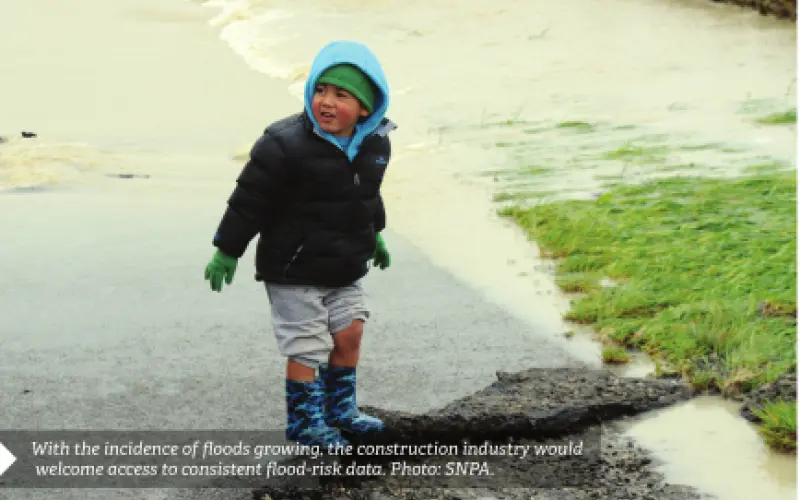


Flood risk is a thorny issue. It’s tough to predict, even harder to manage and notoriously difficult to quantify. Yet it’s an issue that’s impossible to ignore, as several countries have come to realise in the last few decades.
Aotearoa New Zealand currently takes a somewhat decentralised approach to managing flood risk. There are several key mechanisms for hazard control, land-use control, flooding information, emergency management and flood-loss insurance spread across more than half a dozen separate pieces of legislation.
Legislating for flood management
According to Manatū Mō Te Taiao | Ministry for the Environment, the two major players in managing flood risk are the Civil Defence Emergency Management (CDEM) Act 2002 and the Resource Management Act 1991 (RMA).
The CDEM Act focuses on managing hazards, creating resilient communities and ensuring people, property and infrastructure remain safe in an emergency.
The RMA requires that regional authorities control the use of land to avoid or mitigate the effects of natural hazards, and the RMA also requires territorial authorities to control the effects of the use, development or protection of land.
Both Acts rely on forward planning and proactive management to reduce flood risk. Closely linked and playing a significant role in local land-use control is the Building Act 2004.
Building controls framework
The Building Act establishes a set of building controls for the construction, alteration, demolition and maintenance of buildings.
In particular, section 71 deals with building on land subject to natural hazards, including flooding, overland flow, storm surge, tidal effects and ponding.
It requires building consent authorities (BCAs) to refuse consent if the land is subject to a natural hazard unless the BCA is satisfied that the land and buildings will be adequately protected from the hazard.
The Building Act also establishes the Building Code. This contains a set of objectives and minimum performance criteria covering structural stability, access, moisture control, durability, services and facilities, and energy efficiency that all building work is required to meet.
Path to compliance
The Building Code is performance-based, which means it focuses on how a building must perform rather than prescribing how it should be designed and constructed.
Most relevant to flood management is clause E1 Surface water, which aims to protect people from injury or illness and property from damage caused by surface water – it defines surface water as all naturally occurring water that results from rainfall on the site or water flowing onto the site from drains, streams, rivers, lakes and the sea.
To achieve this objective, the Building Code requires that surface water from an event that has a 2% probability of occurring each year must not enter a building.
As it is performance-based, there is more than one way to meet this requirement, but typically it means that all floors inside the building must be higher than the water level that would be reached by a 1-in-50-year event.
Better data, lower risk
The trouble begins when you realise the 2% probability is almost impossible to quantify.
Not only does it have to simultaneously account for multiple sources of water, including tides, rivers and rainfall, it has to contend with a sliding scale of unpredictable meteorological, geological and hydrological events – from cyclones to tsunamis through to the failure of ageing flood protection schemes. It’s a lot to keep track of.
And climate change makes everything worse, increasing the frequency and severity of extreme weather events, accelerating the rate of change and making everything harder to predict. We just don’t have the data to know what 2% means for sure – at least not everywhere.
Joined-up thinking
‘It very much depends on the region you’re talking about,’ says Dr Emily Lane, Principal Scientist – Natural Hazards and Hydrodynamics at Taihoro Nukurangi | NIWA. ‘Some, like Auckland Council, have very impressive information about flood hazards and overland flow paths. Others have less information to work with. Some have almost nothing at all.’
This inconsistency and lack of data makes it very difficult to answer national- level flooding questions and also to make informed decisions about spatial planning and flood-risk mitigation.
Dr Lane leads the mapping component of Mā te Haumaru ō te Wai: Flood Resilience Aotearoa, a 5-year MBIE-funded Endeavour programme to create a system to consistently model our national-scale flood inundation hazard and risk to help answer some of these questions.
‘It will enable much more joined-up thinking regarding flood-risk management. We’ll know where flooding is likely to occur in a changing climate, where to move people out of harm’s way – or not place them in harm’s way in the first place – rather than just building more stopbanks,’ says Dr Lane.
Australian reforms
In the face of growing flood risks, the US, UK and Australia have all turned to better flooding data to improve the resilience of their built environment.
Over the ditch, devastating floods across Victoria, New South Wales and Queensland between 2010 and 2012 prompted the Australian Government to revamp its national construction code to better identify and address flood risks.
To support the regulatory changes, the federal government published a national standard for constructing buildings in flood hazard areas. It also funded the Australian Flood Risk Information Portal, which brings together state and local government flooding data into a single, consistent point of access for all Australian flood information. The project currently operates out of Geoscience Australia, an organisation with similarities to NIWA.
Next steps for Aotearoa
Whether New Zealand should follow suit and bolster legislation to better manage flood risk, particularly within the built environment, is up for debate. Anything that better protects people, communities and livelihoods from growing flood risk seems worth at least exploring.
For their part, the construction industry and climate scientists seem to agree that access to consistent, centralised and freely available flood-risk data would be a valuable step in the right direction.
‘We just need to find a way for everyone to work together better so we can get a good understanding of flood hazards and risks and use it to keep people safe,’ says Dr Lane.