

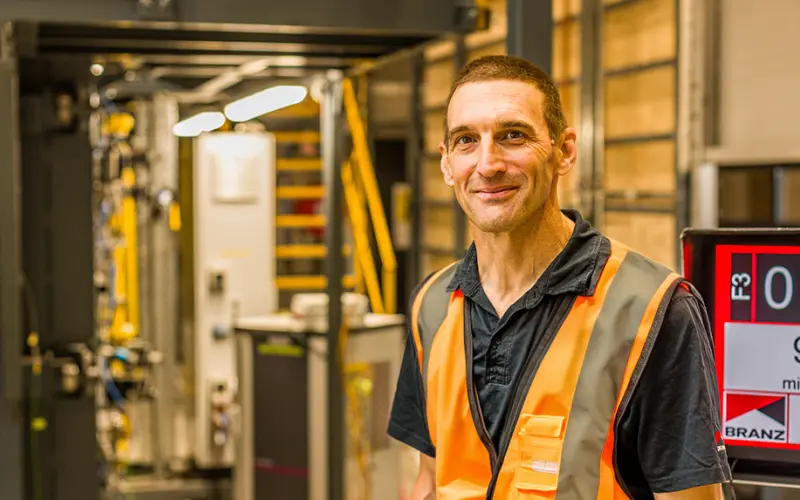


Q. How did you end up as a fire research engineer – education, influences, a particular event?
In short, not by design! My career started as one of the last apprentices to go through the Civilian Technical Training School at the Royal Air Force Signals Engineering Establishment, RAF Henlow, in Bedfordshire. I moved to Aotearoa New Zealand in 2006, moving around the North Island before ending up in Auckland.
Looking to get out of the Auckland traffic and overpriced property market, I joined the fire testing team at BRANZ, undertaking fire testing of building products and systems along with technical support of the BRANZ furnaces. Chats around the pool table with the other fire researchers piqued my interest and led me to jump the fence and join the Better Buildings Research team.
Q. Where did you work pre-BRANZ, when did you come to BRANZ and what do you do here?
Prior to coming to BRANZ in 2016, I worked for the Defence Technology Agency of the New Zealand Defence Force in Devonport, Auckland, undertaking a variety of research, development and testing as well as supporting other researchers’ field trials. I went from blowing stuff up and shooting things to burning them instead! As part of the fire research team, we strive to challenge the industry issues around building fire safety engineering.
Q. BRANZ has a shiny new fire lab. What does it mean to you as someone who gets to work in it, and more broadly, how will it deliver for the fire needs of Aotearoa?
The new fire lab is an exciting prospect for the year ahead. It will bring new challenges with it as we learn how to operate our new workspace and equipment to maximise its potential. In terms of delivering for the needs of Aotearoa, it represents a step change in our capabilities to take BRANZ through the next 50 years.
With an additional furnace capable of handling larger specimens, extending our room calorimetry capabilities and the ability to build and burn façade specimens indoors (meaning we are no longer at the mercy of the weather) and the addition of a 10 MW calorimeter, we will be able to undertake a much wider variety of research. To put the new lab into scale, we will be able to construct a 3-storey building under the calorimeter and measure the heat released during experiments.
Q. What external circumstances are impacting on fire research – for example, climate change, increased high-rise timber buildings and the growth in medium-density housing with its related access issues – and how will these be addressed?
Climate change will continue to have an impact on fire safety engineering from several angles. The South Island has experienced several large-scale wildfires, most recently in Lee Valley near Nelson and on Christchurch’s Port Hills, which prompted evacuations. As the rural and urban interface becomes more complex and wildfires more common, we need to look at the regulatory settings to determine if they remain fit for purpose, especially where medium-density housing projects are backing onto the interface as is the case in some areas.
The low-carbon agenda will continue to drive adoption of mass timber buildings, but key issues remain unresolved around durability and post-fire performance. For mass timber to achieve the aim of being a low-carbon construction method, we need to factor in resilience and not just resign ourselves to knocking it down and starting again in the event of a fire or water ingress.
Q. What do you like most about your job?
Well, who doesn’t like setting stuff on fire! My job challenges me. I enjoy learning new things and hopefully improving the building system along the way, not just in the fire space. I have learned so much about my own home and why it performs so badly. I cancontribute to improving the building stock in Aotearoa – not just the new builds, which arguably should be better than the existing stock anyway, but the work we are doing in the impact space gives me the opportunity to help improve the legacy stock too. In short, I hope I can make a difference.
Q. What are its most challenging aspects?
Currently, the most challenging aspect is resourcing. The fireresearch team has several positions that will need to be filled tomake best use of our new fire lab facilities, so if any of you know any budding pyromaniacs out there, tell them to get in touch.
Personally challenging for me is maintaining the day job while also studying towards my PhD, which includes late night calls with my supervisory team, one of whom is based in the UK.