




Densification refers to the increasing numbers of people and buildings in a particular area. It’s largely achieved by building up, with apartment buildings or medium-density housing (MDH) replacing stand-alone single or 2-storey houses.
The process is already well under way in Aotearoa New Zealand. Look at recent building consent figures for housing compared with 5 years earlier:
- Consents for stand-alone houses have increased by just 3% over 5 years.
- Consents for apartments increased by 38%.
- Consents for terraced houses, flats and units increased by 335%.
Nationally, consents for MDH are poised to overtake consents for stand-alone houses. In places like Christchurch, multi-unit dwellings now account for three-quarters of all new building consents for housing.
Benefits of denser urban areas
More densely populated urban areas allow for more economically efficient and energy-efficient infrastructure, housing, transport and services
Looking at infrastructure, James Hughes, Technical Director Climate and Resilience at Tonkin + Taylor, told Build that it is generally accepted that it is 2–3 times more cost-effective to build infrastructure in concentrated cities than low-density developments over greenfield sites.
James also points out that, as our urban areas have expanded and allowed big-box retail developments with their massive car parks on town and city outskirts, traditional town centres have begun dying, with many empty shops. Bringing more people to live in town and city centres can reinvigorate local businesses and communities.
From an environmental point of view, the key advantage of people living in town and city centres rather than suburbs is the greater access to goods and services on someone’s doorstep and a reduced need for car journeys, which are major contributors to greenhouse gas emissions.
Getting people out of cars is crucial if we are to achieve a net-zero carbon economy by 2050. James Hughes gives more detail about this in the article Smaller, denser and better on page 48.
Government action drives densification
Government policy releases and law changes have been the principal driver behind densification:
- The National Policy Statement on Urban Development Capacity 2016 required local authorities to provide sufficient opportunities for development to meet housing and business needs, including upward development by intensifying existing urban areas.
- The National Policy Statement on Urban Development 2020 sets rules for what local councils can and cannot do in their planning decisions around issues such as setting height restrictions in city centres and enforcing minimum car parking requirements. For Tier 1 councils – the largest urban areas plus adjacent urban areas – in city centre zones, building heights and density of urban form must realise as much development capacity as possible.
- The Resource Management (Enabling Housing Supply and Other Matters) Amendment Bill was supported by both the Labour Government and the National Party. Becoming law in December 2021, this introduced mandatory Medium Density Residential Standards (MDRS).
- The National Policy Statement for Highly Productive Land 2022 aims to prevent or reduce developments on fertile land that would be better used for growing food. Rezoning quality farmland to allow greenfield suburbs will generally be prohibited.
The government is also driving progress by example through the work of Kāinga Ora. ‘They are leading the way,’ says Guy Marriage, an architect, author of the book Medium and senior lecturer at Victoria University of Wellington. ‘They are employing quality graduates and designers and coming up with some developments that are really good.’
Council pushback to government demands
The Resource Management Act change required Tier 1 councils to amend their district plans.
One of the key changes was that, from the edges of the urban centres and rapid transit stops, they are required to have walkable catchments where building heights of 6 storeys or more must be enabled.
They must also allow up to three homes of up to 3 storeys each on most residential sites without requiring resource consent.
The change put the existing character of many city streets made up of villas and bungalows at risk. While most councils implemented the required changes at least to some degree, there was also considerable pushback.
Christchurch City Council is changing its district plan, but with added protection for heritage areas and sunlight access.
While Wellington Council amended its draft district plan, it reduced the walking catchment to urban centres – the area where 6-storey buildings can be built – from 15 minutes’ walking distance to 10 minutes’ walking, and the Johnsonville train line will no longer be considered a rapid transit line. The latter decision will allow lower-level housing to continue to be built near the train line.
Auckland Council proposed exempting extensive areas of older housing ‘to help maintain a sense of history and place’, limiting building heights and density and requiring resource consent to demolish existing character buildings.
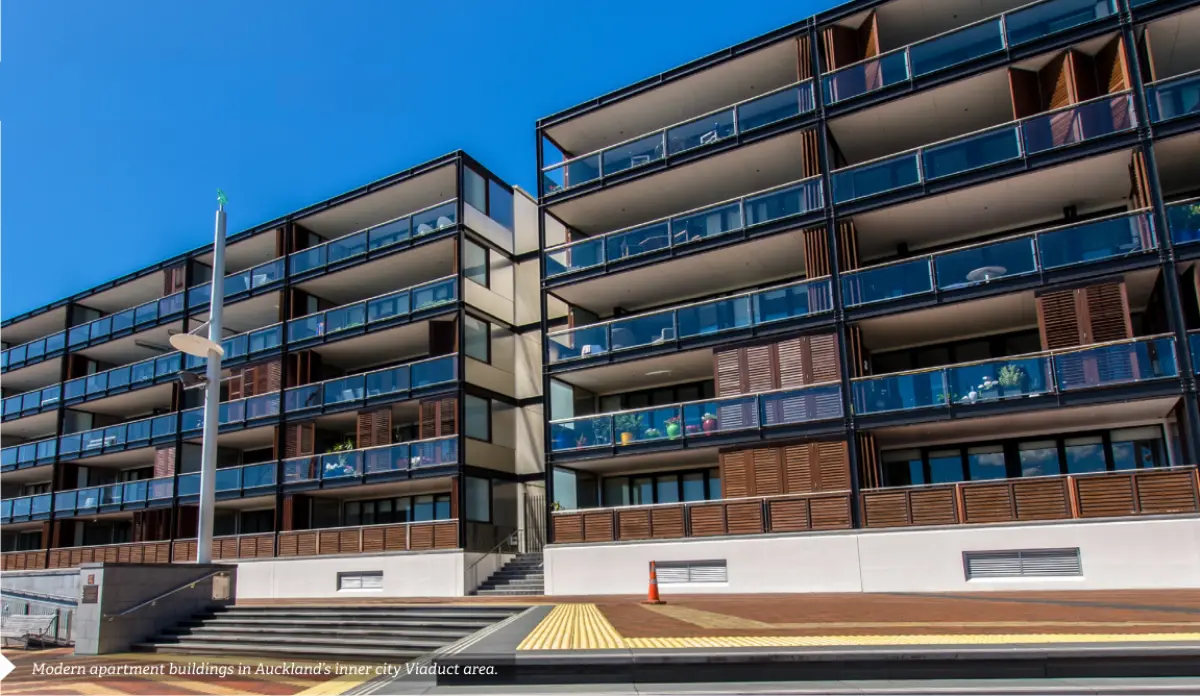
Some residents oppose MDH
On a local scale, some people are resisting change in their neighbourhood. A public meeting at Beach Haven in Auckland in January this year saw opposition to a medium-density housing development in the area. ‘Can’t they build on green land that’s 10 minutes up the motorway?’ one resident said.
‘A lot of the opposition is because people conflate medium or high-density housing with slums,’ says Guy Marriage. ‘They’re worried that undesirable people will move to their neighbourhood and their homes will lose value. But look at New York or London, where plenty of rich people are living in medium or high-density housing.
‘We need to change the mindset. It’s a dangerous mindset.’ He points to Auckland’s urban expansion into the prime market garden land around Pukekohe that used to feed the city, now requiring food to come from much farther away.
Regional and local initiatives
While government policy statements and law changes have had the highest profile in promoting densification, there have also been regional and local initiatives.
In August last year, Greater Wellington Regional Council voted changes to the Regional Policy Statement that will in effect encourage urban density. Councillors said that new developments cannot lead to an increase in emissions, meaning that building new greenfields suburbs that people can only access with private vehicles should no longer be possible.
Good planning is crucial
Densification is not just a matter of making a few tweaks to the housing rules in a district plan. ‘We need to step back and look at the whole rather than just make piecemeal changes,’ says Guy. Planning for attractive public spaces is a crucial part.
James Hughes says the small details need to be well thought through. For example, if a new cycleway is created but is crossed by access to a driveway every 20 m with cars coming onto the street all the time, that’s not ideal. European examples where there is an accessway for vehicles behind developments is a safer design.
Quality of housing is crucial. ‘A home needs to be something you can live in for the rest of your life,’ says Guy Marriage. James Hughes points to too many ‘sausage’ flats that have not been well developed.
There are growing numbers of well designed multi-unit housing such as the Toiora High Street Co-housing Project in Dunedin and other developments around the country. With the benefits they bring of reduced greenhouse gases, cost-effective infrastructure and strengthened city communities, there is little doubt that this is the direction we are headed.
‘Where we still build single or 2-storey houses now, that’s capping the height in that area for the next 50 years,’ says Guy. ‘We can’t go on that way.’
He notes the Italian city of Siena, with a similar population to Whangārei or Rotorua, where there is reasonably dense housing in the city but the countryside beyond is protected and grapes grow just outside the city walls. It is an appealing prospect.