

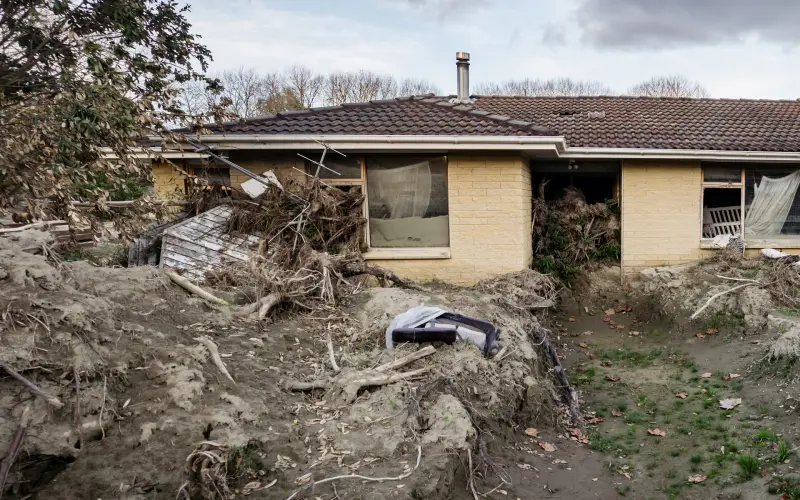


Aotearoa New Zealand is unique as it has a diverse and distinctive built environment as well as a performance-based Building Code. This situation is becoming more challenging as the climate changes and the use of different or new materials may become necessary to meet durability requirements and take into consideration embodied carbon levels.
A question for scientists
How these materials will perform in the built environment with a changing climate is a question for our science community, society and industry.
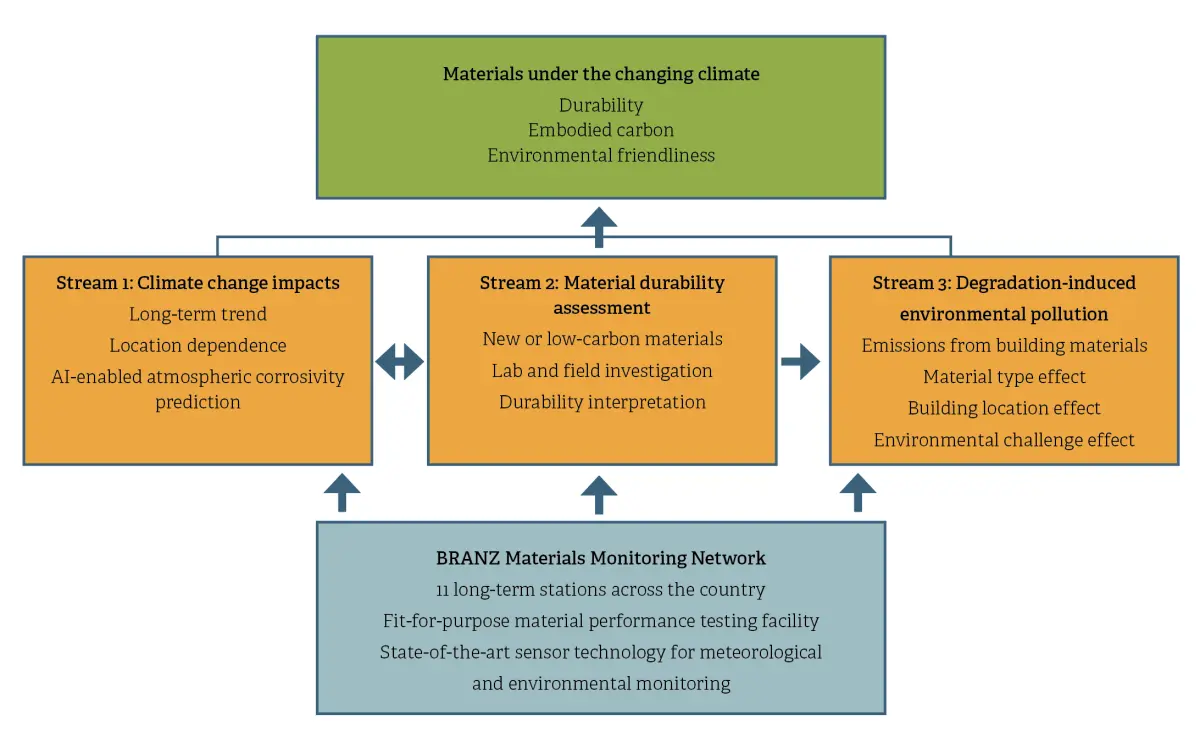
A BRANZ project, Materials under the changing climate, will look at this challenge from several perspectives and help provide a holistic picture of material performance – namely durability, embodied carbon and environmental friendliness. Research insights will be gleaned from conducting real-world experiments coupled with artificial intelligence (AI) analytics (see Figure 1).
Climate change impact
The project will leverage BRANZ’s materials monitoring network across the country to produce a flow of longitudinal data about the climate, environment and material response. Machine learning will be employed to dig into these datasets to explore trends and the location dependence of observations and to predict atmospheric corrosivity in widely variable climate scenarios.
These activities will help provide detailed and ground-truthed information for discussions about climate change impacts to building materials within the context of New Zealand.
Material durability assessment
New materials are emerging to help accelerate the shift to low-carbon or zero-carbon buildings under the government’s emissions reduction plan. These materials, with their unique composition and microstructure or how they were manufactured, may perform differently when compared to traditional materials.
This project will investigate the durability of selected new materials in both accelerated laboratory and long-term field exposure conditions. Learnings about durability from past research as well as this current project will be integrated with AI-enabled atmospheric corrosivity prediction. This will help consider material durability under future climate scenarios.
Degradation-induced environmental pollution
Materials will degrade when exposed to the environment, and the changing climate may impact this further. This process may release heavy metals, microplastics, paint particles or chemicals – substances that could have health risks to humans and ecosystems.
The project will examine what is being released on buildings from the materials – composition, concentration and trend – within the New Zealand Building Code durability timeframe. Data gathered from run-off about material type, building location and environmental conditions will provide scientific insights to help inform contamination modelling, mitigation strategies and, potentially, policy.
An outcome will be that the project will help enhance, protect and restore natural and built environments regarding materials used in the built environment.
Let’s work together
The project already involves a range of stakeholders from government to the research community. Wider involvement is welcomed to help:
- produce trusted data and evidence of climate-environment-material interactions
- transfer outputs into engineering practice and therefore change behavioural norms.
Using a co-creation approach, we want to support the building and construction industry to use the right material in the right place to increase the resilience and sustainability of buildings exposed to a changing climate.