



Over the last two decades, a new form of technology, artificial intelligence (AI), has started interacting with our daily lives – from the personalised recommendations we see on services like Google search, Spotify and Netflix to health applications on smart watches and even essay writing. The question is, will a spark be generated when corrosion and AI collide?
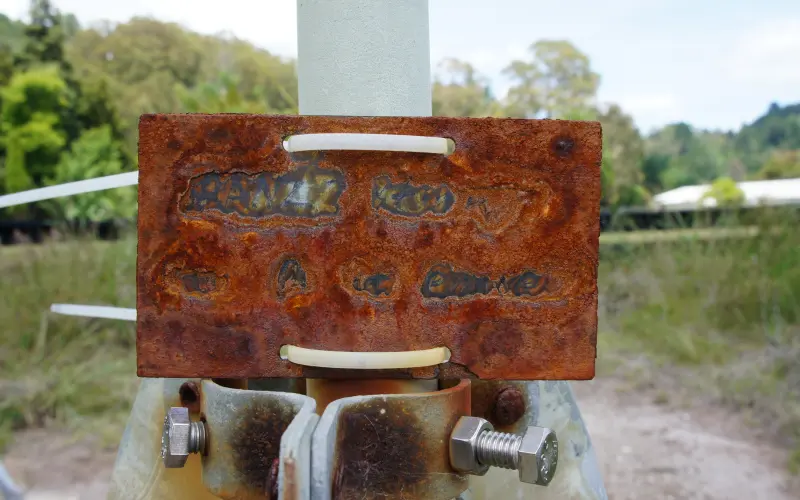
Corrosion is everywhere and occurs in various forms – from rusting nails on timber fences to ‘tea staining’ on stainless-steel handrails and blistering paint on roof claddings.
Corrosion costs
Aotearoa New Zealand’s diverse and unique environments exacerbate corrosion. The annual cost of corrosion to the country is estimated at $16 billion – equivalent to 4.3% of GDP – according to the Australasian Corrosion Association.
Consequently, materials used for buildings and infrastructure need to be specified based on perceived corrosion risks to meet the durability requirements of our performance-based Building Code. This poses immense challenges for practitioners.
How can building materials be better specified, particularly when considering the impacts of the changing climate?
Limitations of empirical corrosion models
Various empirical models have been developed for this purpose. However, so far, reliable results remain elusive.
Corrosion is a result of complicated interactions between materials and environments involving multiple and varying factors. These typically include temperature, humidity, rain, wind, solar radiation and environmental pollutants such as sea salts and nitrogen or sulphur-containing gases. The time taken for corrosion to occur varies greatly as well – from seconds to years.
The empirical models are limited in their ability to deal with this complexity. They are not able to help us understand how these factors contribute individually and collectively to corrosion, so their outputs might not reflect real corrosion scenarios.
These limitations have also hindered their usefulness in predicting corrosion in changing climate and other environmental scenarios or over extended durations.
Growing interest in machine learning
AI replaces classical programming of rules and processes into hard-coded software with a combination of automated predictions and actions.
Machine learning (ML) is a subset of AI. It is an automated method of data analysis that makes connections and identifies relationships across vast quantities of data to solve given tasks.
An ML model is a computer algorithm that searches for statistical patterns in large datasets, estimates mathematical functions and allows discovered patterns to be used for predictions and classifications. For example, it can take data like geographical coordinates and yearly precipitation as inputs and return metal corrosion rates as the desired output.
The learning process involves building analytical input-output relations based on collected data and then iteratively testing the predictive performance of the model on data that had been withheld from the learning process.
When the resulting input-output relation is interpretable (known as ‘white box’), it is especially useful because subject matter experts can confirm known rules, gain new insights from the learned relation and use the model’s predictions to make fact-based decisions or anticipate future states.
ML is proving its worth for automated corrosion image recognition and pattern classification. Recently, it has also proven highly reliable at predicting atmospheric corrosion rates of low-alloy steels in marine-influenced environments.
BRANZ data
Over the past four decades, BRANZ has continuously collected data on material degradation in Aotearoa’s built environment. It includes an atmospheric corrosion rate dataset collected from over 100 exposure sites across the country during a 10-year study in the 1980s and 1990s.
This data is being boosted by a longitudinal flow of climate, environmental pollution and material performance data from a fit-for-purpose monitoring network. The network includes over 25 carefully chosen exposure sites on the mainland of Aotearoa and on the Chatham Islands.
What we are doing
Can we use ML to explore this dataset better with respect to predicting corrosion in the Aotearoa context?
Researchers at the University of Auckland and BRANZ are collaborating closely to build an ML model to quantify spatially varying metal atmospheric corrosion rates across the country.
In general, the resulting preliminary corrosion rate prediction looks reasonable. For example, coastal areas have corrosion rates of >300 g/m²/year and the Southern Alps and Central Otago have very low corrosion rates of <50 g/m²/year.
However, there are areas where corrosion rate predictions need to be verified. These include the Taupō volcanic zone with geothermal influences, sea spray zones and offshore islands.
Next steps
Efforts are now being made to improve the performance of this ML model, including:
- integrating temporal effects of atmospheric corrosion into the model by fully using time-series climatic data
- extending the dataset for model training by collecting more relevant environmental pollution data such as chloride, hydrogen sulphide and nitrogen/sulphur oxides
- identifying and using location-specific key factor sets for model construction
- obtaining and feeding projections of future climate into the model.
In the meantime, we are trialling other ML methods and modelling tools such as COMSOL.
Our ultimate goal is the ability to make data-driven predictions of corrosion in future Aotearoa climate scenarios with more complex climatic, environmental or geographical conditions.
This will help to build an intelligent, digital corrosion map for Aotearoa New Zealand and improve the efficiency and climate resilience of materials while reducing the whole-of-life embodied carbon of buildings and infrastructure.