

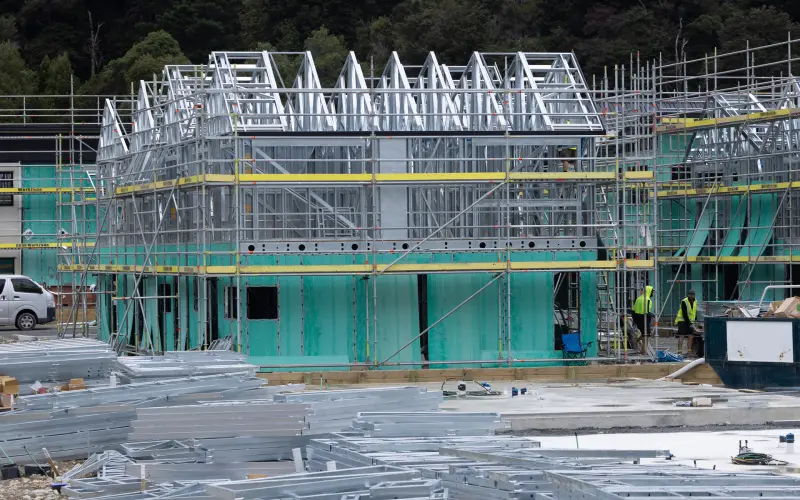


Light timber framing (LTF) is the most common prefabricated building technology for stand-alone residential dwellings in Aotearoa New Zealand, but the country is currently experiencing a shortage of building materials due to the pandemic. Alternative framing materials such as cold-formed steel (CFS) or light-gauge steel have the potential to keep the industry afloat.
Carbon footprint comparison
The prime reason for selecting CFS as an alternative structural material is its comparatively superior strength-to-weight ratio, which can help in the design of complex structures. It also improves productivity because of its ease of manufacture, assembly and installation through to eventual deconstruction.
However, its carbon emissions need to be quantified as part of achieving the goal of net-zero carbon in Aotearoa by 2050.
The building and construction sector’s response to climate change is guided by MBIE’s Building for climate change programme. This article looks at the carbon footprint of LTF and CFS for a stand-alone house.
LCA is a well-known methodology for estimating and analysing the potential environmental impacts of product life cycles, including building products.
Why use LCA?
The study used an LCA approach to estimate and compare the greenhouse gas emissions from two houses in the Auckland area – one constructed from LTF and the other from CFS framing and both evaluated with a service life of 90 years.
The gross floor area (GFA) of the LTF house (House A) was 107 m2, while the CFS house (House B) had a gross floor area of 146 m2. Both houses largely had concrete foundations and metal sheet roof cladding.
The choice of the material types and geographical conditions was specific to the Aotearoa context since carbon emissions cannot be generalised to all buildings. The cradle-to-cradle system boundary was used in the LCA, and the LCA tool LCA Quick v3.5 was utilised to calculate the greenhouse gas emissions. The calculated carbon footprint of each house was normalised for floor area and service life to provide units of kg COeq/m2/year.
The study assumed an annual electricity consumption for House A of 7000 kWh, which is based on the average value of a typical Aotearoa house in 2018 from the Electricity in New Zealand report by the Electricity Authority. Annual electricity use in the larger House B was assumed to be around 9000 kWh per year, based on the BRANZ reference building dataset in LCAQuick.
Annual water consumption for both was taken as the default provided in LCAQuick (67.6 kL/person/year).
What were the results?
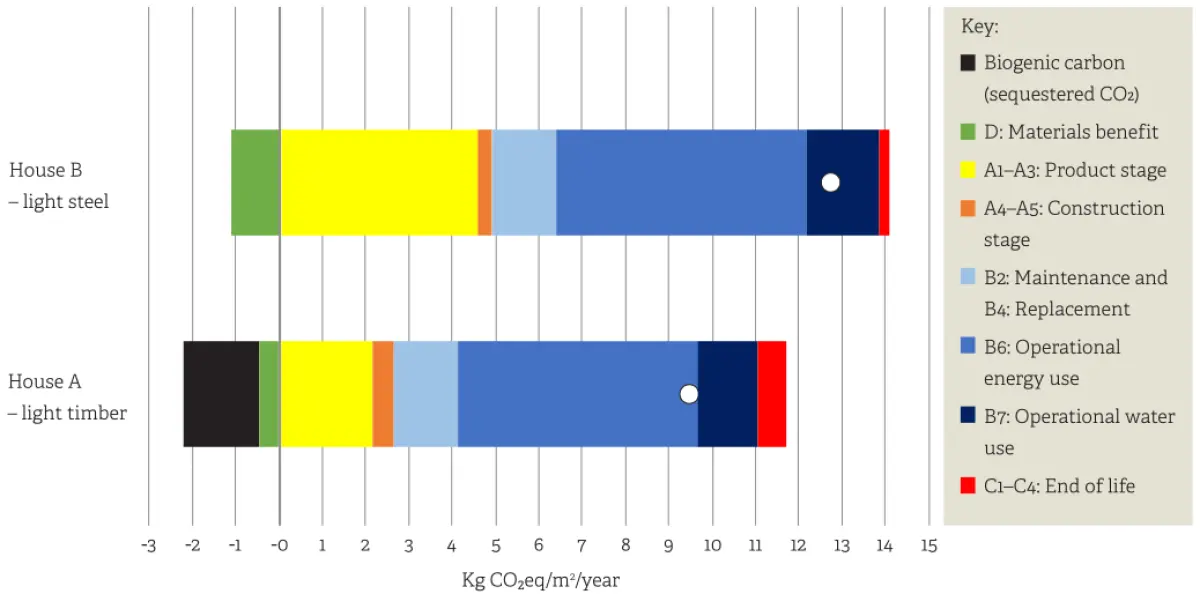
Figure 1 shows the assessed global warming potential (GWP) of the two houses. These are some findings from the study:
- House A is estimated to have normalised gross life cycle greenhouse gas emissions of over 11 kg COeq/m2/year, compared with House B with 14 kg CO₂eq/m2/year. The results indicate that the CFS house has around 20% more greenhouse gas emissions (embodied and operational) than the LTF house.
- The study identified a large difference in carbon emissions in the production stages between the two investigated houses. The LTF house has around 46% less carbon emissions than the CFS house during its material production stages.
- Both houses have lower net carbon emissions when potential benefits of carbon sequestered (biogenic carbon) and module D (from reuse and recycling of waste materials) are considered. House A net carbon emissions reduce to 9 kg CO₂eq/m2/year – a reduction of about 20%. This is primarily due to the potential benefit of carbon sequestered when trees used for timber production come from sustainable forestry management practices – replanting the cut trees. The module D benefit is primarily due to recycling of the metal cladding at the end of its service life. House B’s net carbon emissions reduce by about 9% to approximately 13 kg COeq/m2/year. In this assessment, it was assumed that 75% of steel sheet material is sent to the recycling process and the rest will go to landfill after the service life as applied in LCAQuick v3.5.
- The operational energy use stage (B6) of the two houses makes the greatest contribution to greenhouse gas emissions (41–48%) during the whole building’s life cycle, followed by the production stages (A1–A3) (18–32%).
A limitation of this study was the use of two different-sized houses with different assumed occupancies. Figure 2 shows the absolute GWP results of the two houses.
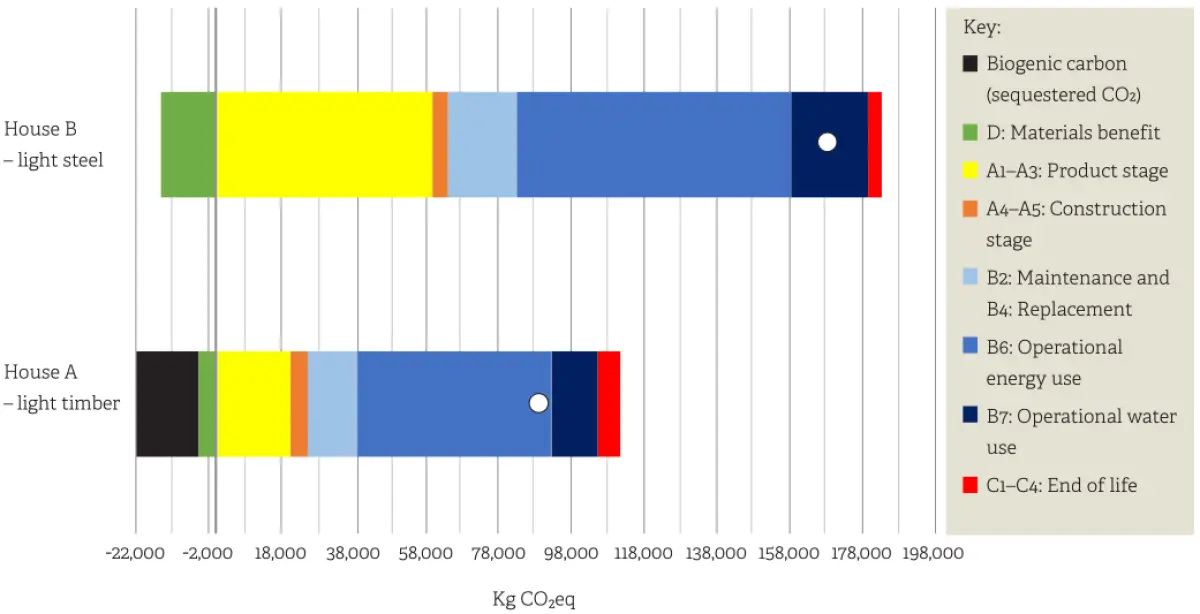
As there could be a misleading conclusion if the two results are directly compared, further study is recommended to investigate the environmental impacts of LTF and CFS houses with a similar gross floor area and number of occupants.
LCA best means of achieving carbon reduction
In conclusion, LCA is a useful approach for assessing the carbon emissions from residential buildings. It is the preferred tool for use by the construction industry for achieving a carbon reduction target. Suggestions to improve the energy efficiency of houses yet to be built include the following.
Controlling the use of electricity
Plug loads and hot water electricity use can lead to significant energy consumption. Since the operational stages of the houses contributed the maximum amount of carbon from both buildings, irrespective of gross floor area, electricity consumption should be minimised.
Forming a strategy to reduce carbon emissions during a building’s production
This is the second-largest contributor to carbon emissions. The materials selection process also plays a crucial role in achieving better energy efficiency. Lower-carbon materials should be selected in the design phase of houses to reduce total carbon emissions. An efficient design is also recommended to limit the number of waste materials, especially for a material with a low recyclability rate.