

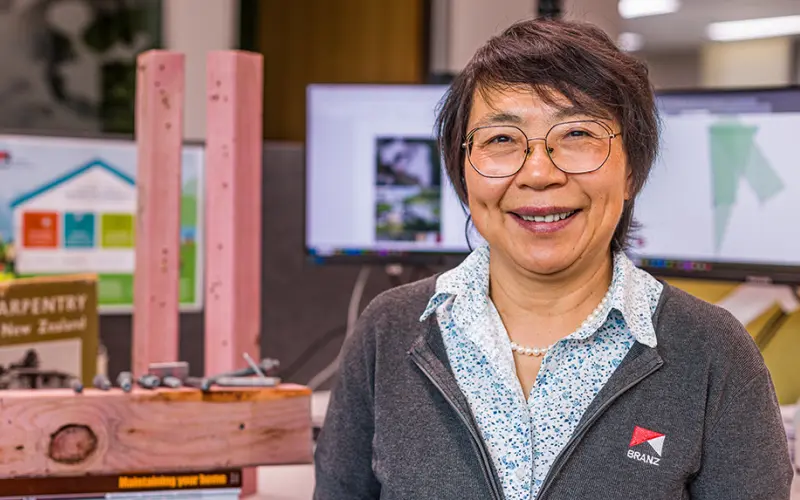


Q. Where did you grow up and study?
I grew up in a small village in China that is about 700 km from the nearest coast. My parents worked on farms and produced crops such as corn, millet, sorghum and beans. Most people in the village were relatives – so I was truly raised by the village.
When I passed China’s annual college entrance examination, my teachers and my relatives decided what I should apply for. They said I should choose structural engineering at the Taiyuan University of Technology (TUT) as my exam results in maths and science subjects met the requirements. They also thought that, as structural engineering involved labour-intensive work such as carrying bricks, students from cities would be less likely to apply for the subject and I would have a better chance of getting into the university.
It wasn’t until I started university that I realised structural engineering was a highly sought-after subject in China because of the construction boom. I cherished the university education opportunity, and my interest in engineering grew stronger and stronger as time passed.
After I received bachelor’s and master’s degrees in structural engineering, I landed a job as an assistant professor in the Department of Civil Engineering at TUT. I was then awarded a scholarship to do structural engineering research overseas for a year. Professor Bob Park at the University of Canterbury agreed to host me as a visiting scholar. After a year working with Professor Park, I enrolled as a PhD student, working with him on a project funded by EQC. I obtained my PhD in structural engineering in 2001.
Q. What’s your work history pre-BRANZ and now at BRANZ?
After I finished my PhD, I started to work for engineering consultancies in Aotearoa including Hadley & Robinson in Dunedin where I worked on a variety of building projects such as a new stadium, school buildings and housing developments. I then moved to Wellington and worked for Dunning Thornton and Beca on many exciting projects, including WCC’s seismic assessment project.
It might surprise people to know I was the engineer for the original Water Whirler on Wellington’s waterfront, which was damaged a few years ago. I then came to work at BRANZ.
Q. What are the chief issues concerning structural engineers at present?
The chief concerns are the need to be an effective communicator and to keep abreast of developments such as the environmental impacts of our work in the Engineering New Zealand Code of Ethics. A structural engineer’s role is to ensure the skeletons of entire structures are strong enough to withstand the actions, either stresses or deformations, imposed by use and the environment. In comparison with other countries, environment-related issues are more significant in Aotearoa, especially the seismic design issues.
Environmental effects are less certain. Managing uncertainty in earthquake engineering or environmental effects has always been a key challenge for engineers here. The uncertainty of earthquake demands has recently been given increased prominence due to the new National Seismic Hazard Model for New Zealand. It is challenging for the structural engineering community to effectively communicate with the public about the uncertainties in the inputs and outputs of structural engineering problems. People do not like uncertainties, but structural engineering issues all have uncertainties and the solutions are all risk-based.
Another challenge for engineers is to balance environmental, economic, social, and cultural sustainability initiatives and outcomes on projects. This is a new area, and we strive to meet emissions reduction requirements by promoting excellence in design to achieve resilience and promoting safe economical construction in accordance with relevant material standards.
Q. How do you see your work having a direct impact on our building systems?
My work at BRANZ has a direct impact. Our research projects were initiated to address urgent structural engineering issues and provide evidence-based solutions. We study the issues, advance our understandings, test our postulated solutions and produce design guidance for the practitioners to use. This then impacts on our building systems.
Apart from conventional work on research projects, I am also involved with standards committees to provide input on various issues. This directly impacts the final forms of standards cited by the New Zealand Building Code and are the common compliance pathways to construct our buildings.
Q. What are the most challenging aspects of your job and those that are most satisfying?
The most challenging is the design and execution of the research to enable impact. In doing the research, we put a lot of effort into making sure that the used methodology is robust and the technical tools developed are workable and user-friendly. When our research does make an impact, we all feel satisfied.