



Housing is fundamental to economic and social wellbeing and plays a central role in individual and community health outcomes, family stability and social cohesion, according to the New Zealand Productivity Commission.
Failure to provide secure, affordable housing
A responsive housing market facilitates labour market mobility, allowing people to move to take up job opportunities and enhance the economy’s productivity.
Unfortunately, housing markets around the world, including in Aotearoa New Zealand, struggle to provide adequate, good-quality, affordable housing with long-term security of tenure to meet population needs.
Globally, some housing markets have responded to pressures in their housing systems to provide alternative tenure structures, which vary from country to country.
Researching alternative housing tenure
Ian Mitchell from Livingston and Associates Ltd is currently working on a research project funded by the Building Research Levy that focuses on affordable alternative housing tenure models and the factors that either enable or limit their growth in a New Zealand context. The project’s research team also includes Chris Glaudel from Community Housing Solutions, James Berghan from Otago University and Daniel Du Plessis from BRANZ.
Establishing needs
The first stage of the research has focused on housing market outcomes to establish the need for alternative affordable housing tenures. Subsequent stages include:
- a review of relevant overseas literature
- interviews investigating enablers and barriers to alternative tenure housing in Aotearoa
- a system-based analysis of the enablers and barriers to the growth of the alternative tenure housing market here
- discussion on the implications of the project’s findings in a housing market and policy context.
Key findings to date
Key findings so far include growth in the intermediate housing market, private renter housing stress and renter market needs.
Intermediate housing market
The intermediate housing market is defined as households that:
- are currently in the private rental market
- have at least one member of the household in paid employment
- cannot afford to buy a house at the lower quartile house price under standard bank lending criteria.
The number of intermediate households increased by 36% or 75,900 households between 2018 and 2022. Over the same period, the total number of households in Aotearoa increased by 6% or 108,720. The growth in the number of intermediate households accounted for 70% of the total increase.
Provincial centres had the strongest growth in the number of intermediate households between 2018 and 2022, which reflects the stronger house prices in these locations relative to the main centres.
Private renter housing stress
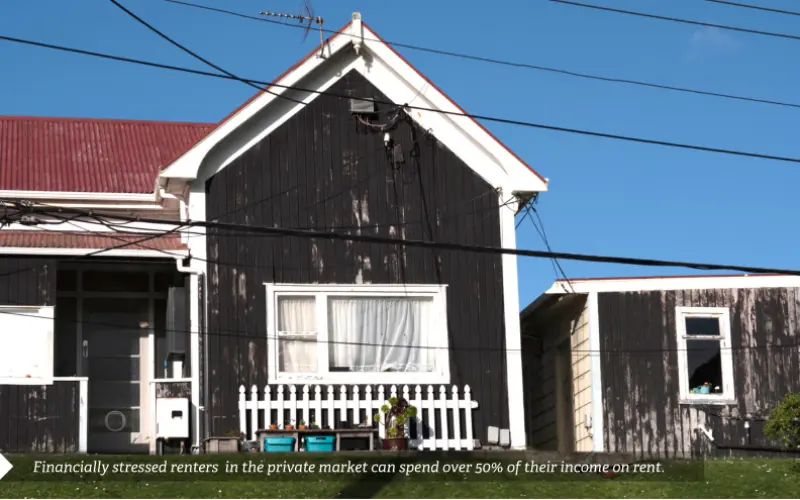
Most stressed and severely stressed private renter households earned less than 80% of the regional median gross household income (RMGHI). A total of 81% of the stressed private renter households earned less than 80% of the RMGHI. All the households paying more than 50% of their income in rent also earned less than 80% of the RMGHI.
Renter housing needs
Renter housing needs include financially stressed private renter households, households whose needs are met by public housing, community housing providers and council tenants and people who are homeless or living in crowded dwellings – including interim or emergency housing. These are some findings:
- Between June 2018 and June 2022, renter households in need increased 380,590 to 450,020 – an increase of 69,430 households or 18.2%
- Māori households account for 16% of all households in Aotearoa, while Pasifika households account for 4%. Nationally, both Māori and Pasifika households are over-represented in both housing need and unmet housing need in 2018.
- Māori households account for over 30% of households in need in Northland, Waikato, Bay of Plenty, Gisborne and Hawkeʼs Bay.
- Pasifika households account for 17% of total housing needs in Auckland. Wellington has the second-highest proportion of Pasifika households in need.