

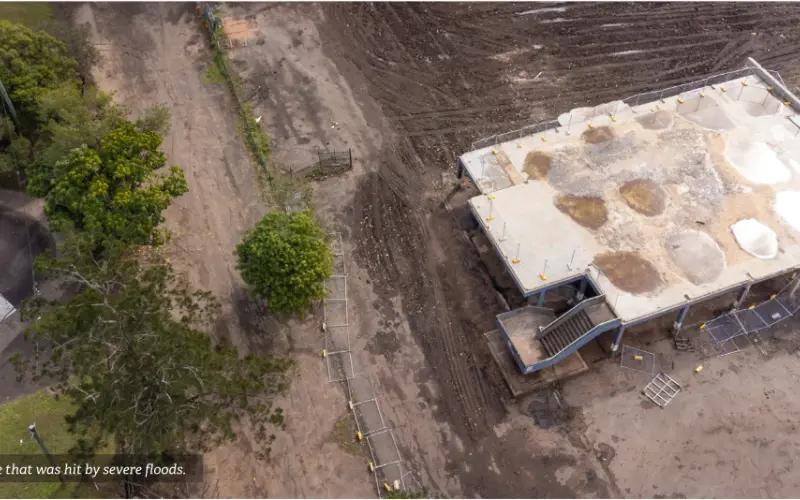


Following damage or loss to contract works or a construction site after a storm or flood, allocations of risk will be determined by the terms of a construction contract.
The potential risk
The flooding in Auckland on 27 January 2023 and the impacts of Cyclone Gabrielle a few weeks later illustrate the importance of reviewing at contracting stage what insurance cover is in place and whether that is appropriate to future proof as best as possible against extreme storms, landslips and floods.
Cyclone Gabrielle hit the northern and eastern coasts of Aotearoa New Zealand on 13 and 14 February 2023, with most devastation occurring in the Hawke’s Bay and Gisborne regions. The cyclone, which killed 11, was described by then Prime Minister Chris Hipkins as the ‘most significant weather event New Zealand has seen this century’. The separate flood in Auckland on 27 January 2023 claimed the lives of four people.
These events resulted in widespread property damage, including at construction sites across a significant portion of Aotearoa. The Insurance Council of New Zealand has reported that insurers have settled 99,798 of 115,353 claims from the Auckland floods and Cyclone Gabrielle, valued at $2.7 billion. Total insurance claims as at 13 December 2023 were estimated at $3.6 billion.
The contract will allocate the risk
Allocation of risk in the event of damage/loss to contract works or a site following a storm/flood will vary depending on the terms of the construction contract. The contract should also confirm who is responsible for obtaining insurance cover and for paying the excess if there are claims.
As an example, NZS 3910:2013 Conditions of contract for building and civil engineering construction and the new 2023 version contain the following general provisions:
- The contractor is responsible for care of the works and site and the costs of repairing damage to it unless the flood or storm event was such that an experienced contractor could not reasonably foresee or make provision for it. This should encompass significant flooding and cyclones in most cases.
- However, where a given force of nature such as flooding is added as an insured risk to the special conditions, that will not be an excepted risk. Repair will be at the contractor’s cost, with the contractor then seeking to be made whole by the insurance policy.
Conversely, the Master Build RBC1 contract provides that the contractor has responsibility for the works while they have care of them, but they are not typically responsible for loss or damage caused by forces of nature if they have exercised care. Whatever the allocation in the construction contract for loss and damage from a storm or flood, at least one of the parties to the project will face a potentially significant exposure. It is important therefore to understand at the contracting stage what insurance cover is in place and what types of loss or damage the respective policies will cover.
Specific insurance policy responses
There are several potentially applicable construction-related insurance policies in the event of damage or loss caused by extreme weather events. Some of these are addressed below.
Contract works
Generally, parties to a construction contract will agree that one party – often the contractor – will procure contract works insurance. Subject always to the specific wording, a contract works policy will typically insure against sudden and unintended physical loss or damage to the contract works occurring during construction. Contract works may be defined as the whole of the works, whether permanent or temporary, including materials that are in the contractor’s care, custody or control while at the contract site. Assuming the main insuring clause responds – that is, there has been accidental physical loss or damage – these policies often cover the reasonable cost of repair or, if not possible, replacement.
Standard limitations policies and other cover
- Existing property – contract works policies will often exclude cover for existing property at the site before the contract works started, although this can be added separately. This risk will often be separately addressed in a material damage policy. Subject to the specific wording, material damage policies may indemnify the insured party against damage to existing buildings.
- Contractors/employers’ property and mobile plant – contract works policies may also exclude contractors’ or employers’ property and mobile plant. This can be significant where a site covered in heavy machinery ends up underwater. This loss or damage will typically be covered by a contractor’s plant insurance policy. Third-party liability policies such as general liability and professional indemnity, which may also be held for construction works, are less likely to be applicable following storm damage to the works.
What happens after damage?
After a storm that has caused site damage, the insurance policy holder ought to be aware of the notification provisions of the applicable policy, which typically require immediate notification.
As well as any contractual and legislative obligations to ensure the workplace is made safe and secure and that all those working on the project remain safe, the applicable insurance policies will typically also include duties to mitigate. What this looks like in practice will vary from event to event and will be subject to requirements to ensure safety.
Practical considerations include evidencing the damage as well as all steps taken and costs incurred in mitigating the damage – reasonable and practical steps taken to limit the effects of the insured. An insurance broker or legal advisor should be able to assist you with your obligations at claims time.
NOTE This is intended as general advice only. For specific advice, contact your legal advisor.