

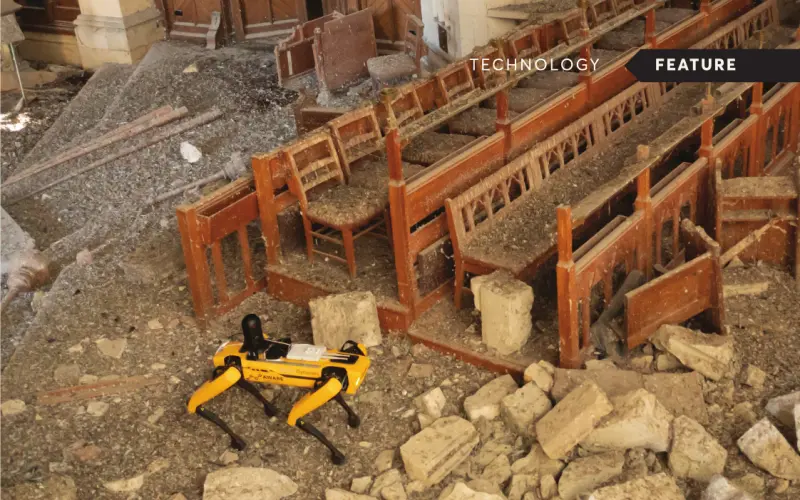


In Aotearoa ’s evolving construction sector, the integration of cutting-edge technologies is imperative for enhanced efficiency, safety and overall productivity. Among new innovations, robotic dogs and databots stand out as game-changers, promising a future where automation and data-driven insights reshape the way construction projects are planned, executed, and monitored.
A canine revolution in construction
Robotic dogs, once occupying the realms of science fiction, are starting to make their mark in Aotearoa’s construction sector. These mechanical companions have immense potential for a range of applications – from security and surveillance to search and rescue missions.
However, the challenge – as with robotic vacuum cleaners – is the interface between the user and the technology. Where specifically can robotic dogs be used on site, and what avoidance systems will they need? These might include navigation and terrain adaptability in dynamic building environments and integration with human workers.
Issues to be resolved
Task adaptability and weather proofing are also issues, and Massey University’s early work has pinpointed problems when robotic dogs encounter drainage grates and unstable trip materials. However, once these issues are addressed, much like the growing prevalence of robotic vacuum cleaners, there will increasingly be a place for robotic dogs on construction sites.
Using a software development kit, users will be able to program the dogs to perform specific tasks.
Robotic dogs can play a crucial role in disaster responses. Their agility and ability to navigate challenging terrain will make them ideal for search and rescue missions in the aftermath of natural disasters. They can be used to access sites deemed unsafe such as the Christ Church Cathedral, where a robotic dog has been employed during the reconstruction project.
By incorporating AI algorithms, these robotic companions can also assess structural damage, ensuring a faster and more efficient response to emergencies.
Used to measure sites
An intriguing emerging prospect is the use of robotic dogs for on-site measuring. Imagine a construction site where robotic dogs roam equipped with advanced lidars and other sensors and measurement tools. These mechanical marvels could precisely and efficiently measure and map construction sites, providing real-time data on the progress and accuracy of projects – usually a tedious and time-consuming manual task.
Job costs and value streams could be estimated in real time by taking your dog off its leash. It does seem that you can teach an old dog new tricks!
Unleashing the power of data
Databots, while still a blue-sky concept, hold the promise of transforming data collection and analysis. These miniature data-collecting agents could be unleashed on the internet, scouring vast amounts of information and distilling it into valuable insights for the construction industry.
Our research has established proof in principle based on feeding PDFs of the 10-year reports prepared by 78 local authorities to a databot and comparing how it performed with what we can do manually.
Manually, it took three people 3 weeks, working weekends and long hours, to categorise the data into the areas of transport, stormwater, wastewater, water supply, waste management, community services/facilities, community leadership and others.
In comparison, it took the databot less than half a day to produce 174,000 cost/ capability data points and then further refine and categorise them.
Critically, the data was categorised into project size and scope, project type, project purpose, funding source, project location and timeline, environmental impact, regulatory compliance, technology integration, social infrastructure and economic impact.
This provided a nuanced understanding of the construction pipeline in local councils, as the data identifies trends, priorities, and potential opportunities for the building industry. It would be invaluable for planning, resource allocation, and decision-making within the sector.
The potential applications of databots are numerous. From analysing market trends and material costs to monitoring regulatory changes, they can streamline data collection, offering a comprehensive understanding of the construction landscape.
This technology can significantly enhance decision-making, enabling construction professionals to make informed choices based on real-time, datadriven intelligence.
Options and strategic implications
The strategic significance of databots lies in their potential to catalyse a data-driven revolution, fostering a more informed and adaptive construction industry.
Looking ahead, the options for robotic dogs and databots in Aotearoa’s construction sector are promising. Robotic dogs could evolve to become indispensable on-site assistants, seamlessly integrating into construction workflows for measurement, inspection and emergency response. Their versatility positions them as strategic assets for ensuring the overall safety and efficiency of construction projects.
Similarly, databots, once fully realised, could revolutionise the way data is collected and analysed in the sector. Their ability to distil complex data into actionable insights can streamline project planning, optimise resource allocation, and bolster strategic decision making.
As robotic dogs and databots begin to redefine our construction sector, the industry stands on the cusp of a technological revolution.
Innovations promise increased efficiency, safety and opportunities for a more resilient and adaptive construction landscape. Embracing these technologies will pave the way for a future where automation and data converge to shape a new era of construction excellence in Aotearoa.
FOR MORE Contact Professor Regan Potangaroa at r.potangaroa@massey.ac.nz.