

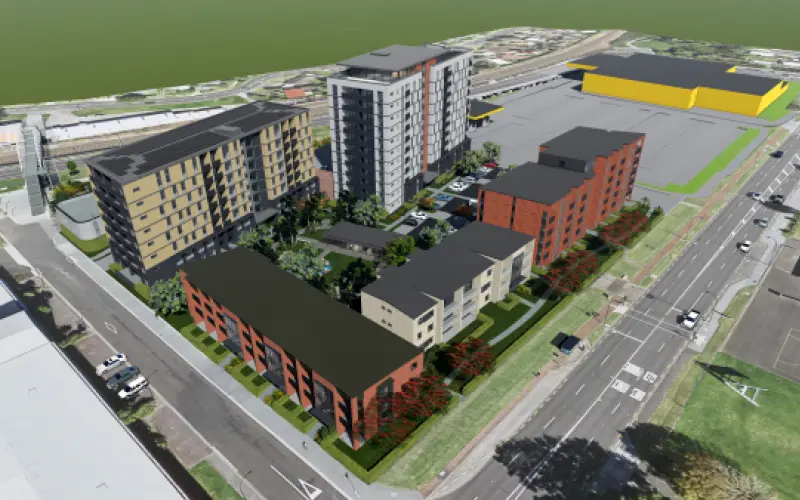


If you think that reducing construction costs is all about slashing quality, using cheap materials and working just to Building Code minimums, you are in for a surprise. There are homes and apartments going up today for well below typical construction costs without any sacrifice in quality. Heat pump heating and cooling and, in some cases, water heating? A solar PV system on the roof? There are affordable homes with these features and more.
Even better, the designers and contractors behind these homes don’t have a blinkered focus on upfront costs. They stress that the lifetime operational and maintenance costs of their buildings are also lower – a significant benefit for both homeowners and the country as a whole.
Simplicity’s secret sauce
Shane Brealey of Simplicity Living says that his construction costs are around 35% less than those of other apartment builders around Auckland, a figure calculated by independent quantity surveyors. He also told Build, ‘I’d be surprised if we’re not getting 2.5% more efficient each year.’
The savings are passed on to occupants, with apartments renting for $200–250 less per week than similar apartments down the road. While Simplicity apartments are built for long-term rental, the secret sauce behind their construction could be applied just as easily to apartments built for sale.
A few elements of their construction process:
- They get the master plan design right at the beginning, with architect, builder and engineer around a table finding the optimal solution.
- The company has a different approach to procurement, with no tenders. It negotiates in an open-book way. It keeps its partners from project to project, so the builders, electricians and plumbers know exactly how the process works on site and they aren’t working with new people every time. Allowances that are often made in pricing for disputes, delays and uncertainty don’t apply here. Dates for work are locked in, giving subcontractors a big advantage.
- There are vastly fewer drawings required in the way they work.
- There is far less waste of all types, including material waste and wasting time. For example, when a subcontractor goes into an apartment, there will be a box in the apartment that contains everything needed to complete the work. No trip back to the van or to a supplier for something that has been forgotten or run out. With wall lining, one person can fit out an apartment and there is no off-cut waste.
‘Our sites are factories on building sites,’ Shane Brealey told Build. ‘We are working in on-site manufacturing, not construction. We are living and breathing Productivity 101.’
Features such as solar panels and rainwater harvesting are often incorporated into the building and the embodied carbon is carefully assessed. A great deal of thought has also gone into the performance and resilience of the structures themselves.
In the Te Reiputa apartment building, Shane Brealey talks about inter-storey drift of around 1–3 mm, ‘where, in many similar buildings, 15–25 mm is possible’. This has advantages in many areas including weathertightness and maintenance.
Simplicity doesn’t keep its secret sauce secret. It opened a Productivity Hub in mid-2024, where people learn for 45 minutes about how Simplicity works and then make a site visit. Over 2,500 people have been through the hub and Shane Brealey says he is mentoring three companies. The Productivity Hub is currently located next to Ellerslie Racecourse.
RTA Studio’s Living House
When Rich Naish, founder and design director of architectural firm RTA Studio, found Kāinga Ora could spend $600,000 building a 3-bedroom house, the practice set out to demonstrate that there was a better path and developed the Living House, building a prototype in Rotorua.
The cost of this 3-bedroom, 1-bathroom 85 m² house was just $335,000, excluding land, foundations and site work.
Like Simplicity apartments, the cost savings don’t come from reduced quality. The home has heat pump water heating, heat pump space heating and 16 solar panels with a 6 kW inverter. There is extensive use of timber inside and a 4 m height in the living and dining spaces.
‘It is great to watch people’s faces as they walk into it,’ Rich Naish told Build. ‘The light, the volume and the natural materials make a big impression.’
How have they kept the price down?
- Reduced construction time and hence labour costs. The house is built with 36 cross-laminated timber modules that can be put together by three people in 6 weeks. 10% of the house cost is labour compared with 40% on many other builds.
- The house is designed so that the plumber and electrician can do all their work in week 5 – they don’t have to make multiple visits over the building period.
- The size is compact. The combined kitchen/living area is 28.3 m² and the bathroom is just under 12 m².
- While there is a choice of exterior and interior colours and options around appliances, there is not the limitless choice of traditional bespoke construction.
RTA Studio is selling its detailed design package, which comes with builder’s manual, construction schedule and MultiProof approval for building consent. 'We are hoping for real uptake by community housing providers, government agencies and iwi,’ Rich Naish said.
Iwi initiatives
Iwi are keenly involved in housing, and some are developing innovative construction and home-ownership projects.
Toa Homes is a joint venture between Ngāti Toa Rangatira and How We Live Investments. Its homes use wall panels incorporating recycled timber and recycled glass wool that have an R-value of R5.0 and similar ceiling panels with an R-value of R7.2. The thermal bridging found in many conventional homes is designed out.
As with the Living House, the panels can arrive at the site in a single delivery and construction is considerably faster than conventional methods. The thermally broken double-glazed windows are filled with argon gas and have low-E glass. The target is to maintain indoor temperatures of 18–22°C. Services include a mechanical heat recovery ventilation system and heat pump water heater.
The company says, ‘We build healthy, passive-capable, high-performing homes at a similar cost to the New Zealand Building Code minimum.’ While its estimated price, from $3,800/m², places it within the range of average new houses in 2025, the performance it delivers is clearly above average.
Other support for affordable housing
There are many other organisations using innovative approaches to help people into housing. One is Tāmaki Regeneration, set up by the government and Auckland Council to support the regeneration of East Auckland suburbs Glen Innes, Panmure and Point England through a shared ownership programme, OWN IT.
Home buyers need a small deposit (as little as 5%) and have lower than usual mortgage payments to make because they start off owning only 70% of their home, gradually acquiring full ownership over time. The plan is to build 10,500 new homes to replace 2,500 older state homes over coming decades.
Levy-funded research under way
The Building Research Levy is funding research into affordability, including the project Housing solutions for low to moderate income households with limited equity. The project, carried out by Livingston and Associates is looking at how other countries provide housing, including housing tenure models and the policies and funding they require. The project aims to establish the size, characteristics and locations of these submarkets in Aotearoa New Zealand, test economic feasibility of promising models here and determine the level of subsidy required. For more, see page 72.
Project researcher Ian Mitchell says there is enormous stress among low and moderate-income earners in Aotearoa. He points out that over 100,000 households (both owner-occupiers and renters) pay more than half their gross income just in housing costs. There are many organisations providing housing to households unable to cope with current prices, and this can be life-changing for those that can access them.
Ian Mitchell told Build that, while these organisations would like to provide more housing, ‘Their ability to expand is restricted by a limited access to affordable capital. This is due partly to the low financial yields that affordable housing generates and a lack of sustainable government funding.’ The project is exploring ways to overcome this.