

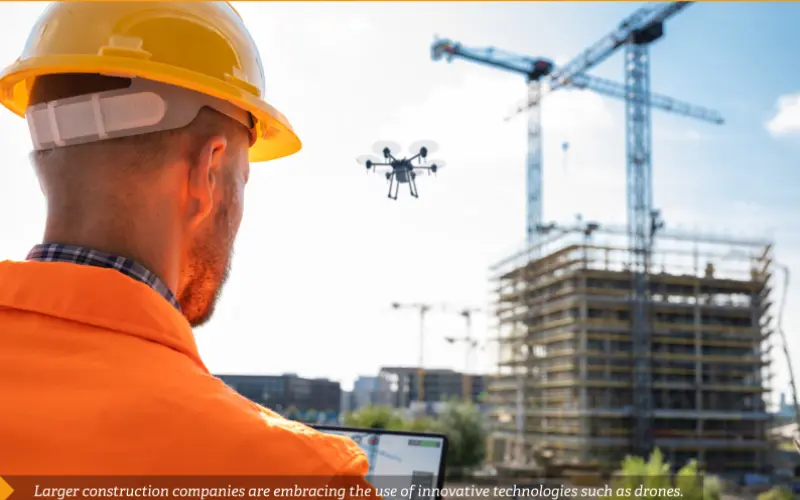


The construction industry is now more open to taking on new technology, due in part to the experiences people had during the COVID-19 pandemic.
‘The past 5 years have seen a huge difference in how companies see new technology – we don’t see a wall of resistance against change any more,’ Dr Alice Chang-Richards, one of the authors of the recent report, Technology implementation: What does the future hold for construction?, told Build. ‘People are aware of the technology now or just can’t overlook it.
‘COVID made people realise how you can keep working without being on site. Remote work, data sharing and cloud access have all accelerated. People quickly learned to use Zoom or Microsoft Teams and found that using technology wasn’t scary. COVID was a wake-up call – we can’t stay in our old comfort zones.
‘I suspect that, in the next 5 years, we are going to see huge change in certain areas such as the wider adoption of building information modelling.’
In addition to building information modelling – or BIM – the digital technologies being more widely adopted include:
- computer-aided design
- cloud-based technologies
- global positioning systems
- geographic information systems
- unmanned aerial vehicles/systems
- smart sensors and virtual reality
- multi-dimensional modelling
- Internet of Things
- artificial intelligence
- digital twinning.
Bigger companies lead the way
Change started 10–15 years ago – mostly in larger engineering companies, with construction companies following.
Dr Chang-Richards, from the Department of Civil and Environmental Engineering at Auckland University, has been part of a BRANZ-supported research project – Technology adoption roadmap for the New Zealand construction sector. She says that, in terms of technology readiness, the top-performing engineering and construction companies have over 100 employees.
In the report’s case studies of five large tech-leading engineering and construction companies, their maturity in technology implementation only came to fruition after almost a decade of perseverance in trials and learning.
There is also a technological divide, with small businesses having lower readiness levels. That doesn’t mean that smaller firms are resistant to change – they often just don’t know where to start.
‘We are finding that small companies are open to information and keen to see how they can use technology. They are open to short courses that are accessible and affordable, but they are wary of going to big tech providers because of the costs involved.’ Adopting new technology, training staff in its use and maintaining annual licences can be expensive.
There must be a clear value to companies for making the investment. The report points out, ‘A large number of small engineering companies still consider CAD to be sufficient for drawings and design, and that BIM is only useful for large projects that involve large players. Unless driven by client requirements – such as [Auckland’s] City Rail Link project – small businesses have little incentive to invest in BIM.’
Mandates drive uptake
In many overseas cases, to bid for a major government project companies must be using BIM. For example, since 2016 in the UK, all centrally funded work has required the use of BIM.
Auckland’s $4.4 billion City Rail Link project was the first public project in Aotearoa New Zealand where the procurement process had a requirement that companies must use BIM. French construction company Vinci Construction brought its technological expertise to the alliance of companies that won the contract.
There is a hope that this will leave a useful legacy of skills and knowledge for the sector in New Zealand. Once New Zealand firms are skilled and experienced in this area, they then have opportunities to bid for work that requires this expertise in other countries.
The private sector has also begun adopting new approaches. A building in Auckland’s Wynyard Quarter used cameras and sensors connected to a digital twin to boost productivity and safety and help with compliance issues (see Digital twins and vibrating vests in Build 179). Others have followed.
Houses and new technology
Earlier research, reported in BRANZ Study Report SR406 Adopting new ways in the building and construction industry, focused on vertical construction, specifically residential housing.
It found that solutions that could potentially improve what industry does and how it does it are not always taken up across industry. Four main barriers identified were:
- regulation
- cost
- education and skill levels
- social inertia.
The research found that easing regulatory processes and reducing the time they take was the single most important change that could enable greater adoption of new ways in this sector. Examples are a more fully electronic system, management of alternative designs and ability to respond quickly to changes in the sector.
The second most important enabler of change concerns the cost of innovation. Finding lower-cost ways to begin is a good approach such as through short courses.
‘Our advice is to start small and prepare for some failures,’ Dr Chang- Richards says. ‘A lot of people are learning from things they find on YouTube. Work incrementally and signal things carefully, so people don’t feel they are caught off guard. Look for change in waves rather than a tsunami.’
Additional investment in education and upskilling of the current workforce as well as attracting more of the right skills to the sector were also seen as having a potentially significant impact.
Learning new skills
At an individual level, developing new skills will be important for career development. ‘I am telling civil engineering students to get some coding and programming skills,’ Dr Chang-Richards told us. She is taking her own advice around upskilling, signing up for a course around how to use drones in construction.
For more: