



Following the 2010/11 Canterbury earthquakes, the 2013 Seddon earthquake and the 2016 Kaikōura earthquake, many buildings could not be reoccupied despite sustaining only minor structural damage – largely due to the failure of non-structural elements (NSEs). This caused major disruptions to local businesses and communities.
Over the last decade, the building and construction industry has worked to identify how buildings can be designed and constructed to perform better in earthquakes. That work has highlighted the need for guidance on:
- enhancing NSE design practice
- better defining roles and responsibilities
- improving the coordination of NSEs.
To address this need, the Building Innovation Partnership (BIP) has been working on a code of practice for the seismic performance of non-structural elements (NSE CoP). Phase 1 of the NSE CoP is the culmination of a year’s effort and brings clarity and consistency to the procurement, design and construction of NSEs. It looks beyond seismic restraint to take a more holistic view of building performance and NSE functionality. It begins defining what we mean by seismic performance and the steps needed to ensure performance criteria are met.
NSE CoP and building performance
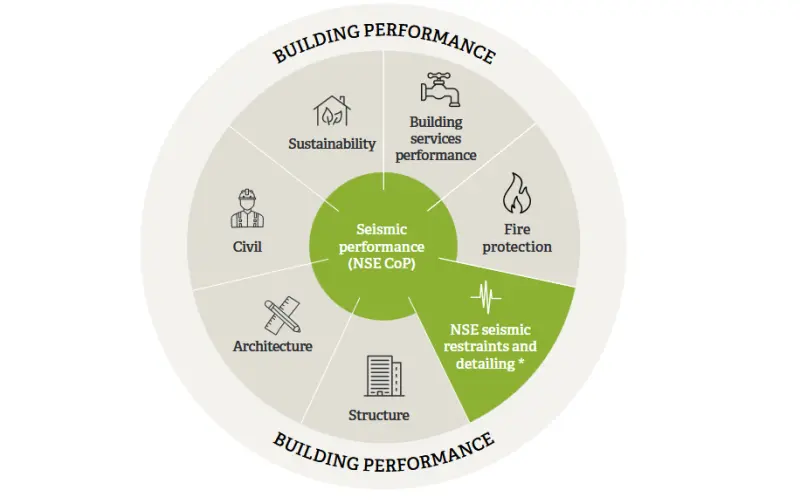
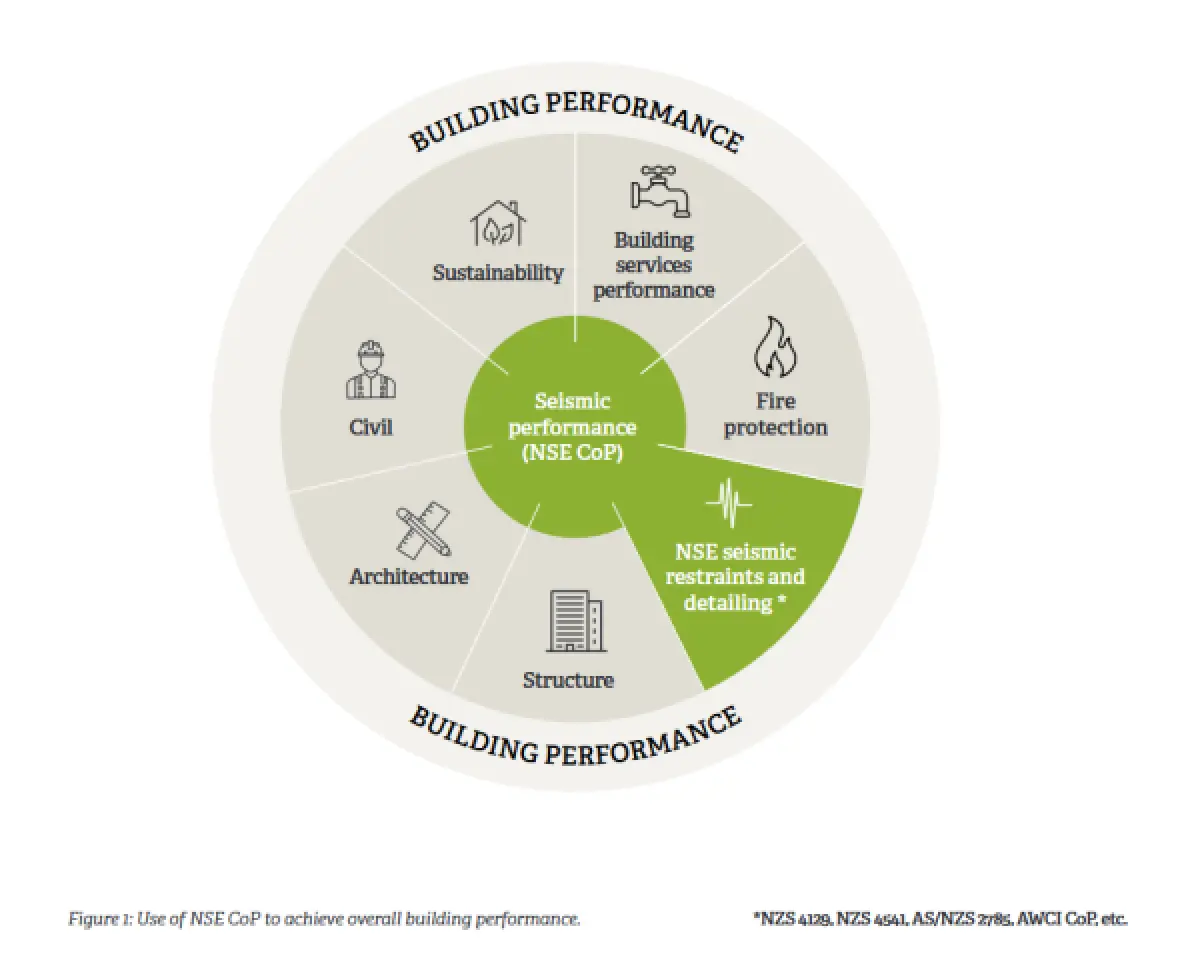
Building performance is multi-faceted and seismic performance is central in Aotearoa New Zealand (see Figure 1).
The NSE CoP:
- clarifies in non-technical terms the impact of NSE components and systems selection on overall building performance
- offers guidance on how design teams should communicate seismic performance of NSEs, enabling building owners to understand the expected functionality and performance of the building or facility following seismic events
- assists designers and consultants to specify NSEs in line with facility/building performance requirements
- assists designers and consultants to understand and coordinate seismic design interfaces between NSEs
- creates a common language akin to an STC rating for designers and contractors to communicate the selection requirements and required seismic performance of NSEs damaged when the building moves during earthquake shaking
- allows suppliers to categorise their products for apples-with-apples comparisons
- provides recommended quality assurance requirements.
Who is it for?
The seismic performance of a building is a holistic issue that touches all disciplines in planning, design and construction. Accordingly, the NSE CoP provides guidance to clients, project managers, quantity surveyors, designers, contractors and subcontractors.
What does it cover?
Phase 1 is the first iteration of the NSE CoP. It aligns with other MBIE guidance such as low-damage design guidelines, and follows a similar structure.
Part A
Part A is directed towards clients, their representatives, project managers, multi-disciplinary project teams, contractors and subcontractors. It includes important information on how to develop the project brief to align with business goals and business continuity plans. It also clarifies the project design methodology and processes through the project phases and into construction.
Part B
Part B defines the performance requirements for NSEs and will be used by project managers and multi-disciplinary project teams suppliers, contractors and subcontractors. It also provides guidance on the requirements for seismic qualification of NSEs and testing protocols where testing is required to confirm the seismic performance of NSEs.
Part C
Part C provides technical guidance on the seismic design of NSEs and is directed primarily towards structural engineers and NSE technical designers. It shows how the performance requirements set out in Part B can be met.
To date, it provides technical guidance on:
- lightweight partition walls
- suspended ceilings
- linear suspended services
- suspended equipment
- floor-mounted equipment
- automatic fire sprinkler systems
- exterior glazing systems.
Technical guidance on other NSEs is proposed for Phase 2.
Future iterations
Phase 1 is just the start. While the NSE CoP is for the whole industry, by necessity, the first phase has a strong design focus. However, Phase 2 will focus more sharply on the requirements of the contractor and subcontractor. There is a need to define how to specify and guarantee the performance of substitute components, particularly when they are imported and may or may not have been tested and certified in their place of origin.
Even for locally manufactured components and systems, there is no clear pathway for seismic qualification. Suggesting appropriate testing protocols and other ways of seismically qualifying equipment such as the definition of ‘inherently rugged’ are planned for Phase 2.
This project is funded by the Building Research Levy, with additional funding from the Building Innovation Partnership and support from MBIE’s Science Partnership Scheme.