




Aotearoa New Zealand has committed to limiting average global temperature rise to no more than 1.5°C above pre-industrial levels through the Climate Change Response (Zero Carbon) Amendment Act 2019. A carbon budget represents an estimate of the maximum amount of greenhouse gas (GHG) that we can still emit to be aligned with this goal.
Research conducted by Massey University and BRANZ takes this carbon budget and allocates it in the following order:
1. Aotearoa based on predicted population growth.
2. Aotearoa residential and commercial construction sectors based on each sector’s contribution to the country’s total GHG emissions.
3. Individual buildings based on BRANZ building stock projection.
Calculating the carbon budget
An individual building’s carbon budget is calculated by allocating a portion of the sector’s budget based on its gross floor area (GFA) or occupancy. Using GFA as a basis means that a building with a larger floor area has a larger share of the carbon budget. Therefore, a large house with low occupancy has a larger carbon budget. Intuitively, this does not appear to be equitable. Therefore, carbon budgets based on occupancy are also calculated. Here, a building with a higher occupancy will have a higher carbon budget.
Professor Sarah McLaren discusses the carbon budgets for the residential sector in more detail in the article Carbon budget for NZ housing in Build 182 (pages 48–49). Based on our calculations, a new dwelling of 198 m² should not emit more than 17.5 tonnes CO²eq GHGs across its life cycle using a GFA basis. With an occupancy of four, the same house should not emit more than 23.1 tonnes GHGs across its life cycle.
How the carbon budget changes
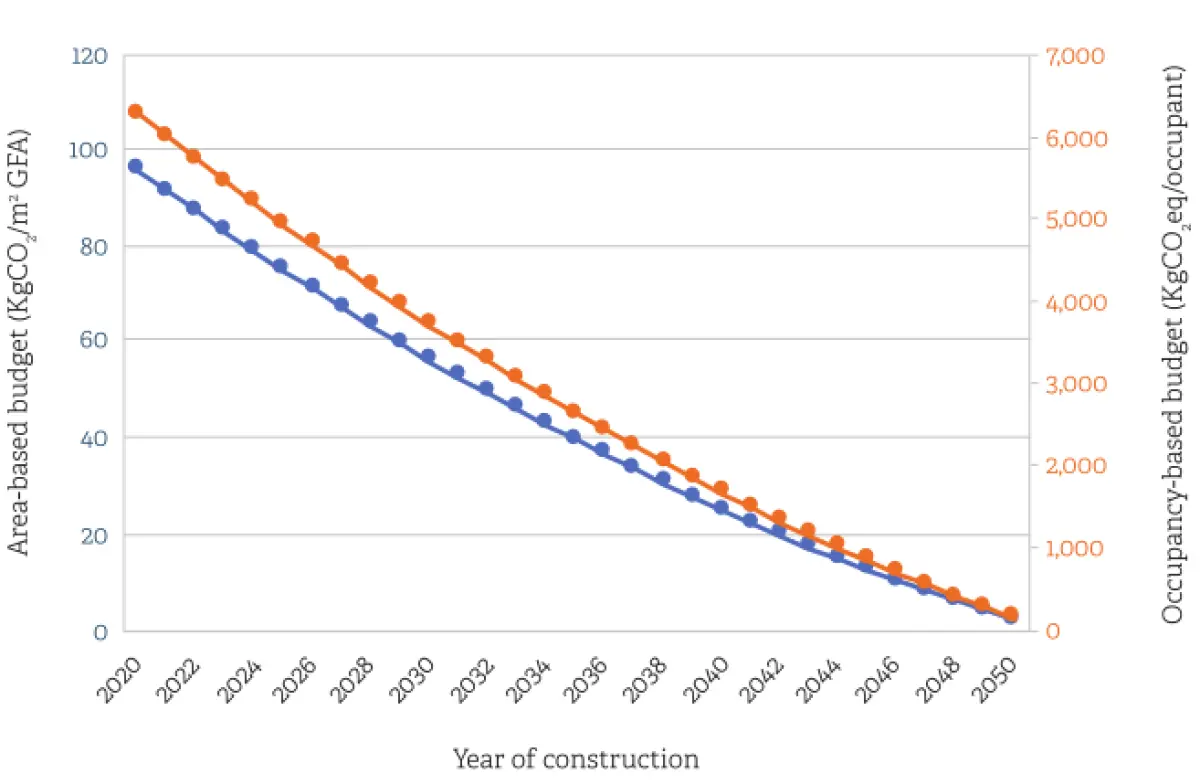
A sector’s carbon budget is not static – it decreases each year as we use up our remaining allowable emissions and get closer to 2050. This means that, each year, there is less carbon budget left that can be allocated to new buildings that are being constructed.
Consequently, looking to the future, constructing and operating houses within their carbon budget means they must be designed and constructed with lower and lower GHG emissions each year to 2050. Figure 1 illustrates how the carbon budgets for new dwellings reduces as we get closer to 2050, after which we need to be delivering net-zero carbon dwellings.
Over coming years, we expect our economy and other economies to progressively decarbonise, meaning that manufacturing of materials and transport of materials should trend downwards. Similarly, we would expect less waste and more diversion of waste materials from landfill. Our dwellings should also be warmer, drier and healthier, requiring less energy to maintain healthy and comfortable temperatures. These developments will help reduce the carbon footprint of our dwellings.
Urgent action needed to reach carbon budget goals
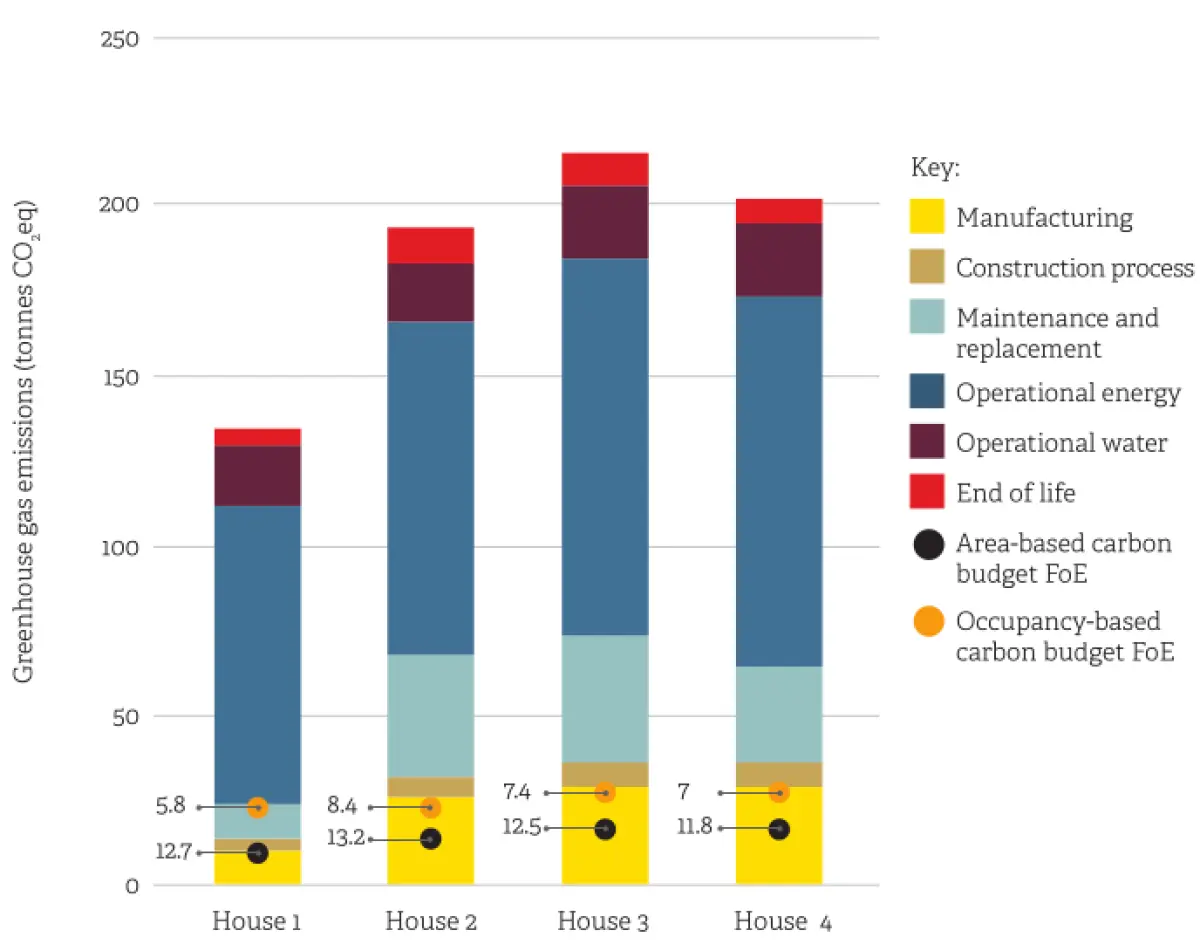
The challenge we face is that we’re not currently close to meeting these carbon budgets. It’s been estimated that Aotearoa’s residential sector is exceeding its carbon budget by a factor of 3.6. Individual new buildings can exceed their carbon budgets even more drastically. Figure 2 shows the carbon footprint of four Code-compliant, stand-alone houses built in 2023 (bars) compared with their respective carbon budgets (dots). The data labels show the factors of exceedance (FoE) – the magnitude by which a building’s carbon footprint exceeds its carbon budget. A FoE of 2 means the building’s carbon footprint is twice its budget.
Figure 2 shows new residential buildings can exceed their carbon budgets by a factor between 6 and 8 (occupancy-based) and 12–13 (area-based). For all buildings, the GHGs emitted to manufacture the materials that go into their construction is sufficient to have them exceed their carbon budgets. Consequently, they can exceed their budgets before construction starts.
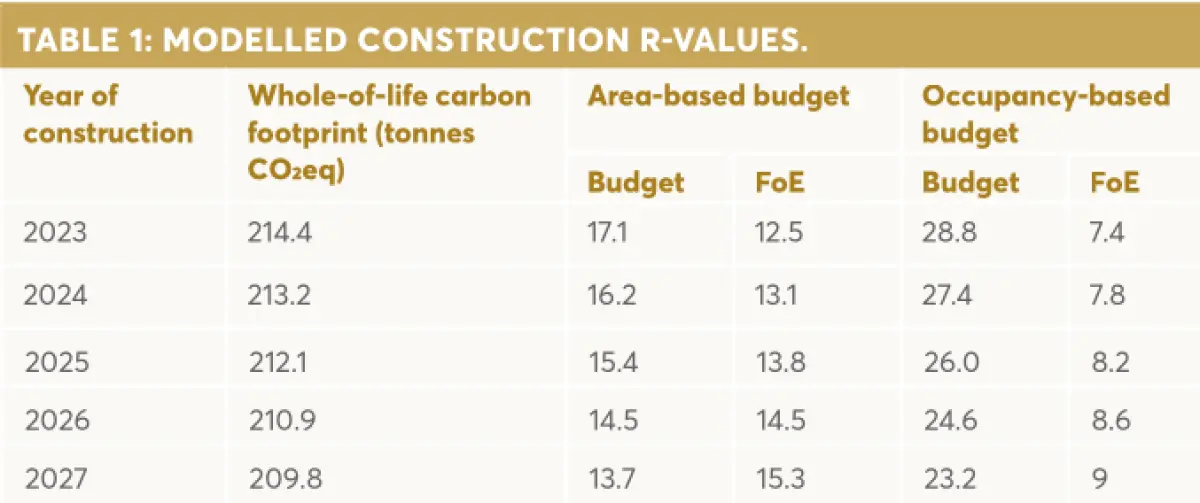
We already have a significant challenge in reducing the carbon footprint of new buildings but will make the challenge greater by taking longer to decarbonise. Each year, a building’s carbon budget decreases, making it harder to deliver a dwelling below the budget. For example, Table 1 shows how the FoE of House 3 from Figure 2 increases if this dwelling was built each year for the next 5 years with no effort to decarbonise. If we built this same building for the next 5 years, its FoE would increase from 12.5 to 15.3 and 7.4 to 9 for area-based and occupancy-based budgets, respectively.
When we exceed our carbon budgets in this way, we use up our allowable emissions more quickly. This leaves less of the carbon budget available for future years, and we increase the risk that the buildings and construction sector will not achieve its contribution to mitigating climate change. To still meet our target, our transition to net-zero carbon buildings will need to gather pace in the coming years.
For more: