

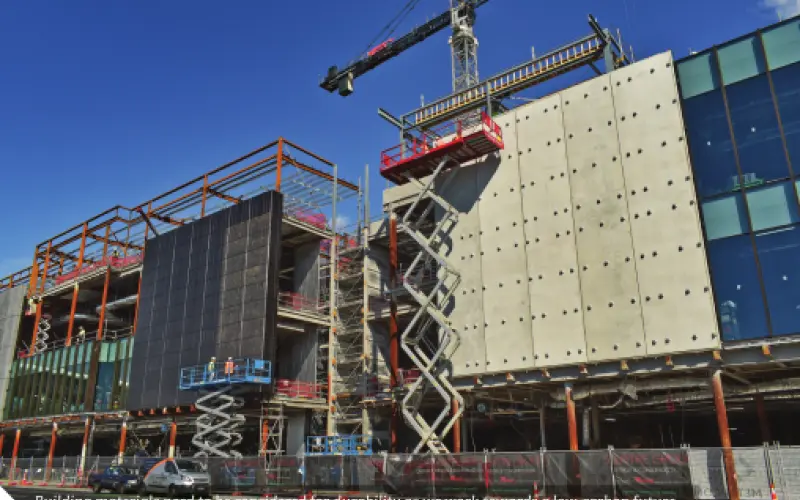


Various materials are used to create our buildings. In 2018, the production of building materials released approximately 11% of global energy and process-related carbon emissions. These emissions are expected to grow, driven by a rise in investments.
Specifically, the carbon locked in a building and attributed to its materials accounts for 28% (including biogenic CO₂ sequestration) and for 39% (excluding biogenic CO₂ sequestration) of its life cycle carbon emissions. As operational carbon becomes better managed and gradually reduced with technological advances and innovation, it is expected that embodied carbon will make up an increasing proportion of a building’s total emissions.
Limiting material consumption
Material efficiency is seen as one of the favourable options of reducing embodied carbon in buildings. This efficiency can include strategies such as:
- lengthening material service life
- effective use of materials by design – for example, lean design
- value retention – reusing for the same application, remanufacturing or repurposing for a different application.
All of these approaches effectively reduce material consumption over time. Material durability is fundamentally linking these aspects together.
Material durability relevant to carbon in buildings
Durability is generally described as the ability of a material to last a long time without significant deterioration of its performance when exposed to its service environment. Specifically, the performance-based New Zealand Building Code quantifies durability by setting minimum service life requirements for functional components in its clause B2. For example, a component that provides structural stability to the building shall have a life not less than 50 years with normal maintenance.
One-third of the respondents to a small-scale BRANZ survey Material Durability and Zero-Carbon Buildings said that durability is the most important factor when specifying materials for buildings. Approximately 93% of the respondents believe that material durability is relevant to the embodied carbon in buildings. Internationally, the importance of materials durability in managing carbon impacts is also becoming increasingly recognised. For example, with a move towards a circular economy, materials need to be selected to guarantee durability for enhanced circularity by saving resources and minimising waste in Europe.
However, what does increased material durability really mean to the embodied carbon in buildings? Understandings vary, the BRANZ survey also showed. The potential carbon benefits of increased material durability seem evident and could be justified by 61% of the respondents who believe that a more durable material could provide a longer period to amortise the embodied carbon from a life cycle standpoint. In addition, it will not need frequent replacement, and subsequently, the carbon invested into its substitutions can be saved.
For example, although corroded steel can be recycled, a US study found that the steel produced to replace the corroded steel accounted for 1.6–3.4% of the total global carbon emissions in 2021. In general, a more durable material may have a higher chance for reuse, remanufacturing or repurposing after its end-of-life stage. Hence, material durability would be a key component to low-carbon buildings.
However, others contend that some more durable materials may possess higher carbon intensities due to their more complex production processes:
- Timber-framed windows (expected service life of 56–65 years) and aluminium-clad timber windows (71–83 years) have averaged embodied carbon of 12–25 kg CO₂ and 48–75 kg CO₂, respectively, according to the Inventory of Carbon and Energy Database and Canadian research.
- One UK study found that protecting a steel surface with 85 μm galvanising and recoating once would result in the lowest carbon dioxide equivalent (CO₂e) for steel components in an ISO 9223 C3 Medium environment over a design life of 100 years. By comparison, using stainless steel for the same application will use more CO₂e.
Therefore, there is a delicate balancing act between the level of embodied carbon of a material and the degree of material durability required for a specific application. So why do we have these differing positions and how do we best navigate this balancing act? Carbon emissions analysis challenging Embodied carbon has been more frequently quantified throughout a building’s life cycle – for example, with life cycle assessments. However, there are some uncertainties in comparatively analysing the carbon benefits of increased material durability:
- More trusted data is needed to cover all life cycle stages of a material, particularly beyond a building’s end-of-life stage.
- Performance characteristics – particularly durability – of some materials, amongst others, are not well understood in specific built environments, especially for emerging low-carbon materials.
- Buildings might be renovated or partly replaced due to reasons that may have nothing to do with material durability or building integrity.
How can these uncertainties be reduced?
System-based approach for material durability
A building is a system with interactions at multiple levels. It performs its function only when all its material-based components are interacting with each other in ways as designed and constructed. Increasing the durability of a specific material needs to consider how it connects with the key components that determine the overall function or performance of the building.
It remains relevant only when it continues to interact with and be valued by its users. Increasing material durability to extend its service life needs to consider the user side of the system – for example, in terms of expectations and experiences over time.
Accordingly, a shift from the current material-centric focus towards a more system-based approach is needed to help balance the expectations between material durability and building service life. This could help reduce carbon emissions analysis uncertainty and obtain the meaningful carbon reduction outcomes we are looking for.
Ready for increased durability?
It is apparent that some challenges and factors should be considered before significantly increasing material durability:
- Thinking and planning about the potential reuse, remanufacturing or repurposing of the materials with increased durability after their end-of-life stage as well as the additional carbon emissions involved.
- Capability of current technology for significantly increasing material durability.
- Availability of trusted assessment methodologies and compliance pathways.
- Cost implications.
- The pace of technological evolution and material innovation.
Not the end but the beginning
Durability is one of the most important characteristics of building materials and is interrelated with the embodied carbon of buildings. However, it is not clear what material durability really means to the building’s emissions profile.
This article discussed findings from BRANZ and overseas studies to provide considerations to reduce the uncertainty in material selection from the perspectives of durability and embodied carbon. We hope it will encourage more meaningful conversations that could help industry and communities make more informed material choices for climate-resilient and sustainable buildings.