



In Build 181 article House condition and occupant wellbeing, BRANZ reported initial findings from the pilot national housing assessment survey – the 2018/19 Pilot Housing Survey (PHS) – run in conjunction with Stats NZ’s 2018 General Social Survey (GSS). The PHS represents an important new approach to collecting robust data on Aotearoa New Zealand’s housing stock, through a partnership between BRANZ and Stats NZ with co-funding from MBIE.
Here we discuss findings from analysis using a linked dataset combining information from both surveys. This includes data on house condition based on independent assessments by surveyors (from the PHS), and characteristics of the occupants and their behaviours around heating and self-reported physical comfort, health and mental wellbeing (from the GSS). The research represents the first time this linked data has been analysed and released publicly.
Understanding the link between housing condition and wellbeing
The aim of the research was to determine any statistically significant relationship between housing condition assessed in the PHS and the occupants’ self-reported levels of comfort – specifically feeling too cold in winter – and their mental and emotional wellbeing from the GSS.
It also looked at the housing conditions of different demographic and socioeconomic groups. The analysis used the mental wellbeing index measure to represent the occupants’ wellbeing and look at its relationship with the independently rated housing quality measures. This wellbeing measure is comparable to that used by the World Health Organization – the WHO-5 Wellbeing Index.
Being cold impacts mental wellbeing
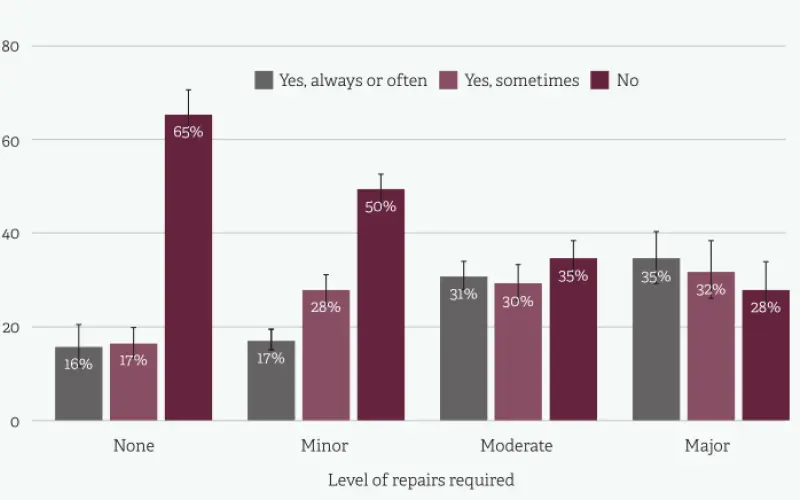
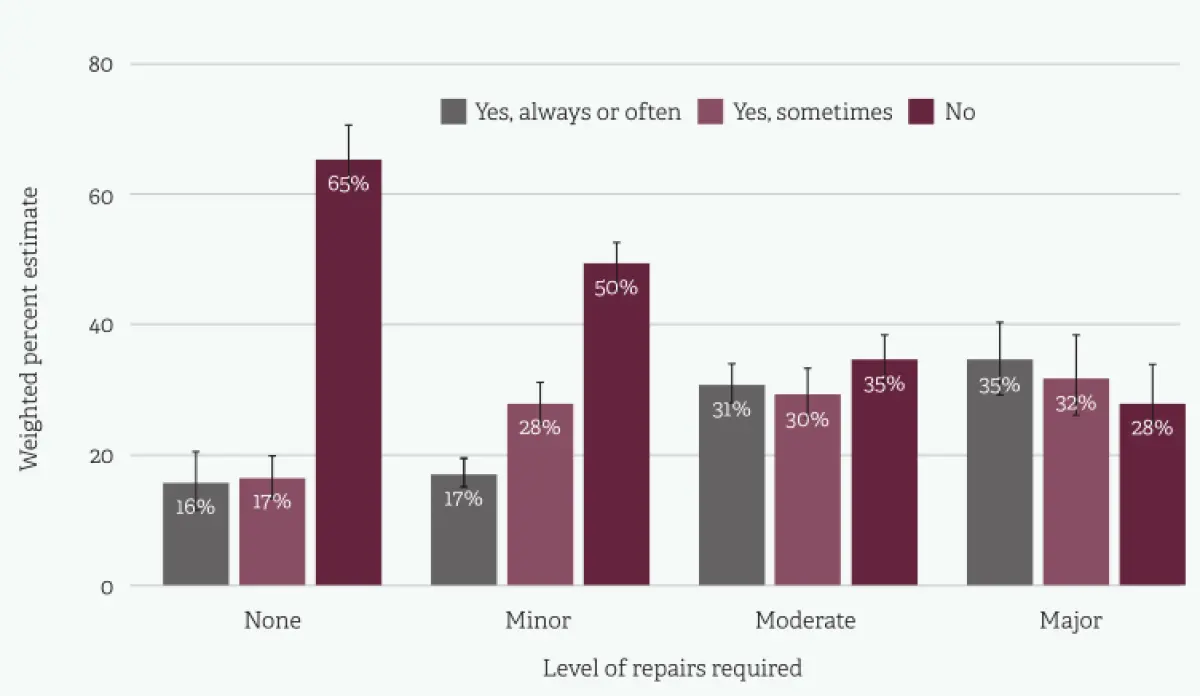
Results showed that better house condition was linked with survey respondents being less likely to report feeling too cold in their home in winter (Figure 1). Those who always or often felt cold in winter were more likely to live in a house with poor or serious exterior condition. Stats NZ has previously reported that those in younger age groups and a higher proportion of Māori and Pasifika households were more likely to always feel colder than they would like in their homes in winter.
Furthermore, those living in a dwelling requiring moderate or major repair were twice as likely to report feeling too cold in winter compared with those in a dwelling requiring no maintenance or repair. Housing defects and issues noted in the assessments of these houses often related to a dwelling’s ability to retain heat such as holes, cracks or gaps in the exterior wall cladding and decayed, cracked or missing window seals.
Mental wellbeing was related to feeling cold. Participants who reported always or often feeling colder than they would like in winter tended to score lower on the mental wellbeing index.
Feeling cold and heating affordability
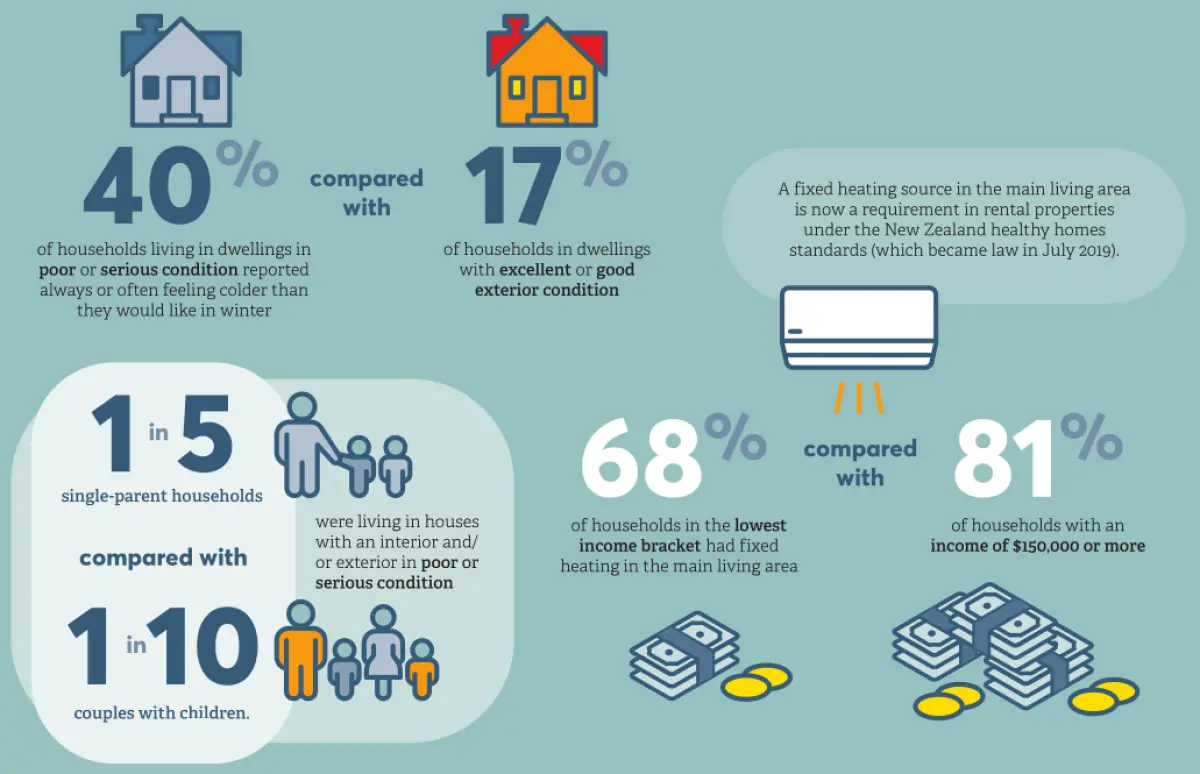
PHS results showed that most houses (78%) had some form of fixed heating in their main living area, most commonly a heat pump (44%) or a wood burner (31%). Households with a fixed heating source in the main living area were less likely to report feeling colder than they would like in winter. Houses with fixed heating sources were also more likely to be in better overall condition. Both factors are linked to higher mental wellbeing index scores.
Those on lower incomes and Māori/ Pasifika households were less likely to have a fixed heating source in the main living area – 64% compared with 80% for non-Māori/Pasifika households.
The likelihood of heating living areas and bedrooms during winter increased with household income. Those in the highest income brackets were most likely to report heating bedrooms every night in winter, though many households in all income groups reported hardly ever or never heating bedrooms in winter.
Cost was stated as a reason for not heating bedrooms for 20% of households in the lowest income group compared with 11% in the highest income group, who were more likely to state that heating was not needed. Pasifika households were more likely than other households to state that they did not heat these areas regularly during winter due to cost – 46% compared with 32% overall.
Some groups disproportionately affected
Analysis found that some population subgroups were more likely than others to be living in houses in poor or serious condition in the interior, exterior or both. These included single-parent households, households on a lower income and households where the respondent identified as Māori or Pasifika.
Single-parent households were also more likely to live in houses with a moderate or worse level of visible mould in living areas and bedrooms (54%) compared with households overall (37%). This aligns with findings from Stats NZ’s analysis of the GSS showing that participants from single-parent families were the most likely to report experiencing issues with housing quality and affordability.
Housing condition and mental wellbeing
Mental wellbeing scores varied significantly by average exterior condition, average interior condition and the level of repairs and maintenance required.
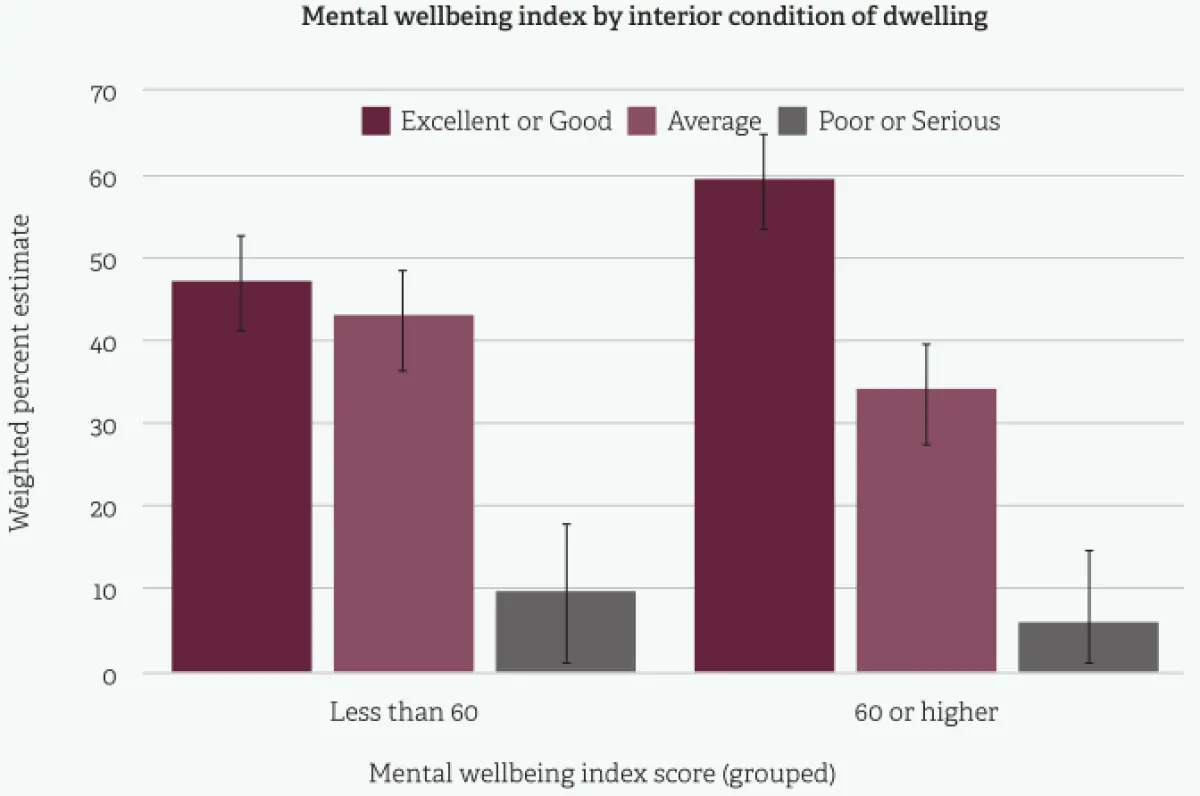
The biggest difference was seen in the average mental wellbeing scores between those living in houses rated as excellent or good compared with those living in houses rated poor or serious.
Results showed that, on average, those in houses with poor or serious interiors had a mental wellbeing score 10 points lower than those in houses with excellent or good interiors (Figure 2).
Factors most associated with mental wellbeing
Analysis showed a statistically significant relationship between the mental wellbeing index score and the interior and exterior condition ratings of houses and the level of repairs or maintenance required.
The average mental wellbeing score was significantly higher for those living in houses with excellent or good interior and exterior condition ratings than those in houses with average condition ratings of poor or serious. Interior condition had the strongest relationship with mental wellbeing of these housing quality measures.
Further analysis showed the interior condition of the house became less important to mental wellbeing scores when other factors were considered. Household income, living in a single-parent household and feeling cold in winter proved to be more significant factors in relation to the mental wellbeing index.
Conclusions
The results represent a snapshot of Aotearoa houses and households in 2018/19. With continuing issues of increased cost of living and housing affordability, these findings are particularly relevant. Housing condition, sociodemographics and wellbeing are complex, interrelated and multi-faceted.
Household income, tenure (renting vs owner-occupying) and housing condition are related, with lower-income households more likely to be renting and rental dwellings more likely to be in poorer condition.
Furthermore, this research shows clear links between house condition and feeling cold and wellbeing.
It follows that efforts to improve the thermal performance of houses through insulation and efficient, affordable heating solutions will have positive impacts on the mental wellbeing of occupants, especially renters. The research shows that some groups are disproportionately affected by housing quality issues and would benefit from targeted policies and interventions.
This research used a unique data source available through a collaborative study with Stats NZ and MBIE. In partnership with Stats NZ, BRANZ has now incorporated the PHS dataset in the Integrated Data Infrastructure (IDI) so it can be linked to other datasets and accessed by other researchers through the Stats NZ Data Lab. This presents an exciting opportunity for BRANZ and others to further explore and add to the growing body of knowledge on housing quality and occupant wellbeing in Aotearoa households.
For more:
-
Stats NZ – Wellbeing statistics 2018: stats.govt.nz/information-releases/wellbeing-statistics-2018
-
Stats NZ – Housing in Aotearoa 2020 (updated 2021): stats.govt.nz/reports/housing-in-aotearoa-2020
-
BRANZ Study Report SR456 Assessing the condition of New Zealand housing: Survey methods and findings (2020): Visit www.branz.co.nz and type the report’s title into the search box.
Disclaimer: Access to the data used in this study was provided by Stats NZ under conditions designed to give effect to the security and confidentiality provisions of the Statistics Act 1975. The results presented in this study are the work of the authors, not Stats NZ or individual data suppliers. These results are not official statistics. They have been created for research purposes from the IDI, which is carefully managed by Stats NZ. For more information about the IDI visit stats.govt.nz/integrated-data