




A new industry-led initiative aims to reduce the environmental impact of Aotearoa New Zealand’s buildings, which contribute up to 20% of the national carbon footprint.
What is carbon footprinting?
Carbon footprinting or building life cycle assessment is used to estimate the greenhouse gas (GHG) emissions from the creation, use and disposal of a building. It is derived from international standards EN 15978 and EN 15804 and is beginning to be used more widely in our construction sector.
However, sourcing consistent and robust data for the embodied carbon in construction products and materials is a key challenge. When data is missing, incomplete or poor quality, assessments are harder to carry out, increasing the risk that calculated carbon savings won’t deliver actual, real-world reductions in GHG emissions.
To help tackle this issue, BRANZ has partnered with Construction Information Limited (CIL) to leverage existing data and research and find a solution.
Embodied and operational carbon
Carbon footprinting is generally used during the early design stage to help project teams understand how they can design a building to emit less and, therefore contribute less to climate change. However, it can be conducted throughout the design process – and beyond – to track the emissions of a building.
Several well-known sector initiatives consider carbon footprinting. For example, the New Zealand Green Building Council’s Greenstar and Homestar certifications offer credits for conducting carbon footprinting and using it to lower the carbon emissions of a design.
Carbon footprinting is very data intensive and requires an understanding of the impact of all the resources a building will use over its assumed 50-year life (for example, materials, energy and water). It is often split into:
- embodied carbon – GHG emissions released to manufacture, install, use and dispose of products and materials, which can be reduced by using fewer materials and choosing lower-carbon options
- operational carbon – GHG emissions released to supply resources such as energy (for example, electricity and gas) and water to a building while it is being used, which can be lowered by reducing the quantity of resources used.
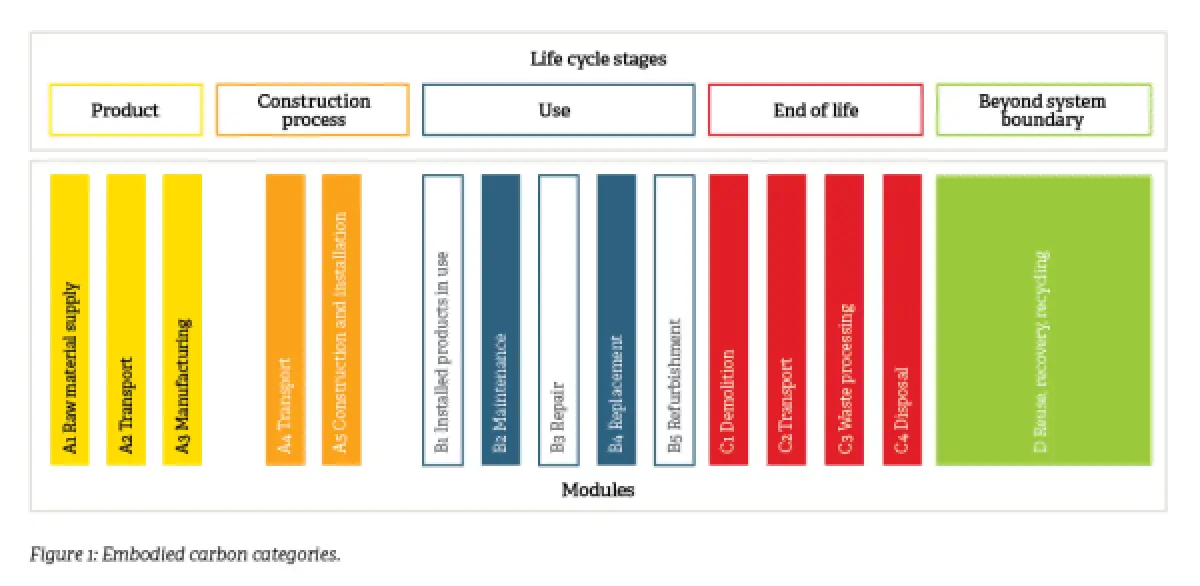
Figure 1 shows how embodied carbon is categorised into life cycle stages and modules when a carbon footprint calculation is conducted.
Robustness and consistency
There are challenges associated with embodied carbon data, including the quantity needed and the assumptions required to develop it.
Data on potentially thousands of products and materials that could go into a building is needed, and how they will be used once they leave the factory must be assumed:
- How will materials be transported to site?
- How much material is going to be wasted on site and what happens to it?
- How will materials be installed and will installation consume more resources – for example, do you need a crane?
- How often will materials need to be replaced or require maintenance?
- What happens to the materials at the end of the building’s life?
- Are there other factors to consider outside of the building’s typical life cycle – for example, opportunities for recycling?
To ensure that carbon footprinting leads to lower GHG emissions, robust evidence must inform assumptions and ensure they are applied consistently between carbon footprint assessments.
Taming the wild west of embodied carbon
Aotearoa is early in its journey to assess the carbon footprint of buildings.
Many early adopters have been practising for some years but a larger number of organisations are just starting.
In the absence of a standardised, national methodology, organisations have developed their own methods, tools and assumptions – and there is growing inconsistency between the assessments being undertaken.
A key piece of technical infrastructure needed to tame this ‘wild west’ of embodied carbon is a single source of carbon data truth, which BRANZ’s partnership with CIL will deliver.
BRANZ’s role
For the past 13 years, BRANZ has been collating embodied carbon data for construction products and materials available in Aotearoa. Rather than simply bringing the information together, we also ensure the data is based on latest scientific evidence to improve its robustness and relevance to our environments.
This data forms the basis for much of BRANZ’s research and to build tools such as LCAQuick – an Aotearoa-specific life cycle assessment tool that more recently has been used as a data source for other tools through CO₂NSTRUCT.
In response to industry demand and with endorsement from MBIE, a national data carbon repository will use BRANZ’s underlying data to create an accessible and usable national data resource covering a broader range of construction products and materials.
BRANZ will ensure the carbon data feeding the online resource is reliable and accurate. The data will be available through multiple channels but largely through an application programming interface (API), making it accessible for developers of embodied carbon tools.
How the data has been developed will be clearly visible and open to interrogation, giving industry evidence to better inform assumptions and ultimately improve the quality of the data underpinning assessments.
The resource will be able to hold more data, which will be managed more effectively – including systematic updating. In addition to product-specific information, it will contain data on generic materials that can be used in lieu of product information or in the early design stage when specific products have yet to be decided.
The next steps?
We are still in the planning stages of this project – identifying the project team, others who need to be involved and the key delivery workstreams - and expect to have the first data available from 2025.