



At a glance
- Many newly built off-grid Kiwi homes can be exempt from specific H1 Energy efficiency criteria if their power supply does
not rely on a network utility operator or a depletable energy resource. - As this aspect of the H1 legislation is not widely known, building consent authorities (BCAs) may seek clarification through
requests for information (RFIs) during building consent applications.
When the revised H1 requirements were released in 2023, the targets for new housing and small buildings were changed to achieve thermal insulation compliance. While public and industry debate centred on the increased R-value ratings required for compliance, another more specific issue emerged.
It is not commonly known but the application of some of the H1 Energy efficiency provisions in the New Zealand legislation (Building Regulations 1992) are limited.
For example, under ‘Provisions’, the first Objective H1.1 states ‘The objective of this provision is to facilitate efficient use of energy’. However, alongside this (in the ‘Limits on application’ column) are the words ‘Objective H1.1 applies only when the energy is not sourced from a network utility operator or a depletable energy resource’.
Interest in this wording grew when the 2023 H1 revision was released – especially among those living in or planning to design and build new off-grid dwellings.
BCA confusion around the H1 exemption
Since 2023, architects and designers working in the off-grid field and using the H1 exemption have noted that many new homes they have designed – or been involved in designing – have required far more engagement with the BCA. Further, different BCAs have responded inconsistently when assessing the applications, particularly when faced with unfamiliar or seemingly non-compliant H1 calculations.
Most BCA responses ranged from the cautious to a refusal to consider the concept at all. Eventually, however, they all accepted and processed the consent submitted. After all, it is hard to argue with
the legislation.
The final hurdle for at least one of the processing officers was an assurance that the project would still be complying with the thermal insulation requirements of E3/AS1. They specifically referenced sections 1.1.1 Thermal resistance, 1.2 Ventilation and 1.3 Condensation control, as they relate to internal condensation.
Why the BCA hesitancy?
Some designers report building consent and RFI conversations where the council’s hesitance seemed to stem from two aspects of the off-grid H1 exemption. The first was that, as the exemption was relatively unknown, it was viewed as a loophole in the legislation and not seen as part of a legitimate pathway to compliance or part of any deemed-to-comply path to building consent approval.
The second aspect seemed to be general caution regarding the use of Alternative Solutions or other innovative building solutions, particularly in non-mainstream and remote dwellings, as many off-grid houses are.
Life off the grid
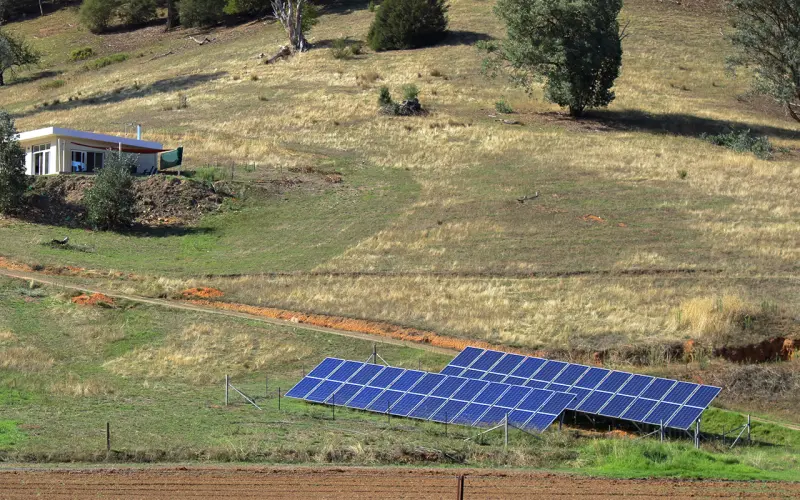
Most off-grid homeowners have different specific building priorities compared to urban dwellers and put much thought and planning into how they will provide the necessities and comforts enjoyed in the city.
While energy supply and management, usually utilising sophisticated solar-powered off-grid systems, will be the primary concern of off-grid homeowners, they have other factors to consider. These include fire risk, security, privacy, general self-sufficiency, communications, resilience, safe potable water, sewage treatment and sustainability.
Typically, off-grid clients are also well informed about the technical details of the systems they want in their homes.
Innovation in off-grid energy efficiency
The limit on Objective H1.1 enables the use of different solutions, not constrained by the more rigid thermal insulation prescriptions of clause H1. When there’s a need to harvest every watt of energy a house will use, homeowners will be cautious not to waste it by inefficient usage or by having a home with a poor thermal envelope.
Some of the innovative solutions used off grid are impressive while being simple and effective. They include a small low-tech hydro-electric installation using the flow of a small spring-fed stream and the use of locally grown wool in wall and underfloor insulation (abundant and sustainable, fire resistant, lasts for decades and can then be composted and continuously renewable).
Another recently completed low carbon off-grid home used virtually no concrete or steel and incorporated minimal oil-based materials. These houses are genuinely leading edge, not the result of attempts to exploit compliance loopholes.
The big picture
One thing we can take away from working with the off-grid community is that, as architects, designers and specifiers, we must remember that not everything about insulation is related to thermal resistance. All aspects must be considered along with the potential of different products and materials to be used in different ways.
There is something enormously satisfying in enabling some of these alternative options to take root and help our future construction systems leave a lighter footprint.