

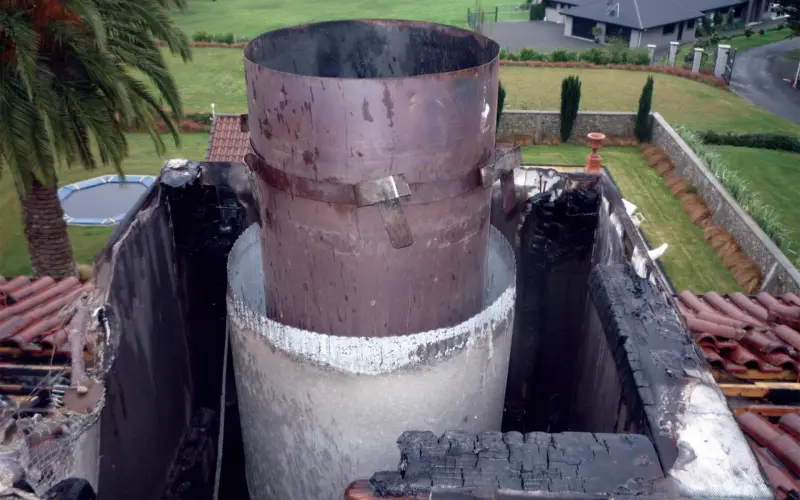


AS/NZ 2918:2001 Domestic solid fuel burning appliances – installation is the standard referenced in C/AS1 for flue and fire box installation. Note that while a March 2026 edition of AS/NZS 2918 has been published, it is the 2001 edition that is referenced.
What fires are covered?
AS/NZS 2918:2001 applies to solid fuel burning appliances (for example, wood or coal burners), which are fully assembled before installation. It also includes open-fronted fireplace inserts and domestic oil-fired appliances.
Precast concrete open fires aren’t included as the fireplace is constructed in situ. An old-fashioned steel-backed open fire insert, sometimes known as a register grate, would comply. Open fronted fireplace inserts are available that provide greater combustion control than a register grate but are essentially the same.
C/AS1 assumes the flue or chimney for open fires will be concrete or masonry construction. However, there are examples of stainless steel flues being used for open fires, which is not strictly in accordance with C/AS1. These would require an alternative method to be submitted to the Building Consent Authority for approval.
The installation of gas burning appliances is covered by a separate standard.
Two essentials for flue installation
The two basic principles for a safe flue installation are:
- adequate ventilation
- sufficient separation from combustible materials.
Stainless steel flues are usually stand-alone items that get close to building elements when passing through a floor, ceiling, roof or wall. Separation from combustible materials (called heat-sensitive materials in AS/NZS 2918) is essential.
Enclosed flues
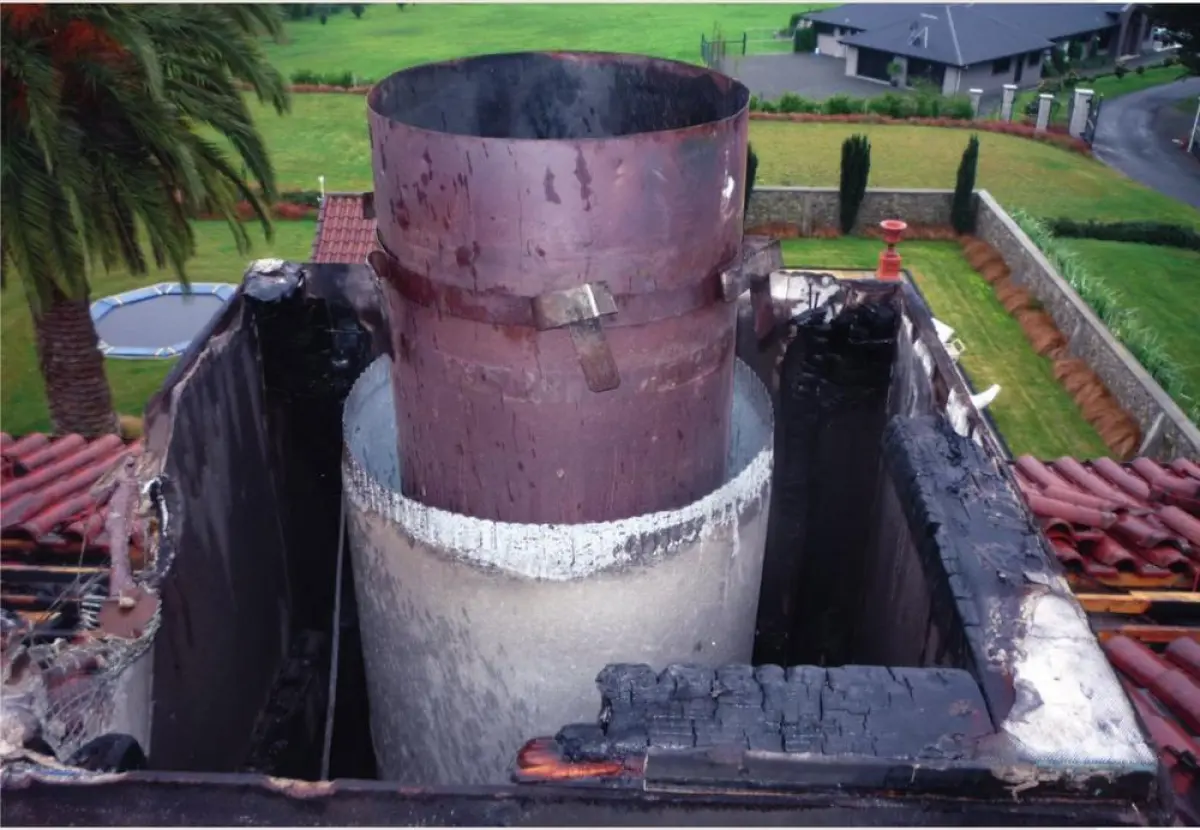
Sometimes a flue is enclosed in a timber-framed structure in the building for aesthetic reasons. AS/NZS 2918:2001 calls this an enclosure, although it is sometimes referred to as a chimney chase. The rules for flues within enclosures are given in AS/NZS 2918 Section 4. Flues can be:
- tested – manufacturer’s specification applies
- untested – specific rules are in AS/NZS 2918:2001.
The main areas that require separation from combustible materials are the:
- walls of the enclosure from the flue
- framing and lining from the penetration through the top.
WALL SEPARATIONS
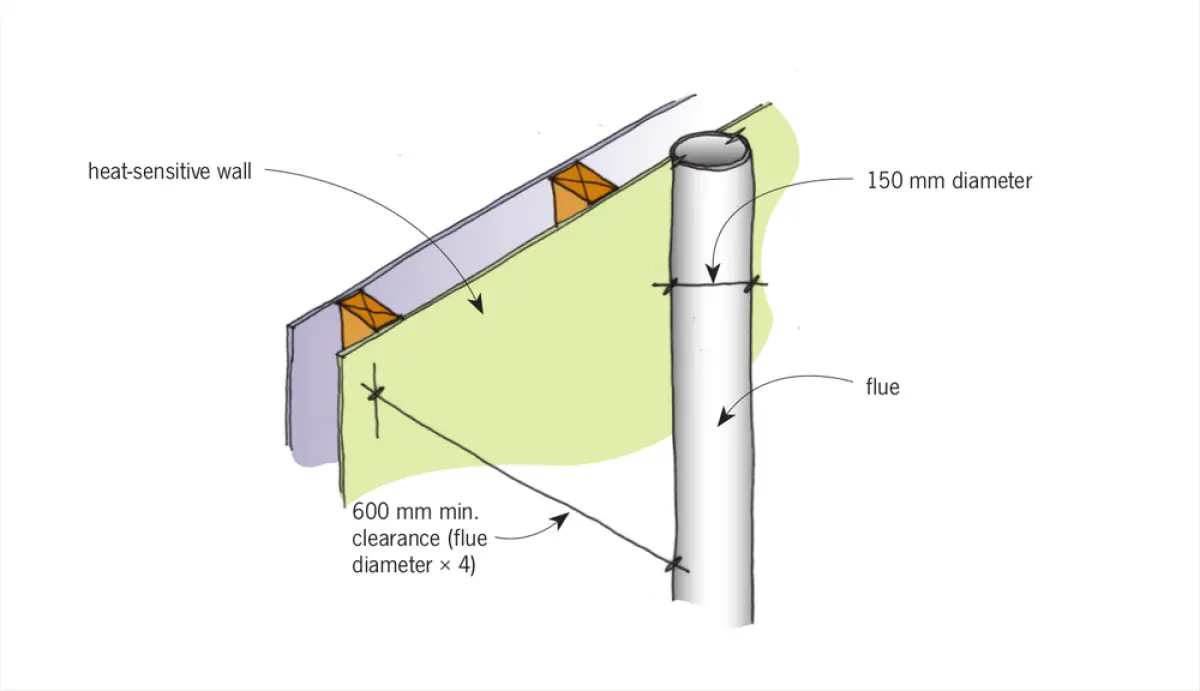
Where the flue has no casing it must be separated by four times its diameter from any heat-sensitive material. This means that a 150 mm diameter flue needs a 600 mm separation (see Figure 1). Therefore, a 1,350 × 1,350 mm enclosure would require no additional protection, but this very large enclosure is often impractical.
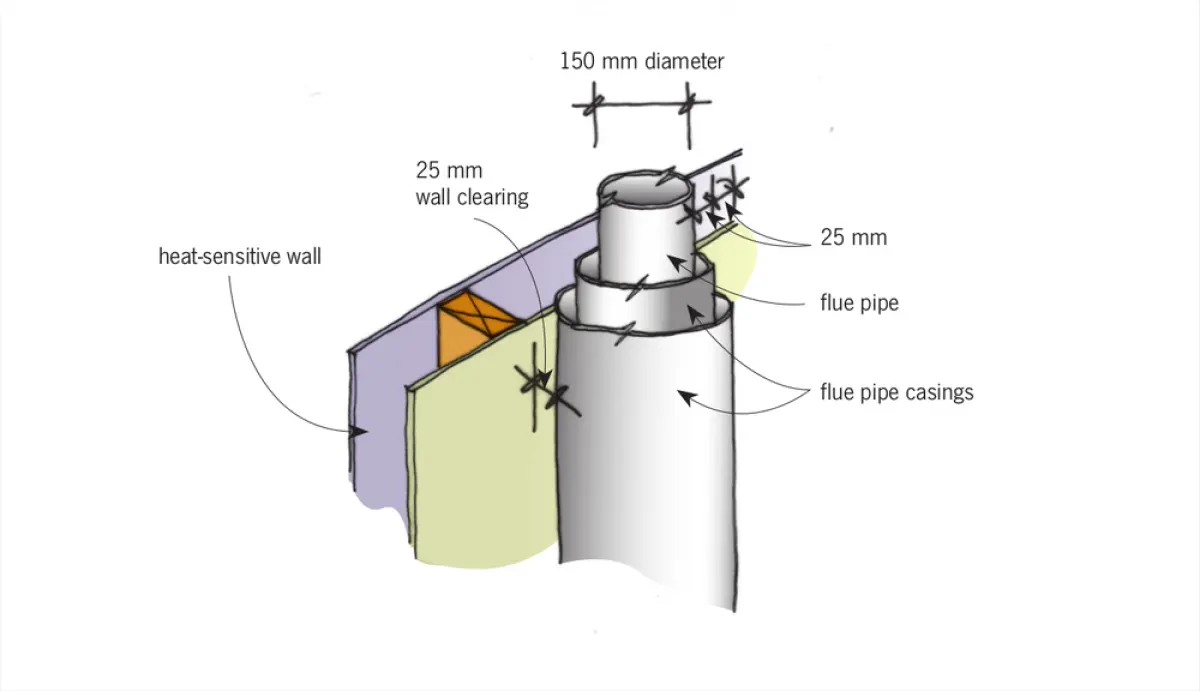
A flue with two casings and 25 mm air gaps between the casings and the flue requires a 25 mm separation from heat-sensitive material – a more practicable size (see Figure 2).
AS/NZS 2918:2001 has no provision for a single casing, but applying the principles of a heat shield could give a separation of 300 mm (2 × flue diameter). In this case, a 150 mm diameter flue would require a 750 × 750 mm minimum enclosure.
VENTING
Ventilating the enclosure around the flue is important to prevent heat build-up at the top of the enclosure, which could result in a fire.
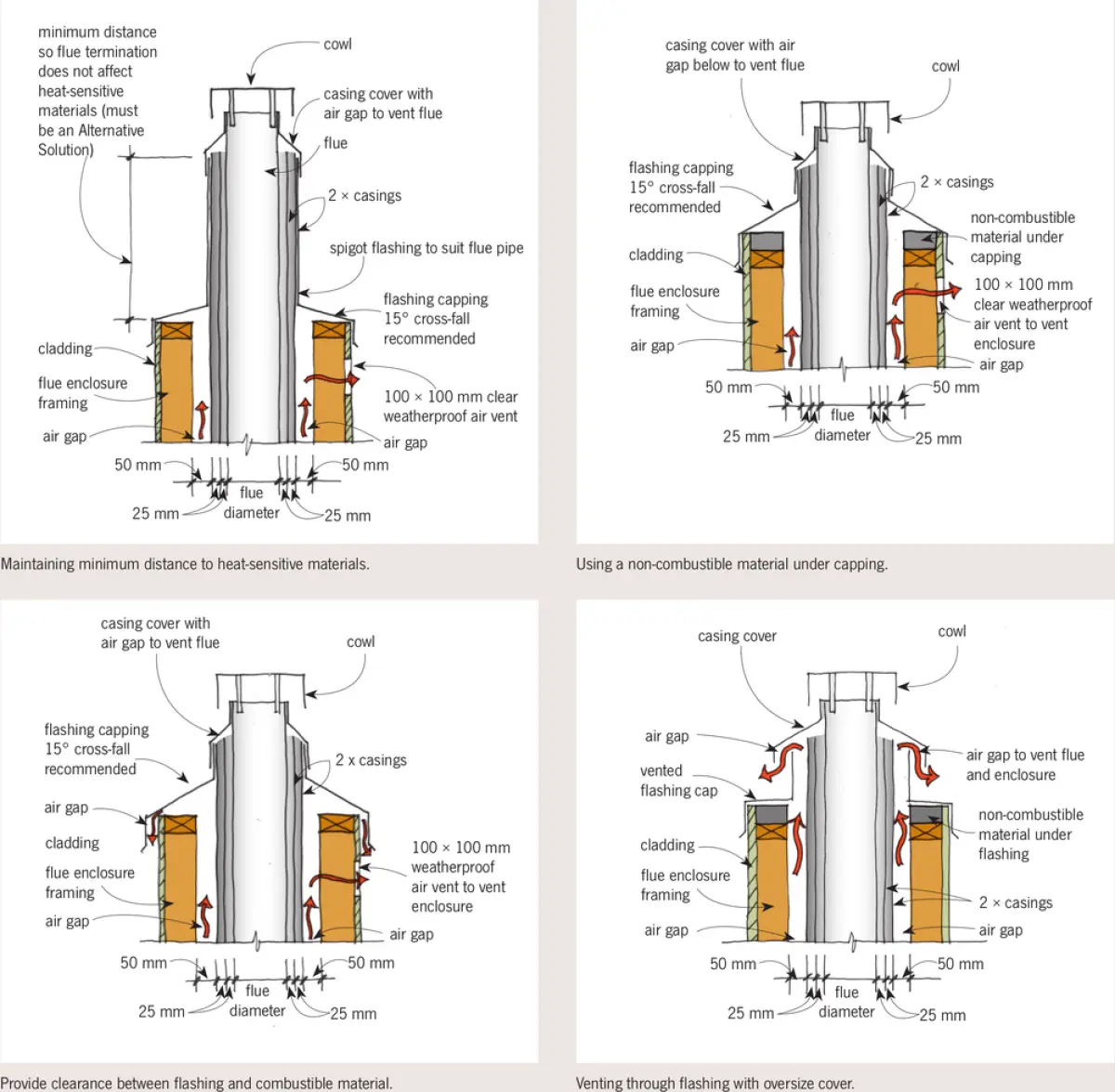
The casings must be vented from inside the enclosure to the outside. Where the enclosure is less than 1 m2, it must be vented top and bottom by openings of not less than 10,000 mm2, which is a 100 × 100 mm square clear opening or 113 mm diameter hole. Venting through the flashing or casing can also provide the same area, but the venting must be continuous to the outside.
TOP/ROOF PENETRATION
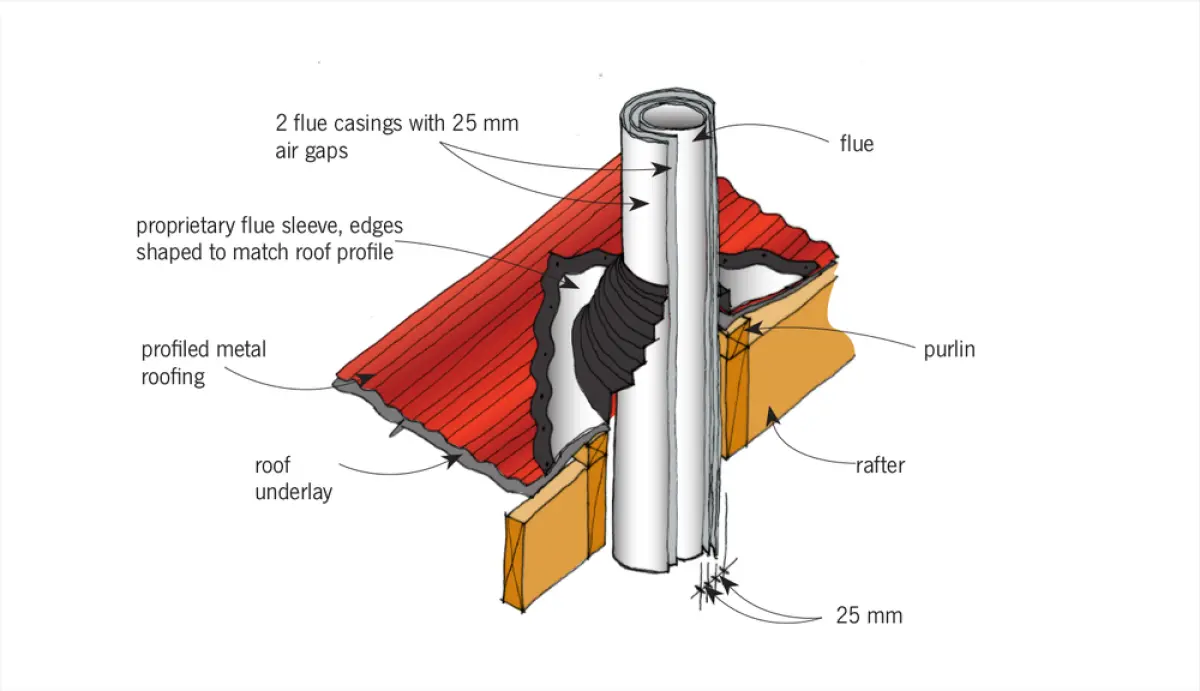
The top penetration is essentially a roof. The roof penetration specifications in AS/NZS 2918:2001 are a double casing with 25 mm gaps between casings and any heat-sensitive materials (see Figure 3). The minimum height of the top of the flue varies depending on where it is on the roof:
- If the flue is within 3 m horizontally of the roof apex, the flue top must be at least 600 mm above the roof apex.
- If the flue is over 3 m from the roof apex, the flue top must be 1,000 mm minimum above the roof and at least 3 m horizontally from the roof surface.
This ensures correct operation of the burner, limits back draughts and prevents flue gases impinging on the roof.
For an enclosure simulating a chimney, this raises the question of how high above the enclosure to terminate the flue. The enclosure can be extended to meet the 600 mm or 1,000 mm height requirement, but there is no guidance in AS/NZS 2918 or C/AS1 on height requirements above a heat-sensitive surface.
AS/NZS 2918 clause 4.9.1(e) specifies that flue termination should not constitute a risk of fire to heat-sensitive materials. Manufacturers must provide their own solutions, with appropriate evidence and justification (see Figure 4). Solutions may be to:
- specify a minimum height above heat-sensitive materials
- provide shielding and air gaps above heat-sensitive materials
- install a layer of non-combustible material at the top of the enclosure.
Open fires and flues
Open fires do not heat a flue any more than a solid fuel burner, whether enclosed (with a door) or as an open insert. In BRANZ’s opinion, the requirements for flues in AS/NZS 2918:2001 would apply equally to open fires.
Options to design right
Provided the requirements of AS/NZS 2918 are followed, a safe enclosure design should be achieved by:
- adequate ventilation in the enclosure – minimum 100 × 100 mm clear open area or equivalent opening top and bottom
- venting the casings with openings at each end of not less than 5,000 mm2 clear open area
- providing adequate separation of the flue in the enclosure
- double casings where the flue penetrates the top and is close to combustible materials
- ensuring the termination does not affect heat-sensitive materials on the roof by either:
• distance
• using a non-combustible capping
• providing a clearance between the flashing and any combustible material.