

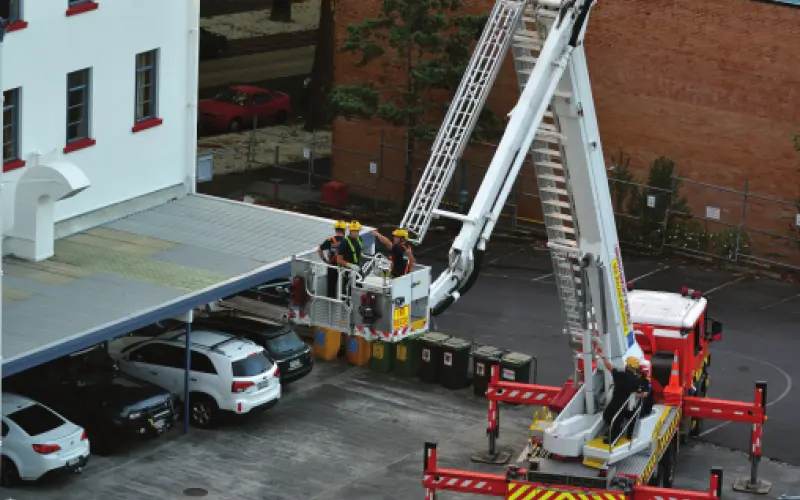


Perhaps not surprisingly, research has shown a correlation between the level to which firefighters can apply water to a building and the level to which there is reduced fire damage.
As urban intensification increases and rules change to permit more buildings 3 storeys and above, it becomes even more important for architects, designers and urban planners to understand the height capabilities of firefighters and their appliances.
Designers need to consider accessibility
Building design, orientation and access, materials choice, hydrant placement and so on all have an impact on how readily a fire can be approached by the fire service and how risks to both building occupants and firefighters can be reduced. From a height point of view, a building designer should ask themselves how a fire appliance would access a building, where it could safely and effectively be set up to operate from and how higher floors would be reached. This requires an understanding of the requirements and capabilities of fire appliances.
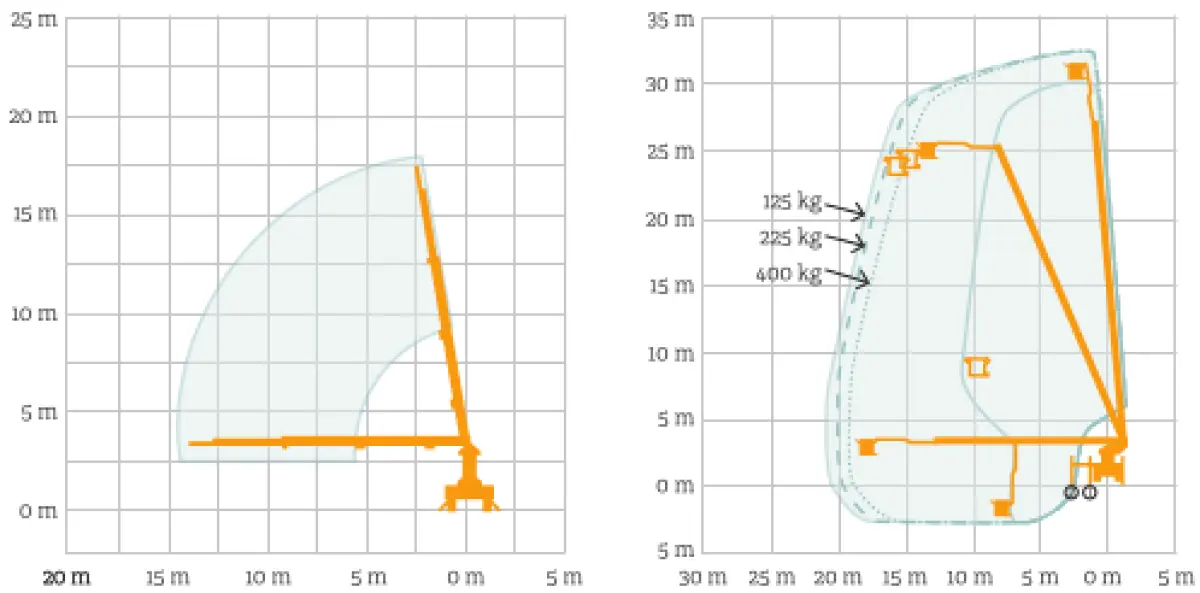
Fire and Emergency New Zealand (FENZ) firefighting appliances are described by type:
- Types 1–3 are the pumping appliances you typically see in smaller urban areas. They have ground-based ladders that can reach approximately 10 m high, enough for rescue in most 3-storey buildings. Groundbased water jets can be directed to reach to the top windows of an approximately 3-storey building as well.
- Type 4 are appliances with hydraulic longer ladders, generally to 17 m. These can reach most 4-storey buildings. There are 18 type 4 appliances nationally, including two reliefs, from Whangārei to Invercargill.
- Types 5 and 6 are aerial appliances with ladders having an effective reach of 22 m. These can reach most 5 to 6-storey buildings. There are nine type 5/6 appliances nationally, including two reliefs, located in Hamilton, Wellington, Christchurch, Dunedin and Auckland.
As BRANZ Senior Fire Research Engineer Kevin Frank points out, this means that many reasonably sized towns don’t have aerial appliances – they only have type 3 fire trucks that can reach a building height of approximately 10 m or a 3-storey building window.
Examples include Paraparaumu (around 30,000 people), Blenheim (28,000) or Masterton (around 22,000). The current trend towards densification may lead to taller buildings in these types of urban environments as seen overseas. Designers should consider the reduced firefighting capability when building in these areas.
While you might imagine that aerial appliances – and especially those with a basket at the end of the ladder – are primarily used to rescue people, this isn’t their most common use. In the first stages of responding to a fire in an occupied higher-rise building, firefighters rely on sprinkler systems, internal firefighting water systems – risers – and protected pathways to get people out. Aerials are mostly used in defensive operations to deliver water from height onto a fire and to prevent it spreading to neighbouring buildings. Frequently, buildings are mostly destroyed by fire at this stage.
Aerials play a more important role in multi-floor buildings that don’t have sprinklers (such as the Loafers Lodge building in Wellington, where people were rescued from a rooftop in a fire earlier this year) and less of a role in sprinklered buildings. Fire engineer Omar Abu-Hijleh says that the effectiveness of long ladders in firefighting can be overstated. ‘If it is a sizeable fire, the hose from an aerial is just one stream of water. In addition, it can be difficult to get the water jet on the seat of the fire due to the walls and roof. It takes a long time to put these large fires out.’
Practical limitations on aerial appliance usage
There are also practical limitations that architects, designers and urban planners need to be aware of. As Omar told Build, there are urban locations where it is extremely difficult to set up an aerial appliance to fight a fire. ‘You need to consider what is possible and practical in the area you are building. Designers need to understand the limitations on the fire service. Fire trucks aren’t transformers.’
It usually takes longer for a larger appliance to respond to a fire. Bigger appliances:
- can have a length of 10–12 m, with working space required around that – where stabilising support arms need to be deployed, this can take the maximum overall width to 6.5 m, again with additional working space required
- require wide turning circles, which are impossible in many central city streets
- can’t be set up or stabilised on sloping steep streets
- typically can’t just set up in the road immediately in front of a building because of the risk of the face of the building collapsing into the street, as a 7-storey inner-city Sydney building did in a fire in May this year
- are significantly heavier.
Building Code requirements for taller buildings
Another reason for paying attention to firefighting height capabilities is the fact that fire resistance, sprinkler and combustibility requirements in New Zealand for multi-storey densified housing are significantly more relaxed relative to comparable countries such as Australia, Canada, England and USA. BRANZ report ER69 Densified housing: analysis of fire resistance requirements has more details: www.branz.co.nz/pubs/research-reports/er69
As an example, Aotearoa New Zealand allows a sprinklered building up to 9 storeys to have a fire resistance rating (FRR) of only 30 minutes with combustible materials generally permitted, while in the UK, the same building would require a 90-minute FRR and the external wall cannot be combustible (Table E3 in ER69). All of these measures – the FRR, construction material type and so on – can contribute to reducing the impact of severe fires in buildings. The only back-up if these measures do not contain a fire is interior firefighting. Firefighting from within the building is not effective if the fire breaches the exterior of the building and spreads from floor to floor. If the exterior of the building cannot be reached by firefighters or hose streams in these instances, there is very little that can be done.
Water, water everywhere
Another increasing challenge for urban firefighting is water availability and water pressure, Paul Richards, Fire Engineering Team Leader at FENZ Christchurch, told Build, ‘We are very efficient at using water, but the amount carried by a fire truck is only enough for a few minutes’ firefighting.’ Water from hydrants is crucial for city firefighting.
In some cases, in recent years, firefighters have found there is insufficient water or water pressure for the number of hoses they wish to use, impacting on their ability to fight a fire. Housing intensification is likely to increase demands on water infrastructure – something that local authorities need to watch closely. London firefighters believe that water supply and water pressure issues limited their ability to fight the Grenfell Tower fire in the UK where 72 people died.
Architects and designers should be aware of the FENZ publication Designers’ guide to firefighting operations – Emergency vehicle access, which sets out recommendations to follow for firefighting vehicles. www.fireandemergency.nz/assets/Documents/Business-and-Landlords/Building-and-designing-for-fire-safety/F5-02-GD-FFO-emergency-vehicle-access.pdf