

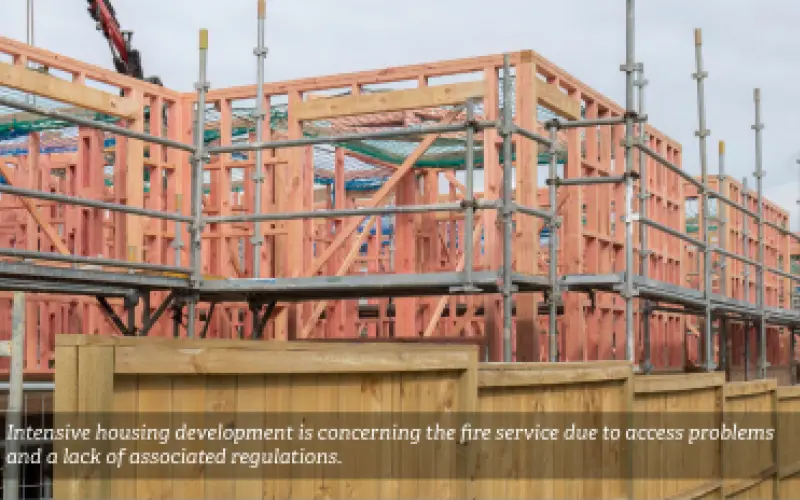


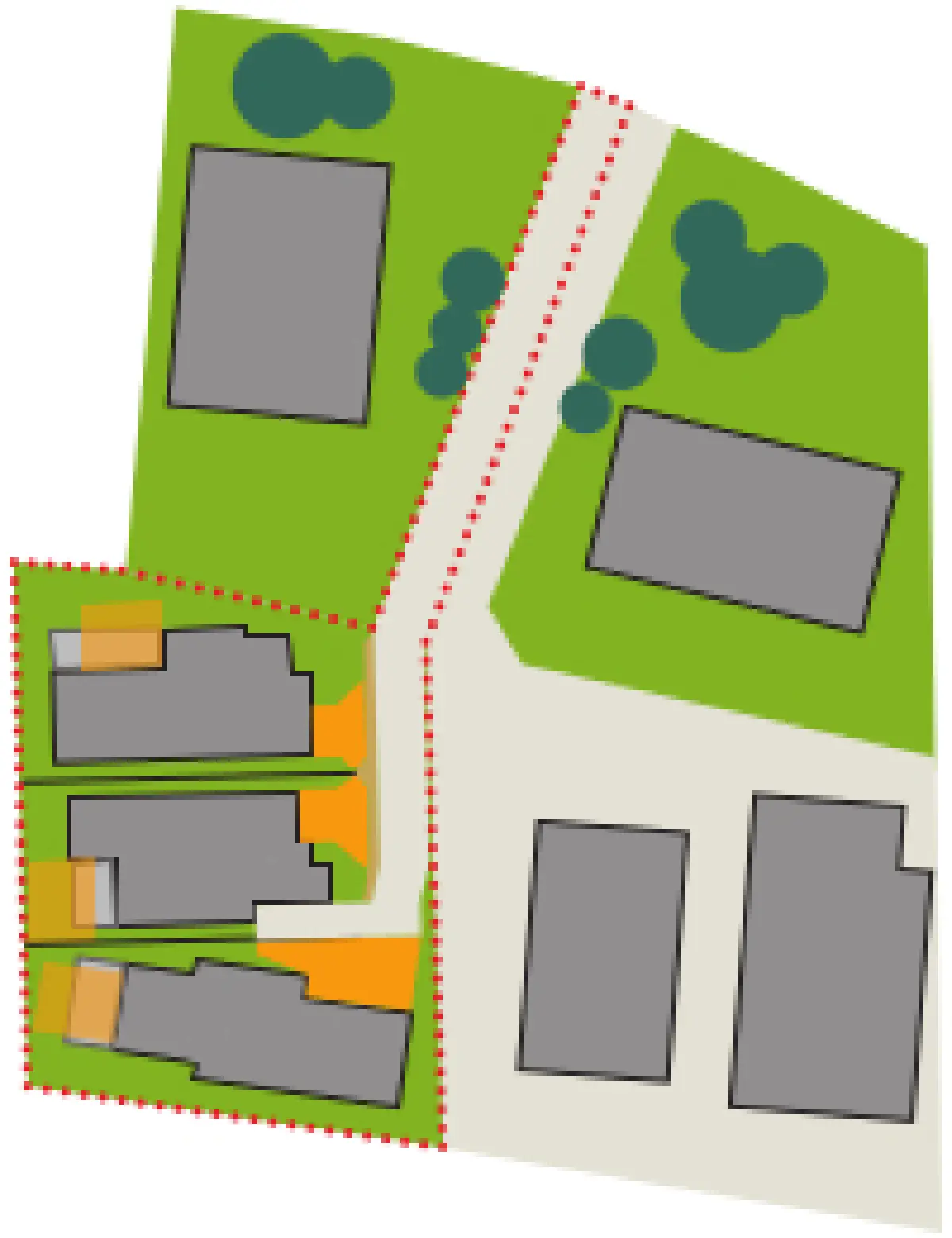
Fire broke out in the middle house of three homes that were being built on a back section. The 40 m driveway down to the section was 2.9 m wide, accessible for cars and a few other vehicles but not wide enough for a fire engine. Firefighters had to leave their vehicles on the street, rolling hoses and carrying equipment down the driveway to the fire.
Even if fire trucks had been able to get closer to the fire, there may not have been enough space for firefighters to work around the trucks as they need to, accessing hoses and pumps, tools and equipment from both the sides and backs of the vehicles.
The new homes were considered fully compliant with the fire clause in the Building Code. For example, each was a minimum 1 m from the boundary (and therefore a minimum 2 m apart), but this was not enough to prevent significant loss. In addition to the building where the fire started being completely destroyed, three others were substantially damaged.
Access problems can delay response to a fire
‘We a re seeing more and more developments where it is difficult or impossible to get a fire appliance in,’ Paul Richards, Fire Engineering Team Leader at Fire and Emergency New Zealand (FENZ) Christchurch, told Build. ‘There are some long, skinny sites where the driveway can be 100 m or longer. The typical hose on a truck is 25 m long, so multiple hoses will need to be connected together. Access problems can delay firefighters’ response to the fire, and there is a risk that an average fire truck may not have enough hose to reach a fire a long way from the road.’ Paul also points out that careful consideration of accessibility benefits all service providers, not just emergency services.
Another concern is the more homes there are and the closer together they are, the greater the risk of fire spreading to neighbouring buildings. Firefighters will need to use more water jets to protect nearby buildings, which stretches the capacity of equipment and personnel as well as the water supply.
Kevin Frank, BRANZ Senior Fire Research Engineer, says the fire requirements in the current Building Code were originally put together for housing areas largely made up of single homes on quarter acre sections beside the road, but that housing intensification is rapidly changing our urban areas. ‘An area that originally had 20 houses can have 140 townhouses today.’
The issues and risks around accessibility don’t just apply to occupied housing but also to construction sites for infill and higher-density housing – see the article Closer housing and construction site fire safety risk in Build 195.
Planning for access and protection
To reduce the risks to building occupants, firefighters and the buildings themselves, designers need to think about fire protection measures beyond those required in the Building Code – both what fire protection is required and how firefighters can access a building without delay. These are some considerations for housing up to 3 storeys:
- Make driveways a minimum 4 m wide and not less than 3.5 m at gateways and between buildings – this is a requirement in C/AS1 for some buildings.
- Allow space so that firefighters can access the sides and back of a fire appliance once they have reached the building. While most fire appliances have ladders sufficient for fighting fires in 3-storey buildings, there needs to be sufficient space to manoeuvre the ladder to where it is required – this is not an issue addressed in the Building Code.
- Bear in mind that it is usually safer for fire appliances to operate at the corner of buildings rather than immediately in front where the building façade can collapse.
- Consider separation distances to the boundary and other buildings that are greater than the Building Code minimums.
- If greater distances are not possible, specify additional fire-rated construction and less combustible material to external façades.
- Consider specifying a residential sprinkler system.
Building Code changes
From late 2024, interconnected smoke alarms became a requirement in new household units in Building Code Acceptable Solutions C/AS1 and C/AS2, citing NZS 4514:2021 Interconnected smoke alarms for houses. There were other changes around evacuation rules.
Several changes that mostly apply to densified housing up to 3 storeys that have not yet been put in place include proposals to:
- boost protections from internal and external fire spread
- raise fire resistance ratings when required for walls in unsprinklered buildings from 30 to 60 minutes
- include more types of multi-unit properties under the tighter rules.
While it remains to be seen if these changes will be codified, they may be worth considering as part of prudent design practice.
Accessing water from street hydrants
Fire appliances typically only carry enough water for approximately 3 minutes of firefighting work, so access to a street water hydrant is crucial. In-ground street hydrants are found in most urban areas either on the roadside or on the street itself.
Hydrant lids are yellow and hydrants typically have a 1 m yellow circular marking around them, but many people don’t recognise hydrants or hydrant markings and inadvertently park over them. It is illegal to park within 50 cm of a marked fire hydrant unless a licensed driver who can move the vehicle stays with it.
Kevin Frank, also a volunteer firefighter, describes a recent call-out where the hydrant closest to the fire was blocked by a car parked over it. Another hydrant 70 m away also had a car parked over it, but a driver was located to move the vehicle.
Housing intensification often brings reductions in off-street parking that are likely to result in more street hydrants getting blocked by vehicles parked on the road. In the design of urban areas and new developments, hydrants should be located where they are not likely to be blocked by parked cars.
Designers’ guide to firefighting operations (FENZ) helps ensure building designs comply with Building Code clause C5 Access and safety for firefighting operations and explains how FENZ is likely to undertake firefighting and rescue operations in buildings. Visit www.fireandemergency.nz/businesses-and-landlords/building-and-designing-for-fire-safety/designers-guide-to-firefighting-operations/