

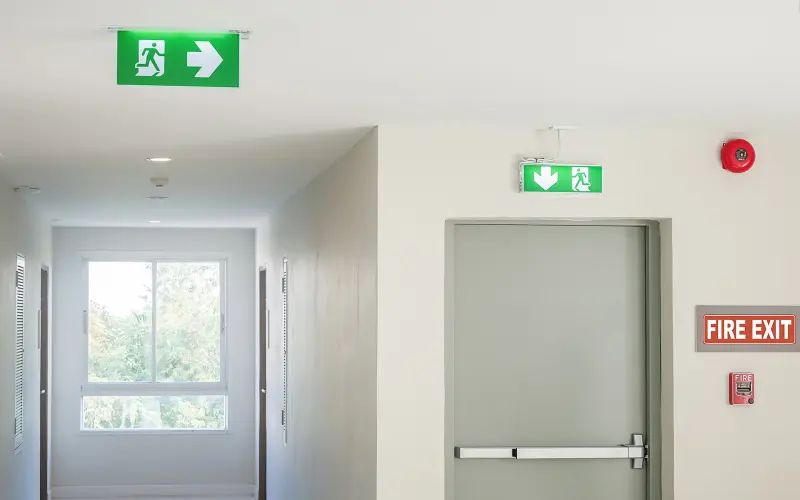


Fire-resistant doorsets, commonly called fire doors, are designed and tested to prevent the passage of fire in a building, to facilitate the safe egress of people in the event of a fire and provide a means for the circulation of people in and around the building during its day-to-day use.
A fire door comprises the door leaf (or leaves), the door frame, any surrounding over or side panels, glazed elements and essential hardware.
Requirements for fire doors
The standards to ensure fire doors (other than lift landing doorsets) comply with the New Zealand Building Code compliance document C/AS1 are:
- AS/NZS 1905.1:1997 Components for the protection of openings in fire-resistant walls – Fire-resistant doorsets – for construction and installation minimum requirements
- AS 1530.4:1997 Methods for fire tests on building materials, components and structures – Fire-resistance tests of elements of building construction (Section 7) – for testing the design and installation method for the required fire resistance rating doorset.
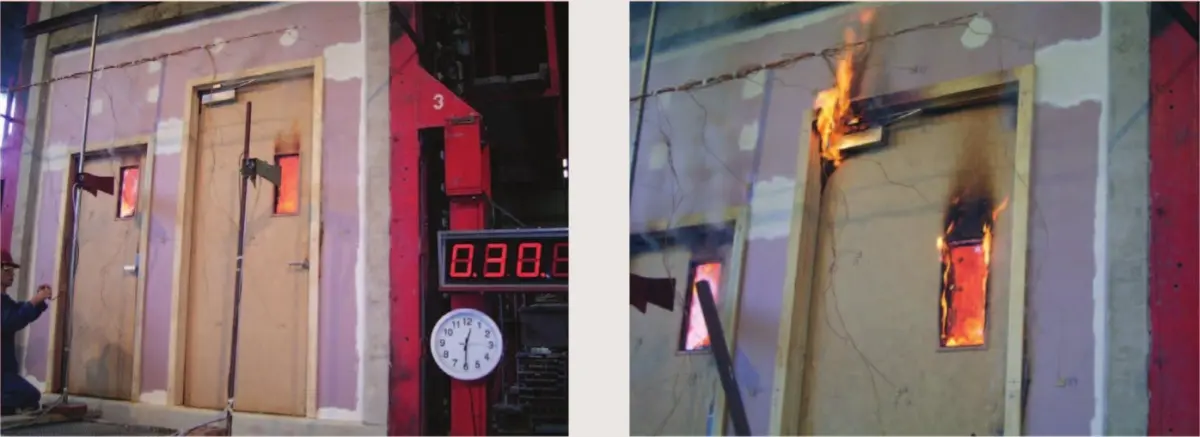
Doors put to the test
Testing a fire door involves installing the doorset as it would be in practice and exposing one side (the exposed side) to a furnace temperature rise (see Figure 1). Observations and measurements for integrity and insulation are made from the other side (the unexposed side). For asymmetrical doors, both sides are tested.
Testing time to failure
When a fire door is tested to AS 1530.4:1997, the time (in minutes) to failure of its integrity, insulation and radiation is recorded in the test report.
Integrity failure is the time taken for a fire door to lose its ability to prevent the passage of flames due to gaps, fissures, cracks, thermal distortion and the failure of ‘essential’ hardware such as latches.
Insulation failure of a fire door is based on the time for the average temperature rise of the leaf (or leaves) to exceed 140 kelvin and the maximum temperature rise of the surrounding element (the wall, side panels and/or overpanels) to exceed 180 kelvin. C/AS1 requires all fire doors to achieve a minimum insulation rating of 30 minutes.
Radiation failure of a fire door is the time for the radiant heat flux of the doorset to reach 10 kW/m2 at a distance of 365 mm from the unexposed face during testing (0.67 kW/m2 is equivalent to summer sunshine and 10.4 kW/m2 would cause pain after 3 seconds exposure). C/AS1 does not require the radiation failure for a doorset’s fire resistance rating – it is only used for fire engineering purposes.
After a successful test, the fire door is assigned a fire resistance rating (FRR). This is stated in minutes in the form stability/integrity/insulation – a doorset with a fire resistance rating of 60 minutes integrity and 30 minutes insulation will be denoted as FRR –/60/30. The ‘–’ shows that a specific criteria is not relevant.
Further evidence of the fire resistance rating and use of other components used in the fire door’s construction is detailed in the associated fire test report.
Fire door construction
The minimum fire resistance rating a fire door requires depends on the purpose of the building, the layout of compartments and/or escape routes, and any concessions or dispensations considered in the overall fire protection design scheme. C/AS1 provides guidance.
AS/NZS 1905.1:1997 details fire door requirements for fire door manufacturers, building designers and building end-users. While many variations in materials and configurations can be used to construct fire doors, AS/NZS 1905.1:1997 includes some components that must be included, excluded or be conditional in the design.
To be included are:
- a self-closing or automatic mechanism
- locksets (except for double-acting doorsets) that keep the doorset closed and latched during a fire
- sequencers (for double leaves/doorsets in pairs) that have rebated meeting stiles/edges in the door leaves.
To be excluded are:
- self-latching bolts such as barrel bolts that could make the doorset non-self latching.
Conditional components are:
- electric bolts, which should be self latching in the event of a power loss but should not render the doorset non-self latching
- hold-open devices, which are permitted provided they deactivate in the event of a fire alarm.
Other design components to be considered in the design of fire resistant side-hung and sliding doorsets in AS/NZS 1905.1:1997 Section 2 include:
- door seat rebate dimensions
- hinges and pivots (including opening/closing force settings)
- materials for essential latching components
- further door closer design and settings (pressures, cushion back-checking action and so on)
- sliding doorsets’ opening and closing requirements.
Installing a fire door
The installation of a fire door is just as important as the design and testing and must replicate the tested specimen, usually many times on a single project.
Follow the doorset manufacturer’s instructions, and see AS/NZS 1905.1:1997 Section 5 for guidance on basic installation considerations such as:
- door sills
- door frames
- installation gaps (that is, the permitted gaps between the leaf and frame or the frame and wall opening)
- additional doorset fixing information and interfacing the doorset with the compartment wall opening.
The final check of any fire door is to ensure that it complies with the supporting test evidence (or assessment report) and it can close unassisted into the latched position (or flush within the frame reveal for double-acting doorsets).
Identification of fire doors
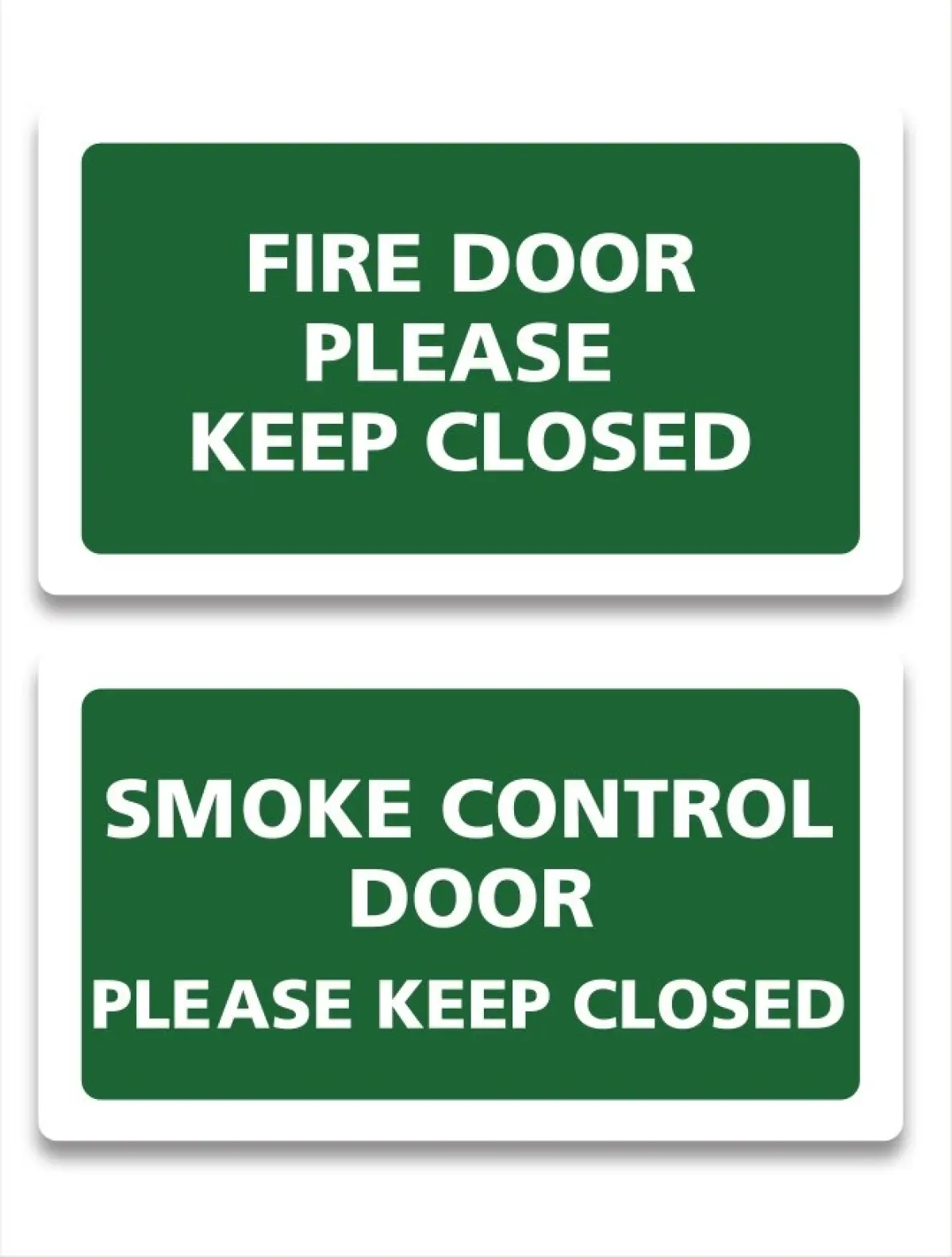
Compliance document F8/AS1 requires signs within a building for fire doors. The signs should be no less than 90 mm × 50 mm and the text no less than 8 mm high comprising white letters on a ‘safety green’ background. A sign should be fixed to both sides of the fire door and be the relevant version of the words shown in Figure 2. Where a hold-open device is used the signs must state ‘FIRE DOOR’ or ‘SMOKE CONTROL DOOR’.
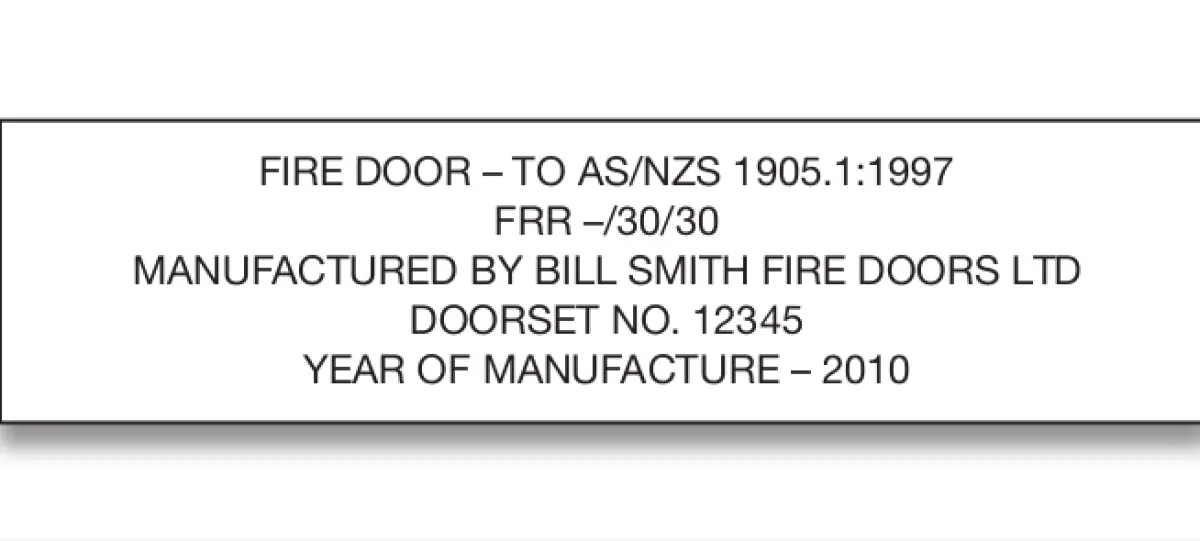
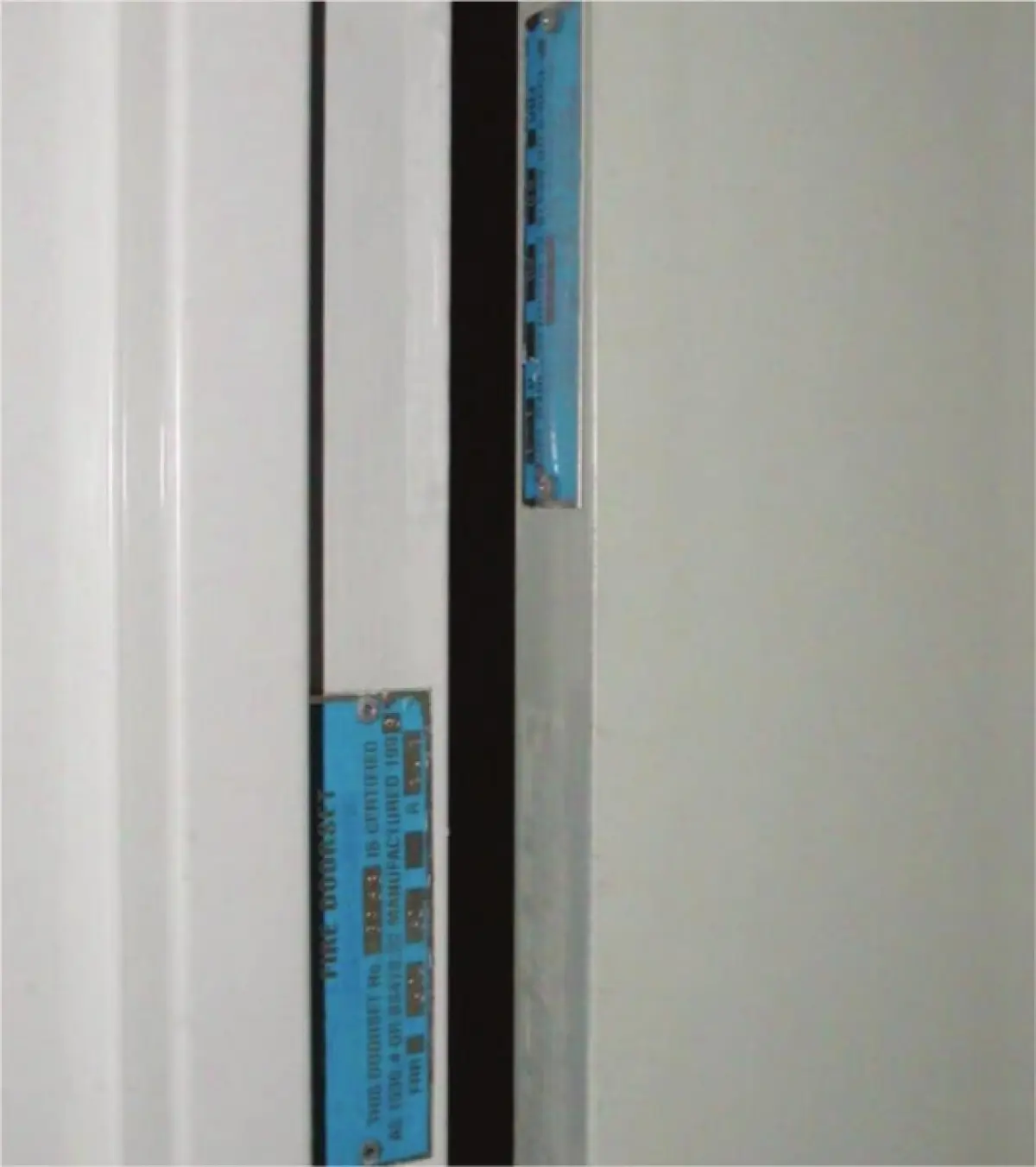
A building inspector or building owner needs to be able to readily identify all of the information associated with a fire door (usually by a non-transferable tag, see Figures 3 and 4). The fire door tag attached to the leaf and the doorframe is considered compliance with AS/NZS 1905.1:1997 and should include:
- the standard to which the doorset is tested or assessed
- the rating
- the manufacturer
- the manufacturer’s unique door identifier
- the year of manufacture of the doorset
- where the door is required to provide protection from one side only, an arrow showing which side of the door was facing the furnace during testing (the exposed side).
Deviations from tested specimen
It’s good practice for building designers, operators and door installers to review and understand the supplier’s supporting documentation for a fire door at the initial stages of the build. This will ensure that the fire door to be installed has been tested or assessed and is fit for purpose.
Where deviations from the tested specimen have occurred, an assessment report (based on at least one test) from an accredited laboratory is required to show compliance with AS/NZS 1905.1:1997.
The manufacturer needs to make any relevant information within the test report and/or the assessment report available to the building’s owner or representative.
Inspection of fire doors
All buildings (except dwellings without cable cars attached to them) are required to possess a:
- compliance schedule
- compliance schedule statement
- building warrant of fitness (BWoF).
The compliance schedule statement is required to be displayed publicly, and the BWoF is required to be displayed in an area where the building users can view it.
In addition to the other building systems required to be surveyed by an independently qualified person, section SS 15/3 of the Compliance Schedule Handbook provides guidance for the daily, bi-annual and annual inspections required for fire doors. Fire doors must be included in the compliance schedule if they are part of a means of escape, which they usually are.