




When undertaking renovations or larger alterations or even sometimes just repairs to an older existing dwelling, there are usually walls or parts of walls (both internal partition walls and external perimeter walls) that will have to either be shortened or removed entirely.
Access the bracing design plan at local councils
Those designing new houses have the confidence of knowing the wall bracing ratings of the various wall construction systems they choose to utilise. These are usually provided by the manufacturers of the proprietary construction systems selected and usually based on results of the P21 test method – initially developed by Mike Collins from what is now Scion along with Russell Cooney here at BRANZ.
Architects and designers working on existing buildings often do not have this luxury. The exception is most homes that have been built or extensively altered in the past 40 years or so, which will usually have a comprehensive bracing design plan.
This can be found by accessing the building plans submitted for building consent at the time of construction, which are generally easily available via the building file at the local council or sometimes in its archives.
What if there is no plan?
However, for houses built before the introduction of NZS 3604:1978 Code of practice for light timber frame buildings not requiring specific design, there will generally be no documentary record of the wall bracing incorporated into the design. Indeed, before 1978, the bracing was often left up to the builder to incorporate on site to the best of their judgement.
Estimating the bracing system incorporated into the various walls in these houses after the event relied on a trained eye and an educated guess.
To first confirm the estimate of the wall framing construction and the wall linings – including substrates such as lath or timber sarking – would depend on an invasive test or waiting until demolition of the wall when the work begins.
Note that, during alteration work to older buildings such as traditional villas and bungalows, some insurers will stipulate that wall system elements such as scrim or sarking may be considered a fire risk and must be removed so partial deconstruction may be required anyway.
Yet although you could eventually establish the construction system used in each wall, there was still no accurate method of estimating the bracing value of the wall – usually expressed as bracing units per lineal metre of wall length (BUs/m).
To help rectify this gap in our construction knowledge, in 2013, BRANZ commissioned a study report to determine the bracing ratings of non-proprietary bracing walls.
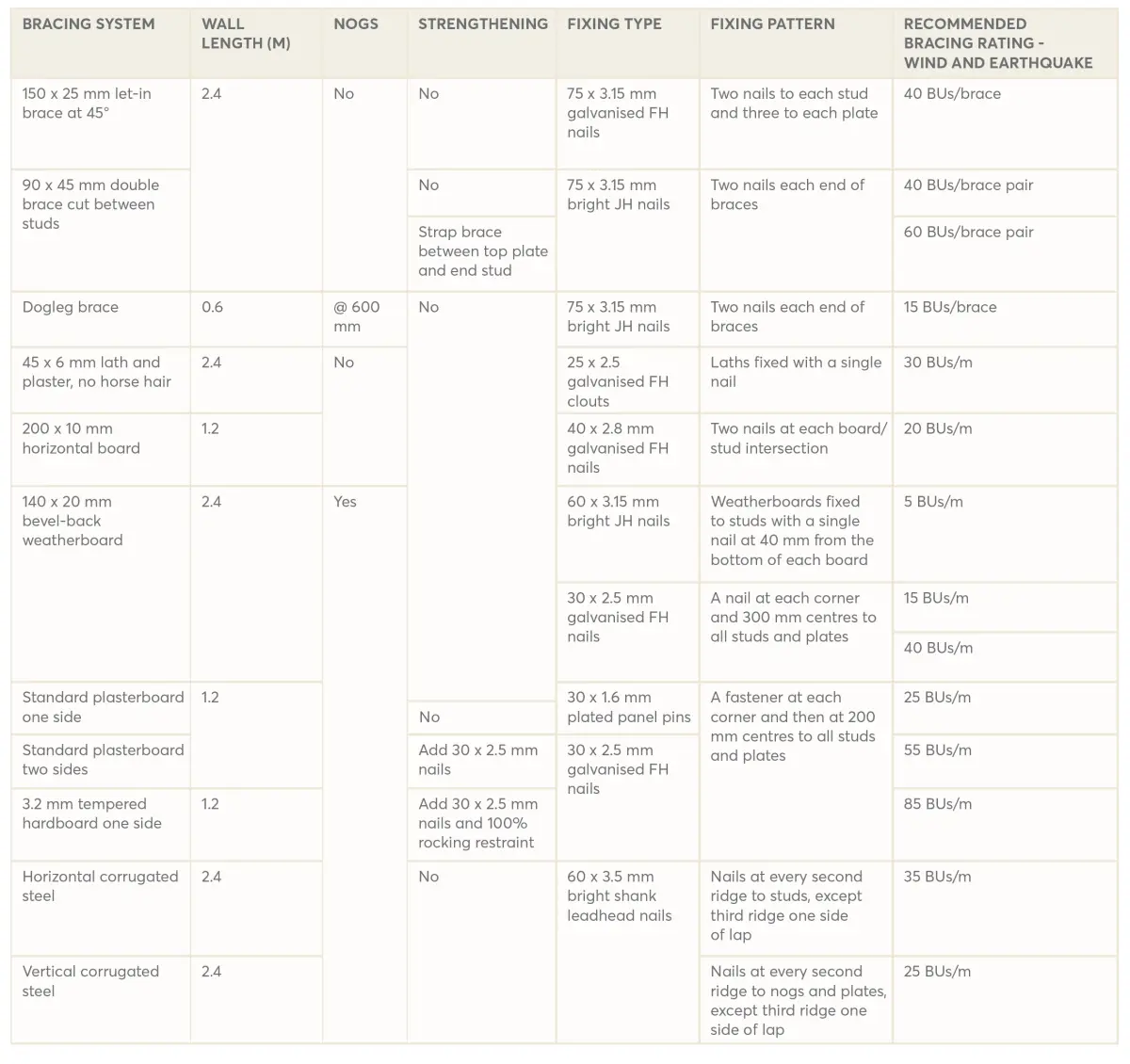
SR305 Bracing ratings for non-proprietary bracing walls was intended for engineers, architects and others wanting to determine the bracing ratings of existing walls in older construction as well as use the bracing ratings of non-proprietary bracing walls in new construction.
The study was undertaken in the BRANZ structures laboratory and at least a dozen different traditional style and modern non-proprietary sample wall panels were built and tested. They were tested using the BRANZ P21 test method, generally until the test panel failed. See summary results for various wall systems in Table 1.
The report filled an enormous gap in the design of alterations to heritage and period character homes in Aotearoa New Zealand, and there is a well-thumbed hardcopy in the bookshelf of my own architectural practice. Every time we have referenced it during building consent applications over the years, it has been accepted by BCAs across the country without question. Clearly, it has become accepted by councils as an industry standard.
Sometimes a structural engineer is needed
Note, however, that there are some circumstances where it may not provide the total answer to achieving bracing compliance – especially when working on early 20th century or even older dwellings.
I have struck old heritage homes that have been built with no bottom plates to the perimeter walls. In this situation, the only solution is to get an experienced structural engineer on site who can design a suitable bespoke remedial solution – the key to wall bracing is the connection between top and bottom plates, so in this situation, the answer is specific engineering design (SED).
There are also many older 2-storey homes built with balloon framing – continuous individual studs from the bottom of the lower storey to the top of the upper storey. There is no top or bottom plate per se at the inter-storey level, so again the solution will be SED.
Similarly, we have been commissioned to undertake renovations to Heritage New Zealand Category 1 dwellings with extra-high stud heights and ornate cornices and decorative ceilings – pressed metal, plaster and even papier-mâché.
Again, when unable to access the top plate, SED becomes the only course of action. A point of interest here though – with one of those SED solutions, the engineer went on to cite the BRANZ study report on bracing requirements for non-proprietary bracing walls in the bracing design of the rest of the bracing to the amended wall structure.